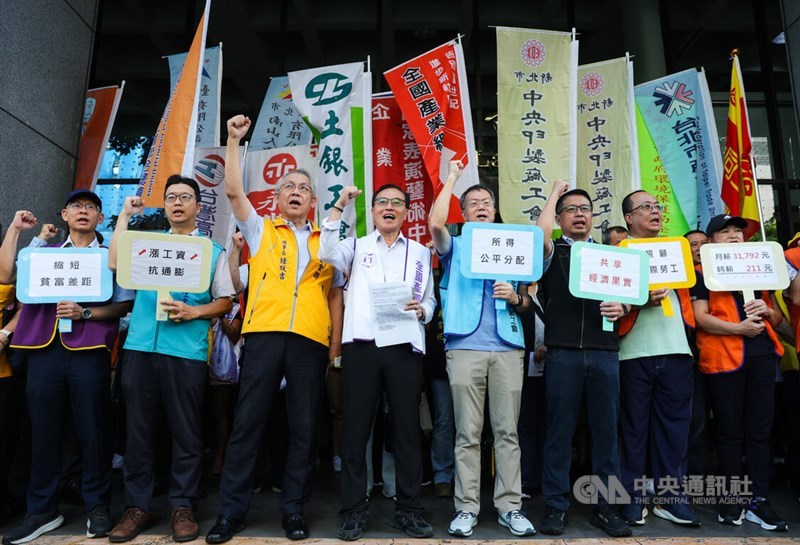
Taipei, Sept. 25 (CNA) Labor representatives expressed disappointment while major business groups called for relief measures after a Ministry of Labor (MOL) committee on Thursday approved a 4.745 percent minimum wage hike for next year.
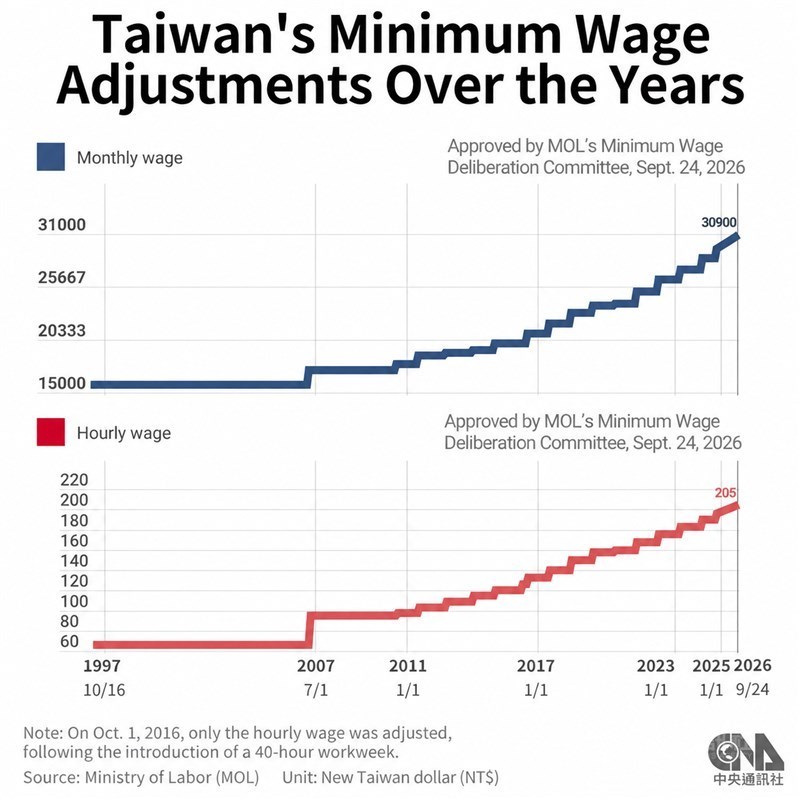
At its annual meeting, the Minimum Wage Deliberation Committee agreed to raise the monthly minimum wage from NT$29,500 (US$928.35) to NT$30,900 and the hourly rate from NT$196 to NT$205, effective Jan. 1, 2027, pending Cabinet approval.
■ Taiwan minimum wage hike to benefit 2.61 million workers: Labor Ministry
The adjustment, which includes a NT$1,400 hike that will take the monthly minimum wage above NT$30,000 for the first time, is expected to benefit around 2.61 million workers, including 414,400 migrant workers.
Tai Kuo-jung (戴國榮), one of the labor representatives on the committee, said after the meeting that they had pushed for a 7.77 percent increase so workers could share more fully in the benefits of economic growth, projected at 11.05 percent this year.
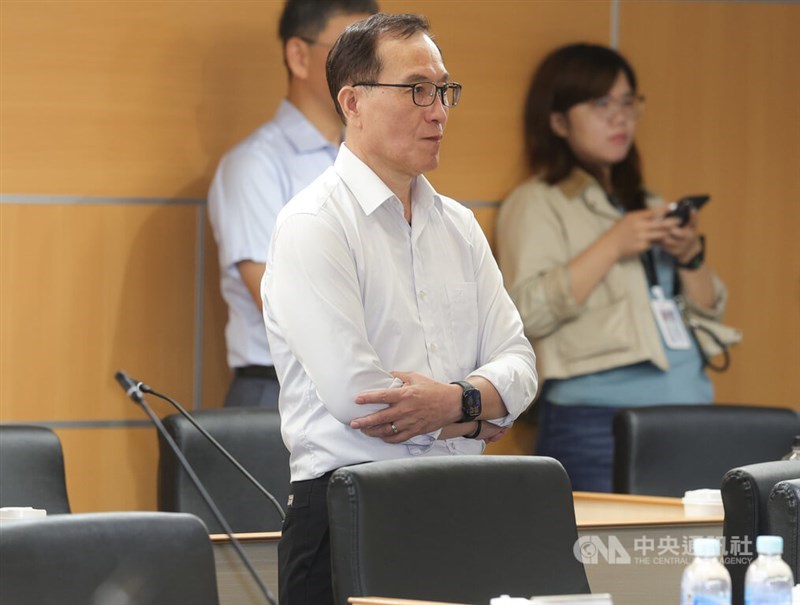
Employer representatives initially sought an increase of no more than 3 percent, arguing that industries had contributed to Taiwan's economic growth to varying degrees, according to Tai.
He also said employer representatives had argued that the final NT$1,400 increase demonstrated their willingness to compromise, as monthly minimum wage increases in recent years had not exceeded NT$1,250.
However, labor representatives rejected that argument, Tai said. "If we are going to look at the previous high of NT$1,250 for monthly wage increases, why can't we also look at this year's economic growth rate?" he asked.
Tai said the final result fell short of labor representatives' expectations, while another labor representative, Cheng Li-chia (鄭力嘉), described it as "unsatisfactory but acceptable."
Business groups call for support measures
Business groups, meanwhile, said the increase would put additional pressure on firms that had not benefited equally from recent economic growth.
Hsu Shu-po (許舒博), chairman of the General Chamber of Commerce of the Republic of China, said labor-intensive and traditional industries rely heavily on migrant workers, meaning a higher minimum wage would directly increase their labor costs.
For small, medium-sized and micro businesses with limited ability to pass higher costs on to customers, the impact would extend beyond wages, Hsu said, as the increase could also raise employers' statutory contributions to labor insurance, labor pensions and national health insurance, which are tied to workers' pay.
Hsu urged the government to consider shouldering a larger share of insurance costs, noting that employers currently pay 70 percent of labor insurance premiums for employees, compared with 20 percent paid by workers and just 10 percent by the government.
He also called for eligibility requirements to be relaxed and application procedures simplified for government support measures aimed at helping businesses cope with the minimum wage increase.
The Chinese National Association of Industry and Commerce, Taiwan, meanwhile, urged the government to provide financing and other substantive support to help small and medium-sized enterprises upgrade and transform their operations as the minimum wage is raised.
It said such support could help businesses boost productivity and increase the added value of their products.
- Society
Champi expected to become typhoon within 24 hours; path remains uncertain
10/16/2026 07:40 PM - Politics
10 local election candidates fail eligibility review: CEC
10/16/2026 07:27 PM - Politics
Taiwan lawmakers pass health insurance premium subsidies for seniors
10/16/2026 07:24 PM - Politics
Taiwan should not rule out nuclear power as energy option: Lai
10/16/2026 06:59 PM - Sports
Taichung city government signs deal for 'Taiwan Dome'
10/16/2026 05:38 PM