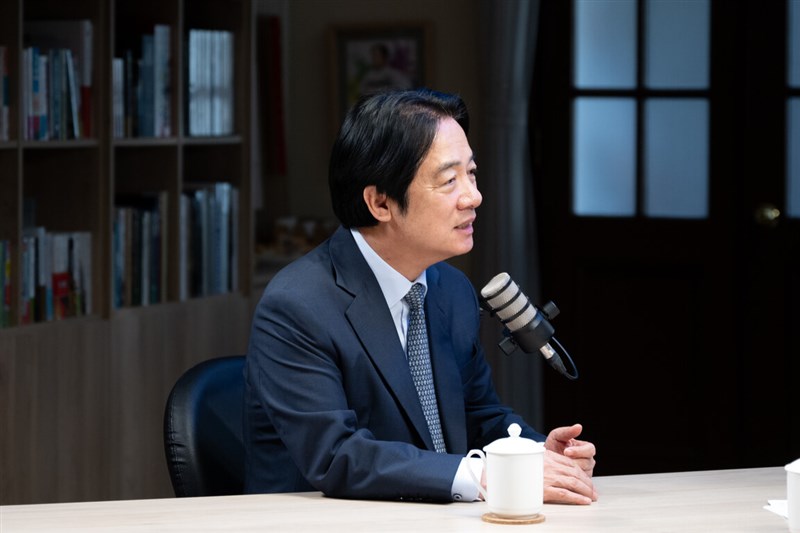
Taipei, Oct. 16 (CNA) Taiwan should not rule out any energy source or abandon environmental sustainability in favor of ideology and short-term benefits, President Lai Ching-te (賴清德) said in a recent interview, calling for a "professional assessment" of whether nuclear power should be reintroduced into Taiwan's energy mix.
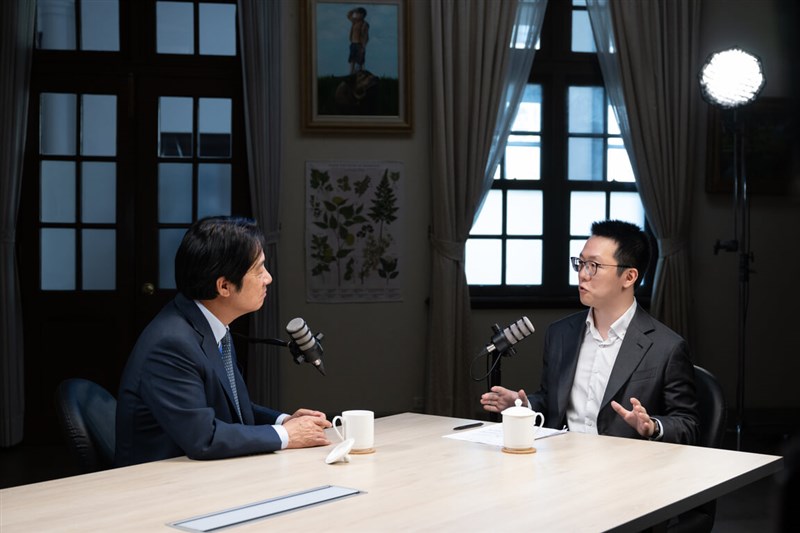
In an online interview with influencer Yu Ting-hao (游庭皓) that aired Friday, Lai was asked whether he would describe his approach to restarting nuclear power as proactive or passive.
Lai said that is up to the public to decide, but reiterated his position that Taiwan should not rule out any energy source because of ideology or sacrifice environmental sustainability for short-term benefits.
Lai's remarks marked a shift from the Democratic Progressive Party's (DPP's) longstanding opposition to nuclear power.
After taking power in 2016, the DPP pursued its non-nuclear homeland policy and continued to do so following a 2018 referendum in which voters rejected the policy by a margin of 59 percent to 41 percent.
As premier from September 2017 to January 2019, Lai pushed for more gas-fired power capacity while sticking to the DPP's non-nuclear homeland ideology and rejected the idea of extending the service life of its active nuclear power plants.
Taiwan eventually phased out nuclear energy in May 2025, when the second reactor at the Ma-anshan Nuclear Power Plant in southern Taiwan was decommissioned, fulfilling the non-nuclear homeland pledge.
That occurred as Taiwan continued to rely on fossil fuels for over 80 percent of its electricity mix, and questions remained over the electricity supply given the country's AI development.
In the interview with Yu, Lai said the Legislative Yuan, currently controlled by opposition parties, has passed legislation providing a legal basis for reintroducing nuclear power, and state-run Taiwan Power Co. (Taipower) has been making preparations accordingly.
The government will begin work to resume nuclear power generation if nuclear safety and nuclear waste disposal issues can be resolved through a professional assessment in a way that wins public support, Lai said.
AI issues
Meanwhile, asked how the government would balance efforts to develop the artificial intelligence (AI) industry against the regulation of AI applications, Lai said it would promote the industry's development responsibly.
He cited the Artificial Intelligence Basic Act, which took effect in January, saying it requires the government to uphold human autonomy, privacy, information security, fairness and non-discrimination, transparency, and accountability while developing the AI industry.
To prevent AI from exacerbating the uneven distribution of wealth and resources between the high-tech and non-tech sectors, Lai said the government would provide NT$100 billion (US$3 billion) over eight years to help micro, small and medium-sized enterprises (MSMEs) transform their businesses.
It would also encourage large companies to support smaller ones and integrate smaller businesses and traditional industries into technology supply chains.
For example, Taiwan Semiconductor Manufacturing Co. (TSMC) and ASE Technology Holding Co. have established a semiconductor packaging and testing supply chain in Kaohsiung, he said.
That, however, maintains the emphasis on the tech sector, which has gained a much stronger hold on Taiwan's economy in recent years with its massive exports of AI servers and other products supporting the United States' buildup of data centers and AI computing power.
In 2022, for example, electronic product components (mostly semiconductors) and "information, communication and audio-video products" accounted for US$265 billion in exports, or 55.2 percent of the US$479 billion in total exports, according to Ministry of Finance data.
By 2025, the two tech categories totaled US$474 billion in exports, or 74 percent of the US$641 billion in total exports, reflecting the growing dominance of tech in Taiwan's economy.
Lai noted that Taiwan has a goal of becoming one of the world's five most AI-literate countries by helping at least 1 million MSMEs adopt AI and developing a talent pool of at least 500,000 AI professionals by 2040.
Section 301 investigation
Turning to trade, Lai said Taiwan would closely monitor the outcome of the U.S. investigation under Section 301 of the Trade Act of 1974 and strive to retain the terms previously agreed upon in trade negotiations, including a 15 percent reciprocal tariff that does not stack with most-favored-nation (MFN) rates.
Taiwan has also secured preferential treatment under Section 232 of the Trade Expansion Act of 1962, while the U.S. investigation into forced labor has resulted in a 10 percent tariff rate that does not stack with MFN rates, Lai said.
The outcome of a separate U.S. investigation into structural excess capacity remains pending, he said.
Lai said Taiwan-U.S. trade negotiations were based on mutual benefits, adding that U.S. reciprocal tariffs posed challenges but also presented an opportunity to deepen industrial ties between the two sides.
Taiwan's exports are expected to reach US$900 billion this year, with the United States as its largest export market, and Taiwan's trade surplus with the U.S. is likely to exceed last year's level, he said.
- Politics
10 local election candidates fail eligibility review: CEC
10/16/2026 07:27 PM - Politics
Taiwan lawmakers pass health insurance premium subsidies for seniors
10/16/2026 07:24 PM - Politics
Taiwan should not rule out nuclear power as energy option: Lai
10/16/2026 06:59 PM - Sports
Taichung city government signs deal for 'Taiwan Dome'
10/16/2026 05:38 PM - Science & Tech
Discoverers name asteroid after Kinmen
10/16/2026 04:56 PM