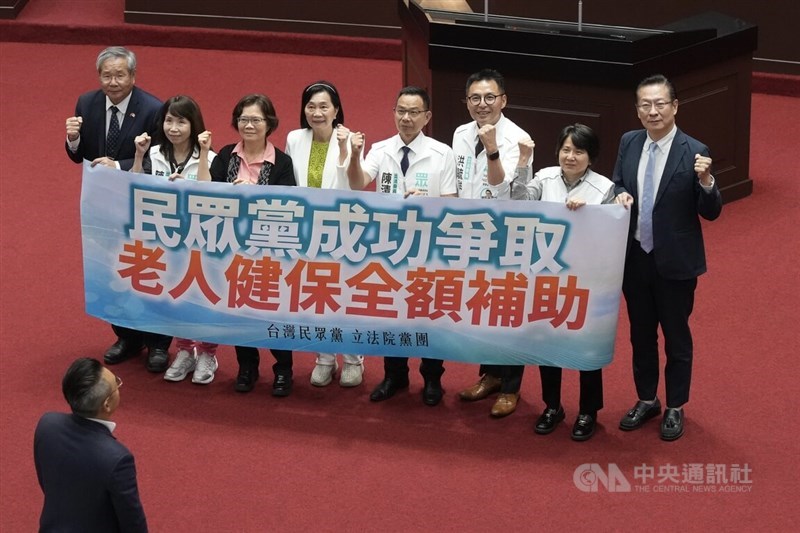
Taipei, Oct. 16 (CNA) With only six weeks remaining until local elections, opposition lawmakers on Friday passed a legal amendment requiring the central government to fully subsidize National Health Insurance (NHI) premiums for certain seniors.
The amendment to Article 22 of the Senior Citizens Welfare Act, proposed by lawmakers from the opposition Kuomintang (KMT) and Taiwan People's Party (TPP), passed by a vote of 60 to 39, with lawmakers from the opposition parties joining forces to approve a revised motion
Under the amendment, the central government must cover the full NHI premiums of seniors whose total consolidated income in the most recent year, as assessed by tax authorities, falls below the tax filing threshold or is subject to an income tax rate below 20 percent.
According to the Ministry of Finance's progressive income tax brackets for this year, net consolidated income of NT$1.38 million or less is taxed at a rate below 20 percent. This means seniors aged 65 and older with annual net income within that threshold will qualify for the subsidy.
The TPP caucus said the policy fulfilled a campaign pledge made by its founding chairman Ko Wen-je (柯文哲) during his 2024 presidential campaign to provide comprehensive NHI premium subsidies for people aged 65 and older.
The party added that Ko introduced subsidies for seniors' NHI premiums when he was Taipei mayor, covering residents aged 65 and older as well as Indigenous residents aged 55 and older. Several other local governments later adopted similar policies, but some financially strained cities and counties with large elderly populations were unable to afford them.
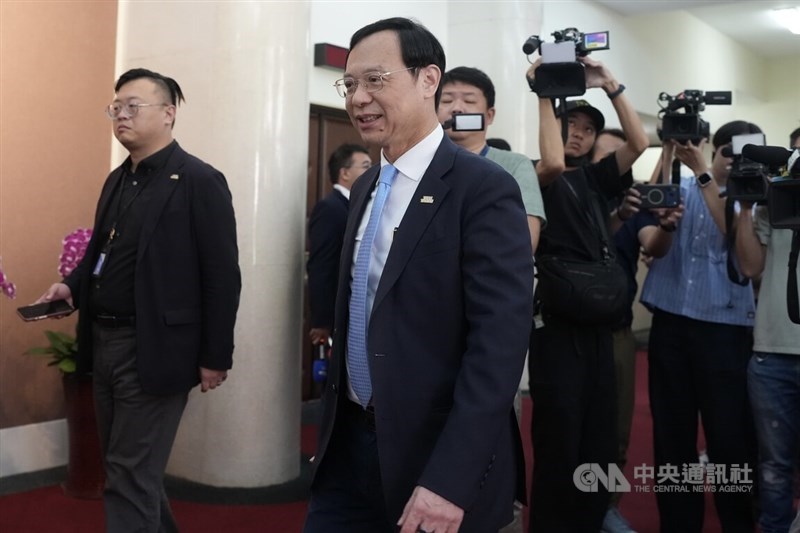
However, Health Minister Shih Chung-liang (石崇良) expressed concern about the amendment, saying it departed from the NHI system's principle of contributions based on ability to pay and could undermine its long-term sustainability.
"An election is temporary, but the NHI system is something people rely on and needs to be stable and sustainable," Shih told reporters before attending a book launch at Mackay Memorial Hospital on Friday afternoon.
Shih warned that breaking the principle of contributions based on ability to pay could lead to further measures that disrupt the system's operation.
He said the change could create intergenerational unfairness and prompt increases in premiums, limit growth in the overall NHI budget and exacerbate the difficulties faced by medical institutions, or require the government to allocate more tax revenue to health insurance at the expense of other welfare programs.
Taiwan has become a super-aged society, with people aged 65 and older accounting for one-fifth of the population. Shih said this group already accounts for more than 42 percent of NHI spending, while annual funding for long-term care has risen from less than NT$5 billion in 2015 to more than NT$110 billion this year.
The TPP caucus estimated that the amendment would add nearly NT$39 billion in annual government spending, based on a monthly subsidy of NT$826 per senior.
Meanwhile, Shih cautioned that the financial burden would grow as Taiwan's population ages, saying the eventual fiscal impact could exceed initial estimates and threaten the sustainability of the health insurance system.
By Tseng Yi-ning, Shen Pei-yao, Hsu Wei-ting and Sean Lin)
Enditem/AW
- Society
Champi expected to become typhoon within 24 hours; path remains uncertain
10/16/2026 07:40 PM - Politics
10 local election candidates fail eligibility review: CEC
10/16/2026 07:27 PM - Politics
Taiwan lawmakers pass health insurance premium subsidies for seniors
10/16/2026 07:24 PM - Politics
Taiwan should not rule out nuclear power as energy option: Lai
10/16/2026 06:59 PM - Sports
Taichung city government signs deal for 'Taiwan Dome'
10/16/2026 05:38 PM