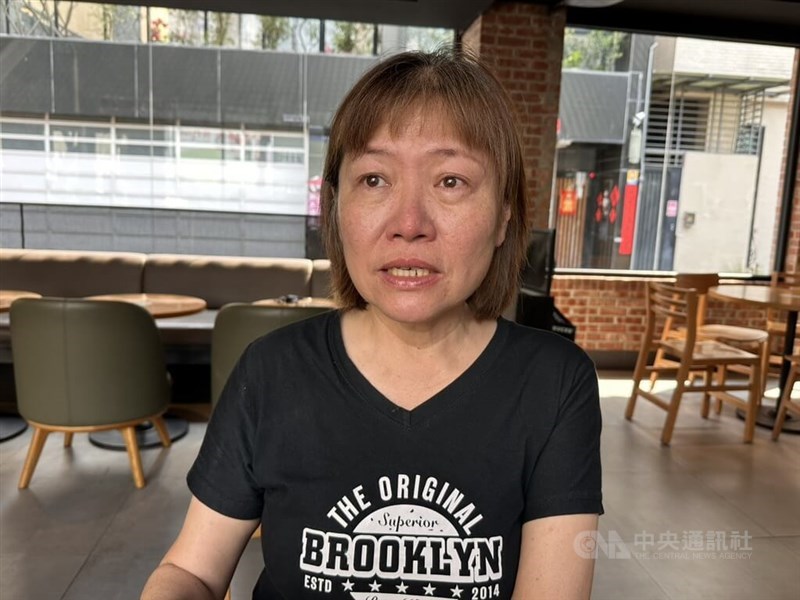
Taipei, June 9 (CNA) "I wasn't good at speaking or teaching in this life, but I get to be a teacher in my afterlife," Wei Tsung-ming (魏從明) said before his death, his wife told CNA in an interview.
After his passing in 2025 at the age of 60, Wei became a body donor (or "silent mentor") at the College of Medicine of Kaohsiung Medical University (KMU), where he received the opportunity to teach students this silent lesson about life.
As she related these events to CNA recently, Hsu Yu-chen (徐玉珍) was visibly emotional and her eyes welled with tears from time to time.
Hsu said Wei was diagnosed with retroperitoneal liposarcoma in 2009 and underwent multiple surgeries as the cancer repeatedly returned.
He initially registered as an organ donor, but after learning about the "silent mentor" program from hospice nurses, he decided to donate his body during the final stage of his illness.
No organ donation
The disease progressed to the point that doctors determined his organs were no longer suitable for organ donation, not even his corneas, Hsu said.
She recalled quietly telling Wei the news. "I asked him, 'Or maybe we just stop the body donation, then?'" Wei responded by repeatedly shaking his head.
According to Hsu, her husband completed all the paperwork required for body donation before his death. "I am simply carrying out his wishes," she said.
"He remained determined until the very end," she added.
Hsu said her husband believed the body is merely a shell and that it should be put to good use after death.
In Taiwan, there has long been a belief that the body should remain intact after death. Despite this cultural norm, a small number of people each year choose to become "silent mentors" for medical students, donating their bodies for anatomical study and surgical training.
Li I-chen (李怡琛), associate dean of the Department of Medicine at KMU, said body donors are typically more accepting of life and death.
One donor once said that the body is of little use after death and that its greatest value lies in helping medical students continue their education and benefit society, he recalled.
"I would rather have students make a mistaken incision on my body than make one on a real patient," he quoted the donor as saying.
Li said that after a body is donated, it undergoes embalming and other preservation procedures before becoming a "silent mentor" for medical students.
Family members typically wait two to three years before they can proceed with funeral arrangements, and the lengthy wait can be emotionally taxing, he said. However, donors are treated with the utmost respect throughout their service as "silent mentors."
Respecting the dead
Chen Yung-chia (陳永佳), a professor of anatomy at KMU, said that before beginning dissections, students visit the families of donors to learn about the lives of their "silent mentors."
At the start of each class, students bow to their silent mentors as a tribute to the donors and an expression of gratitude. Students bow again at the end of the course, Chen added.
After the training ends, the university holds a remembrance ceremony in accordance with the donor's religious beliefs. The remains are then cremated and either given a tree burial or returned to the family, according to Li.
A KMU medical student surnamed Su (蘇) said that silent mentors teach students not only about the structure of the human body, but also prompt them to reflect on a more fundamental question: What is a human being?
- Society
Taiwan headline news
10/03/2026 10:22 AM - Sports
'Hao-yu like that?' A deep dive into Lee's rookie MLB season
10/03/2026 10:00 AM - Sports
Taiwan boosts medal haul in multiple events at Asian Games on Friday
10/02/2026 08:55 PM - Society
Workers at Taiwan snack maker Kuai Kuai extend strike over relocation
10/02/2026 08:45 PM - Business
Chain businesses association seeks more foreign workers
10/02/2026 08:04 PM