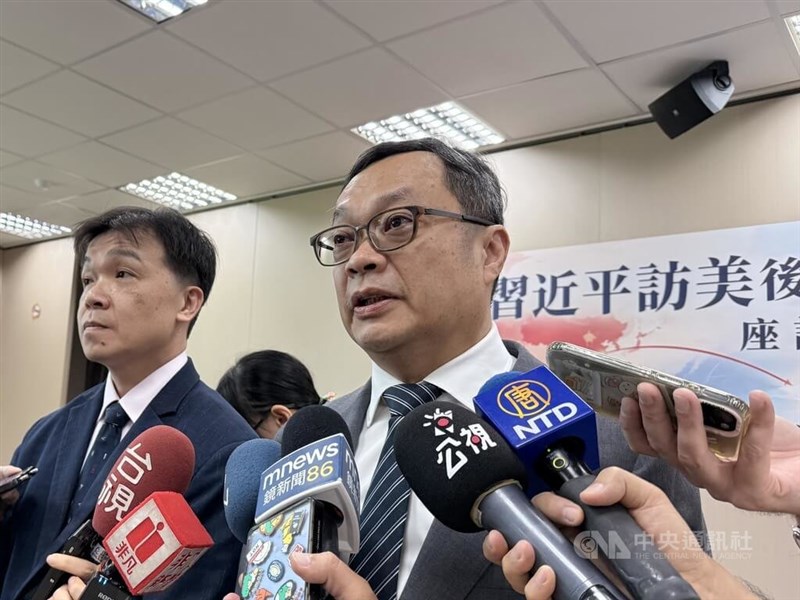
Taipei, Sept. 27 (CNA) Taiwan's deputy foreign minister said Sunday that the Trump-Xi summit resulted in no change to U.S. policy toward Taiwan, despite Beijing's efforts to push Washington toward explicitly opposing "Taiwan independence."
U.S. President Donald Trump said Saturday (Washington time) that he and Chinese President Xi Jinping (習近平) "didn't spend a lot of time talking about Taiwan," adding that the Chinese leader "understands very much how I feel."
Trump's remarks came after his meeting with Xi at the White House on Thursday during the Chinese leader's Sept. 23-25 state visit to Washington, D.C., their second face-to-face meeting this year.
Speaking to reporters ahead of a seminar in Taipei on Sunday, Deputy Foreign Minister Chen Ming-chi (陳明祺) said Trump's comments should be understood "in context."
He pointed to repeated statements by U.S. officials that Washington's policy toward Taiwan had not changed.
Chen cited U.S. Ambassador to China David Perdue, who told CNBC on Friday that there had been "no change" in U.S. policy toward Taiwan following the talks.
"We have also received repeated confirmation from our American friends through various channels that U.S. policy toward Taiwan remains unchanged," Chen said, without identifying who had conveyed those assurances.
While Chen acknowledged that Trump himself had spoken "rather vaguely," he said Taipei would continue using its "very smooth" communication channels with Washington to learn more about what was discussed at the summit.
He also said Beijing had sought to push Washington toward explicitly opposing "Taiwan independence," rather than maintain the longstanding U.S. position of not supporting it.
Chen said that position did not appear in the U.S. account of the summit or in Trump's comments.
"That did not directly receive U.S. endorsement, and President Trump did not use such wording at all this time," Chen said.
Chen also addressed a pending US$14 billion arms package for Taiwan.
He said that in the broader security context, Washington "very much understands" Taiwan's defense needs and Taipei's commitment to increasing defense investment amid continued Chinese military pressure.
Asked when the Trump administration might approve the package, Chen cited comments made by U.S. Secretary of State Marco Rubio before the summit.
Rubio said arms sales had to be weighed against several considerations, including U.S. military needs and industrial capacity.
"That is a matter of U.S. policy, so we will not comment further," Chen said, adding that Taipei had continued communicating with Washington on its defense needs.
In a separate statement Sunday, Taiwan's Ministry of Foreign Affairs said the summit had focused mainly on economic and trade issues between the United States and China.
It said this was "consistent with information we had obtained beforehand and with broader expectations."
The ministry added that there was "in fact, no need for Taiwan to be discussed in U.S.-China talks."
It noted that senior U.S. officials, including Rubio, had repeatedly said Washington's Taiwan policy remained unchanged, with the Taiwan Relations Act and Six Assurances continuing to serve as important foundations of that policy.
- Society
NIA seeks new logo for fund supporting new immigrants
10/19/2026 09:32 PM - Politics
Business groups back Taipower, CPC subsidies; scholars dissent
10/19/2026 09:31 PM - Society
Typhoon Champi to turn away from Taiwan, will still bring heavy rain
10/19/2026 07:53 PM - Society
Taiwan, Philippines sign animal husbandry research pact
10/19/2026 07:26 PM - Society
Workers rally in Taipei for pension reform, profit-sharing rules
10/19/2026 07:00 PM