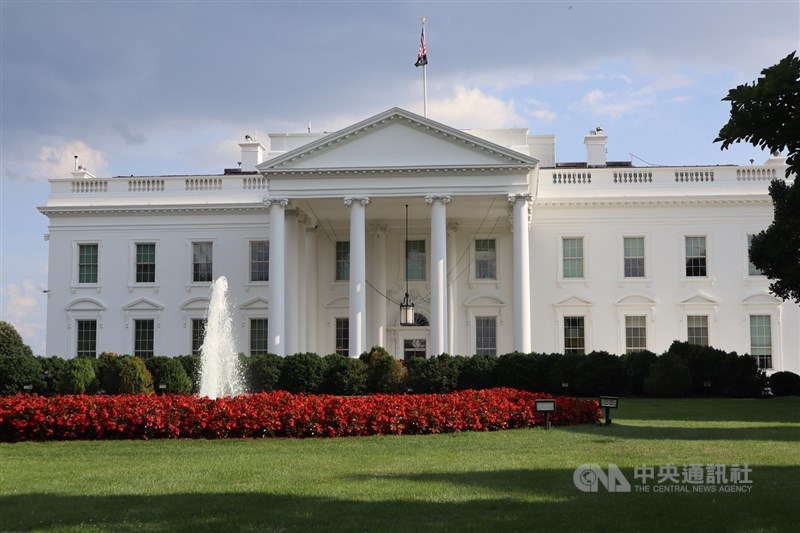
Taipei, Sept. 26 (CNA) The White House's fact sheet on Chinese President Xi Jinping's (習近平) state visit to the United States this week does not mention Taiwan, in contrast to the readout issued by China's Ministry of Foreign Affairs.
According to the White House fact sheet, issued on Friday, the two leaders discussed bilateral trade and investment, geopolitical flashpoints, including Russia, North Korea and Iran, as well as drug control.
The fact sheet covers the broader state visit by Xi and his wife Peng Liyuan (彭麗媛), while China's readout focuses on Xi's Sept. 24 meeting with U.S. President Donald Trump at the White House.
Taiwan is notably absent from the White House fact sheet, unlike the readout published on the same day by China's Foreign Ministry on the Sept. 24 meeting.
According to China's readout, Xi stressed China's "clear-cut" position on safeguarding national reunification and territorial integrity.
"It is hoped that the U.S. side will adhere to the correct position of opposing 'Taiwan independence,' and handle the Taiwan question with caution, so as to lay a solid foundation for China-U.S. strategic cooperation and the development of bilateral relations," the readout said.
Trump has not publicly "opposed" Taiwan independence, instead saying in May in an interview while visiting Beijing that he was not "looking to have somebody go independent" as he urged both Beijing and Taipei to "cool down."
According to the White House fact sheet, the two leaders "recalled that United States and China were allies in World War II and fought side by side to win the war."
China's readout does not mention the remark, but it was included in a report published by China's state-run Xinhua News Agency on the same day. Taiwan's government has rebuked this stance and accused Xi of distorting historical facts.
Taiwan's Mainland Affairs Council and Ministry of Foreign Affairs have stressed that it was the Republic of China, whose government relocated from mainland China to Taiwan in 1949 after the Chinese Civil War, that fought alongside U.S. forces in World War II.
The Taiwanese government has not, however, publicly responded to the White House's fact sheet.
Among other issues discussed by Trump and Xi, the two agreed that Iran can never have a nuclear weapon, according to the White House fact sheet -- a point that is not mentioned in China's readout.
They reached consensus on recommendations for more favorable tariff treatment for US$30 billion of non-sensitive goods in each direction under the U.S.-China Board of Trade, according to the fact sheet.
The two sides continued to work on U.S. concerns regarding supply chain shortages related to rare earths and other critical minerals, with the goal of ensuring shipments return to appropriate levels, according to the fact sheet.
Both sides agreed to support each other in hosting the G20 in Miami, Florida and APEC in Shenzhen, China, with both leaders intending to attend each other's summit, according to the fact sheet.
The two leaders also discussed the control of drugs and controlled substances, including orphines and precursor materials for fentanyl, according to the White House fact sheet. The fact sheet said the United States welcomed China's scheduling of orphines and noted China's new export controls on two fentanyl precursor chemicals.
The two leaders also discussed the risks and benefits of emerging technologies, with Xi advocating closer cooperation between China and U.S. in the field, according to China's readout.
- Society
Champi expected to become typhoon within 24 hours; path remains uncertain
10/16/2026 07:40 PM - Politics
10 local election candidates fail eligibility review: CEC
10/16/2026 07:27 PM - Politics
Taiwan lawmakers pass health insurance premium subsidies for seniors
10/16/2026 07:24 PM - Politics
Taiwan should not rule out nuclear power as energy option: Lai
10/16/2026 06:59 PM - Sports
Taichung city government signs deal for 'Taiwan Dome'
10/16/2026 05:38 PM