Support for Taiwan self-defense, freedom aligned with international interests: Deputy FM
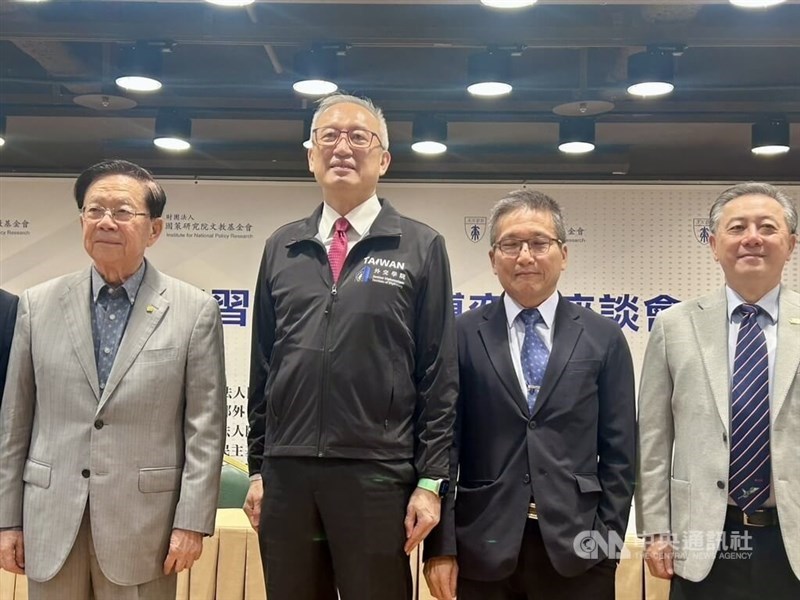
Taipei, Sept. 26 (CNA) Deputy Foreign Minister François Wu (吳志中) said Saturday that supporting Taiwan's democratic political system and self-defense is aligned with the interests of the United States and the international community, after Chinese President Xi Jinping (習近平) reportedly pressed U.S. President Donald Trump to openly oppose Taiwan independence and further delay a US$14 billion arms sale package to Taiwan.
"China undoubtedly tried to score on the Taiwan issue, but would a concession on Taiwan be in the U.S. interests?" Wu told reporters on the sidelines of a forum on the implications of a meeting between Trump and Xi at the White House on Thursday, where the two leaders reportedly discussed trade, artificial intelligence, Iran and Taiwan.
Wu said it would be in the U.S.' "vital interests" to move the arms sales forward and allow Taiwan to defend itself and its free and democratic political system, so that "its 23 million people would not live under the same system as [people in] China."
Wu added that supporting Taiwan's self-defense and freedom is necessary for Taiwan to continue making contributions to the world in the field of semiconductors.
Wu noted that some media outlets had reported that Xi likely pressed Trump to formally halt the planned US$14 billion arms sale package to Taiwan and publicly state his opposition to Taiwan independence during the meeting.
"But as far as I know, the U.S. has not responded to these issues."
Wu referenced a joint statement by U.S. Secretary of State Marco Rubio, Japanese Foreign Minister Toshimitsu Motegi and South Korean Foreign Minister Cho Hyun on Sept. 21 during the ongoing United Nations General Assembly in New York, in which they emphasized the importance of peace across the Taiwan Strait.
They also expressed support for freedom of navigation and overflight, unimpeded lawful commerce and other lawful uses of the sea in the Indo-Pacific and globally, in accordance with international law as reflected in the United Nations Convention on the Law of the Sea (UNCLOS).
Wu also mentioned another joint statement issued during the U.N. General Assembly on Sept. 22 by the foreign ministers and high-level representatives of eight countries - Australia, France, Germany, Japan, New Zealand, Poland, South Korea and the United Kingdom.
In the statement, the officials stressed the importance of maintaining peace and stability in the Indo-Pacific, encouraged dialogue and opposed any unilateral attempts to change the status quo across the Taiwan Strait.
The joint statements showed that U.S. interests in Taiwan are "aligned with interests of mainstream countries," Wu said.
WWII history distorted
When asked to comment on Trump and Xi's assertions that the People's Republic of China (PRC) and the U.S. fought side by side against Japanese aggression, Wu said this type of historical distortion was a tactic commonly employed by the Chinese Communist Party.
"China has been aggressively pursuing narrative diplomacy, and through information manipulation, tries to replace our role in World War II," Wu said, adding that the foreign ministry will not stop countering China's narratives in the international arena.
According to China's state-run Xinhua News Agency, Xi reportedly told Trump at the meeting that "during the Second World War, Chinese and Americans fought shoulder to shoulder against fascist aggression. Chinese people have never forgotten that part of history, nor have the American people."
Trump, meanwhile, invoked the First American Volunteer Group of the Republic of China Air Force, also known as the Flying Tigers, and praised the "bravery during their joint combat with Chinese soldiers and civilians against the Japanese invasion," according to Xinhua.
Wu did not, however, comment on Trump's remarks.
The Republic of China (ROC) and U.S. forces fought against the Japanese invasion of China during World War II, and the Flying Tigers operated under the ROC's Air Force when they helped repel Japanese forces. The PRC had not come into existence then.
After the war, the ROC, led by Chiang Kai-shek's (蔣中正) Kuomintang (KMT), retreated to Taiwan in 1949 following the KMT's defeat in the Chinese Civil War by the CCP. The KMT then ruled Taiwan for more than 50 years, during which Taiwan transformed from one-party rule into a democracy.
- Society
Champi expected to become typhoon within 24 hours; path remains uncertain
10/16/2026 07:40 PM - Politics
10 local election candidates fail eligibility review: CEC
10/16/2026 07:27 PM - Politics
Taiwan lawmakers pass health insurance premium subsidies for seniors
10/16/2026 07:24 PM - Politics
Taiwan should not rule out nuclear power as energy option: Lai
10/16/2026 06:59 PM - Sports
Taichung city government signs deal for 'Taiwan Dome'
10/16/2026 05:38 PM