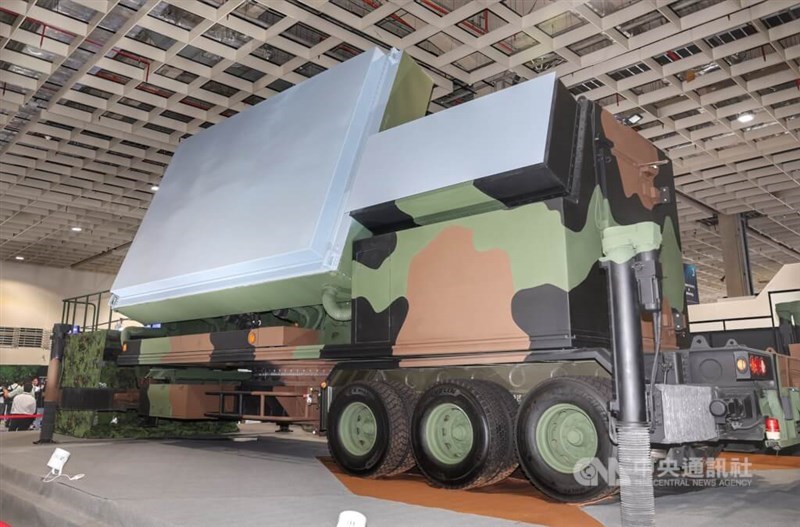
Taipei, Sept. 3 (CNA) The Cabinet on Thursday approved a supplementary budget request totaling NT$607.6 billion (US$19.12 billion), including NT$145.7 billion in spending previously rejected by opposition lawmakers, to procure drones and a new surface-to-air defense systems.
Under the Cabinet's proposal, NT$55.9 billion of the supplementary defense budget has been earmarked to fund three types of uncrewed systems requested by the Ministry of National Defense (MND) -- coastal attack drones, coastal reconnaissance drones and small one-way unmanned surface vessels (USVs).
The government plans to acquire more than 40,000 coastal attack drones, 600 coastal reconnaissance drones and 100 small one-way USVs in 2027.
The procurement plan came after the Legislature, in which the opposition Kuomintang (KMT) and Taiwan People's Party (TPP) hold a majority of seats, passed the Act on Strengthening Defense Autonomy and Developing the Unmanned Vehicles Industry last month.
The Act allocates NT$40 billion a year for six consecutive years and covers the procurement of the three unmanned systems, subject to review of spending plans by the Legislative Yuan.
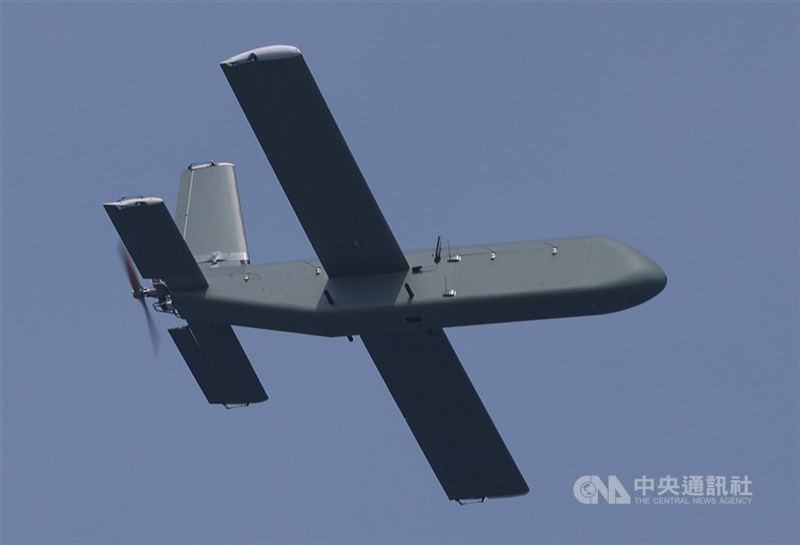
Asked to clarify the apparent overlap in drone funding, Lt. Gen. Huang Wen-chi (黃文啟), head of the MND's Department of Strategic Planning, said the supplementary defense budget proposal was put forward in response to opposition parties cutting NT$470 billion from the Cabinet's NT$1.25 trillion special defense budget in May.
The budget reflected the military's schedule for force buildup, Huang said.
"We hope that through this supplementary budget, procurement of coastal reconnaissance drones and coastal attack drones can begin this year," Huang said.
As for small one-way USVs, Huang said only a small amount has been earmarked under the supplementary budget for procurement preparations, adding that the military expects to start receiving the systems in 2027.
The supplementary budget also covers the procurement of the indigenous Albatross II intelligence, surveillance and reconnaissance (ISR) drones developed by the government-funded weapons developer National Chung-Shan Institute of Science and Technology (NCSIST).
It also includes funding for the procurement of Chiang-Kong mid-altitude anti-tactical ballistic missile systems, developed by NCSIST, which reportedly have an interception altitude of 70 kilometers and are expected to play an important role in intercepting China's ballistic missiles.
However, Huang did not reveal how much funding would be earmarked for the Albatross II and Chiang-Kong systems.
The spending plan also includes NT$7.3 billion for "urgent munitions stockpiles" and NT$900 million for the Taiwan Tactical Network, a system aimed at improving the situational awareness of frontline troops by providing them with a common operational picture
It also includes NT$64.5 billion in confidential budgets for two classified projects, which are believed to be funding removed by the Legislature for Taiwan-U.S. co-development programs.
Meanwhile, asked if Premier Cho Jung-tai (卓榮泰) would countersign the opposition-backed procurement act, a prerequisite for President Lai Ching-te (賴清德) to promulgate it, government spokesperson Michelle Lee (李慧芝) said the Cabinet would make a decision after reviewing its provisions and feasibility, as it only received the act on Wednesday evening.
Cho has declined to countersign several opposition-backed laws that could affect the central government's finances. In one of the most high-profile cases, he refused to endorse a law that would increase the share of tax revenues allocated to local governments last year, after raising doubts over its constitutionality.
Meanwhile, the government-run oil supplier CPC Corp, Taiwan, is set to receive NT$233.8 billion, the largest share, of the supplementary budget to support its operations, as the company has accrued deficits since 2020 due in part to petroleum and natural gas price smoothing policies implemented by the government.
- Business
Taiwan shares close up 0.3%
10/16/2026 01:40 PM - Business
Taiwan economic growth in 2026 to be highest in 39 years: CIER
10/16/2026 01:06 PM - Culture
Lee Yun-chan wins Best Director at Busan Int'l Film Festival
10/16/2026 01:01 PM - Society
Warm weather to persist across Taiwan through Saturday: CWA
10/16/2026 11:08 AM - Sports
Jeremy Lin joins ESPN's NBA analyst lineup for new season
10/16/2026 10:53 AM