Legislature passes drone procurement bill with US$7.56 billion spending cap (update)
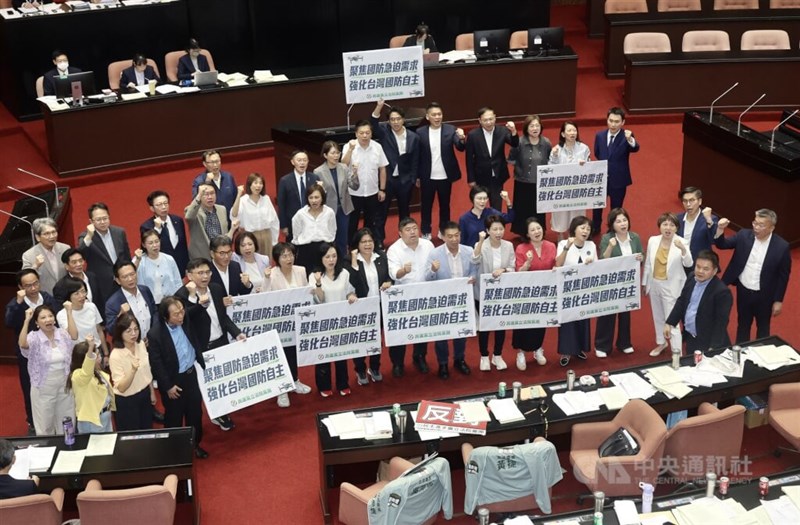
Taipei, Aug. 27 (CNA) The Legislative Yuan on Thursday passed a key budget bill that prioritizes the procurement of indigenous unmanned vehicles, setting a spending cap of NT$240 billion (US$7.56 billion) in principle, while allowing additional funding subject to legislative approval.
The opposition-led Act on Strengthening Defense Autonomy and Developing the Unmanned Vehicles Industry was passed by a vote of 60-50 in the 113-seat Legislature.
The act directs the Ministry of National Defense (MND) to prioritize the procurement of domestically produced "low-cost, high-performance" unmanned systems.
It requires the central government to, in principle, earmark NT$40 billion annually for six consecutive years, using its general budget to procure unmanned vehicles, in a bid to bolster national defense and drive industrial growth.
Annual budgets vs. special budget
The caucus of the main opposition Kuomintang (KMT) had said it favored funding unmanned systems through annual budgets, given the rapid evolution of drone technologies. It argued that this would allow for phased procurement and prevent the systems from becoming "outdated" by the time they are delivered to the armed forces.
The Cabinet's proposal, which requested NT$210 billion in a special budget over six years, failed to win approval. The bill, backed by the ruling Democratic Progressive Party (DPP) caucus, was rejected by the KMT and the smaller opposition Taiwan People's Party (TPP), which together hold a legislative majority.
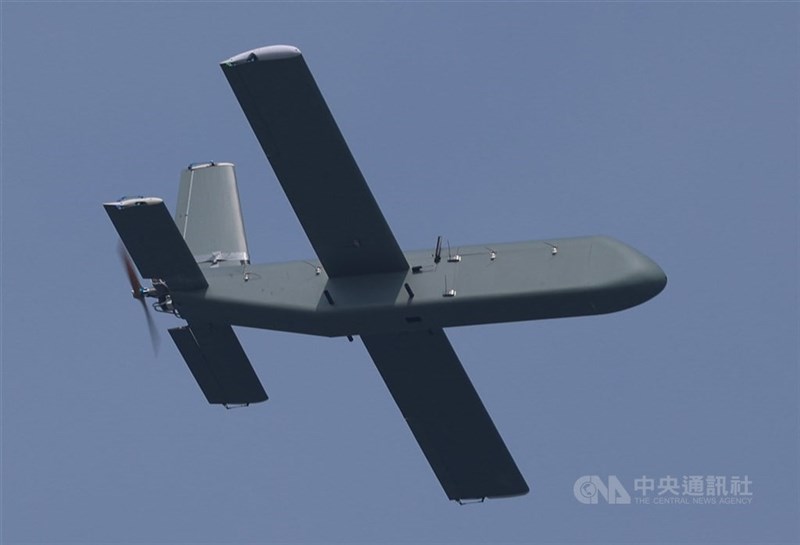
Under the act's definition, unmanned vehicles are autonomous or remotely controlled systems that can operate in the air, under the sea, on the sea surface, on land or in other unspecified environments.
They can be used in a wide array of scenarios, including attacks, reconnaissance, logistics, communications, decoys, electronic warfare, mine-sweeping and mine-laying.
A rare compromise
Crucially, the act covers the three types of unmanned systems that the MND has requested for procurement -- coastal attack drones, coastal reconnaissance drones and small suicide unmanned surface vehicles -- that were previously excluded from proposals by the KMT and TPP.
The last-minute addition represented a rare compromise between the ruling and opposition parties, after DPP lawmakers repeatedly urged their inclusion.
Industrial growth and regulation
In addition to national defense, the act focused heavily on industrial regulation and development, with provisions covering the planning of unmanned vehicle testing sites and requirements for indigenous production levels and cybersecurity compliance.
The Ministry of Economic Affairs (MOEA), which oversees implementation of the Act alongside the MND, is to determine what constitutes "indigenous" unmanned systems and "trustworthy supply chains," thereby ensuring components used by manufacturers in drone production meet cybersecurity and security requirements.
In addition, the MOEA will establish at least three test sites for military and private manufacturers to evaluate drone flight controls, anti-jamming systems and combat readiness within one year of the act's enactment.
The MOEA will also be responsible for accrediting local manufacturers that have achieved required domestic production levels and met supply chain requirements. The names of such manufacturers will be published on an official website to promote international partnerships.
The two agencies must brief the Cabinet and the Legislature annually on progress in procurement, efforts to meet domestic mass production targets and manufacturer accreditation.
The act also directs the establishment of a Cabinet-level national committee to oversee and streamline national policies for developing the unmanned vehicles industry, with committee members selected by the Cabinet from nominees recommended by legislative caucuses.

Government dismayed
At a news conference following passage of the bill, DPP Legislator Chung Chia-pin (鍾佳濱) slammed the provision mandating the establishment of the committee, describing it as "sugar-coated poison."
He expressed concern that the mandate would allow Beijing to infiltrate the committee by bringing members nominated by certain political parties under its fold, resulting in confidential information being leaked to China.
In a statement, the MND expressed "regret" that the Cabinet's proposed special budget failed to pass, saying that the outcome would hamper its efforts to acquire key combat capabilities "within the shortest possible time."
Meanwhile, KMT caucus leader Fu Kun-chi (傅崐萁) said the act underscored his party's resolve to defend the Republic of China (Taiwan's official name) and to make Taiwan an "important drone manufacturing hub globally."
Cabinet spokesperson Michelle Lee (李慧芝) said although the Cabinet's proposal failed to pass, it would "do its utmost" to plan unmanned systems procurement budgets to ensure Taiwan will quickly acquire critical defense capabilities and drive technological development for the industry.
- Society
Taiwan headline news
10/08/2026 10:09 AM - Business
U.S. dollar up in Taipei trading
10/08/2026 10:09 AM - Business
Taiwan shares open lower
10/08/2026 09:08 AM - Politics
China-born spouse denied right to run for local office in Hsinchu
10/07/2026 08:59 PM - Society
Taiwan Railway apologizes after train blows past station
10/07/2026 07:52 PM