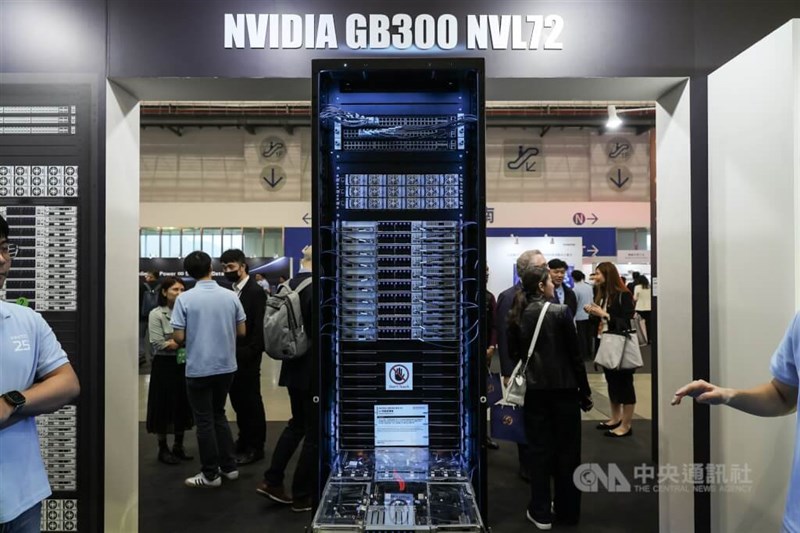
Taipei, Oct. 5 (CNA) American AI chip designer Nvidia Corp. and Taiwanese manufacturing giant Hon Hai Precision Industry Co. have improved the success rates of critical assembly steps for Nvidia's GB300 NVL72 rack-scale AI platform by using robots, the companies said.
In an Oct. 2 report on Nvidia's technical blog titled "The Machines that Make the Machines," the U.S. company detailed how its operations team and Hon Hai trained robots to assemble critical GB300 NVL72 components, improving manufacturing stability and efficiency.
Success rates for key assembly steps exceeded 90 percent, according to the report.
Nvidia said the two companies focused on assembling the GB300's tester tray, which is used to verify the functionality and performance of GB300 computing modules before shipment and deployment. Key tasks included busbar assembly and the insertion of multiple electrical connectors.
For busbar assembly, Nvidia said a major challenge was getting robots to grasp and transport a metal bar that carries high electrical currents to the tray, insert it and secure it with screws at 16 locations.
For multi-connector insertion, robots must lift two large and two small cable-mounted electrical connectors from the tray and insert them into sockets with tight clearances, Nvidia said.
According to the latest test data, the automation system achieved a success rate of more than 95 percent for busbar assembly, which requires tightening 16 screws, with a target of completing the assembly in under 124 seconds.
For multi-connector insertion, involving four cable connectors of different sizes, the success rate ranged from 90 percent to 95 percent, with a target of completing all insertions within 72 seconds.
During GB300 tester-tray assembly, Nvidia said flexible automation systems are needed to address uncertainty because rapid design cycles and relatively low production volumes make fixed automation infeasible.
Robots therefore need to be adaptive and robust enough to handle variations in the assembly process, it said.
Hon Hai, also known globally as Foxconn, is one of Nvidia's major suppliers. The company announced last year that it was working with Nvidia to build a smart manufacturing plant at its production site in Houston, Texas, using Nvidia's model-driven humanoid robots to produce AI servers.
Hon Hai has said it plans to expand its use of robots developed with Nvidia to other plants in Texas, Wisconsin and California.
The company, which currently accounts for more than 40 percent of the global AI server market, remains upbeat about the sector. At an investor conference in mid-August, Hon Hai forecast that its AI rack shipments would more than double from a year earlier in 2026.
In recent years, Hon Hai has aggressively diversified its business under its "3 plus 3" strategy, expanding into integrated hardware and software.
The initiative covers three emerging industries -- electric vehicles, robots and digital health care -- which the company is developing using AI, semiconductor and communications technologies, with electric vehicles as its core business.
- Sports
Brothers clinch second-half title, secure CPBL playoff berth
10/05/2026 02:00 PM - Business
Taiwan shares close up 2.55%
10/05/2026 01:50 PM - Science & Tech
Nvidia, Hon Hai use robots to improve GB300 assembly success rates
10/05/2026 01:15 PM - Culture
Taiwanese artists featured at 'She Makes Noise' festival in Spain
10/05/2026 01:02 PM - Sports
Taiwan's Chou wins second women's 9-ball world title
10/05/2026 12:25 PM