Washington, July 18 (CNA) U.S. Senator Tammy Duckworth has warned that China may be more likely to impose an economic blockade on Taiwan than launch a full-scale military invasion in 2028, arguing such a move could be carried out under the guise of maritime safety.
Speaking at a Center for Strategic and International Studies (CSIS) event in Washington, D.C. on Thursday, Duckworth responded to comments by former Australian Prime Minister Kevin Rudd, who recently suggested Chinese President Xi Jinping (習近平) could seek to exploit simultaneous U.S. and Taiwanese presidential elections in 2028 to attack Taiwan.
Duckworth, who serves on the U.S. Senate Foreign Relations and Armed Services committees, said she believed Beijing would be more likely to pursue an economic blockade.
She revealed that the U.S. Senate conducted tabletop exercises in early 2025 examining a potential Chinese attack on Taiwan.
The scenario that actually plays out is an economic blockade, more than a military attack, she said.
According to Duckworth, China could seek to block access to the Taiwan Strait by requiring commercial vessels to report to the Chinese Coast Guard for escort under the pretext of ensuring maritime safety.
"It is actually blockading the straits and telling shipping companies that if you want to go through the Taiwan Strait, you need to check in with the PRC Coast Guard to help escort you through the strait safely," she said.
Duckworth said such a blockade could be presented "under the guise of safety and security" and added that she believes "that may be something that could happen in 2028."
Drawing a comparison with tensions surrounding the Strait of Hormuz, she warned against allowing restrictions on international waterways to become normalized.
"Let's make sure that what's happening in the Strait of Hormuz does not become the new and acceptable norm for all of the other waterways around the world," she said.
Asked how such a scenario could be deterred, Duckworth said the United States should continue to demonstrate its commitment to freedom of navigation by sending naval vessels through the Taiwan Strait and encouraging other countries to do the same.
She also cautioned that any disruption to shipping through the Taiwan Strait would have far greater global economic consequences than instability in the Strait of Hormuz.
Duckworth visited Taiwan from July 6-8, becoming the first U.S. senator to visit the country after the May summit between U.S. President Donald Trump and Xi in Beijing.
During a meeting with President Lai Ching-te (賴清德) on July 7, Duckworth said the visit was intended to demonstrate that U.S. support for Taiwan transcends changes in administrations.
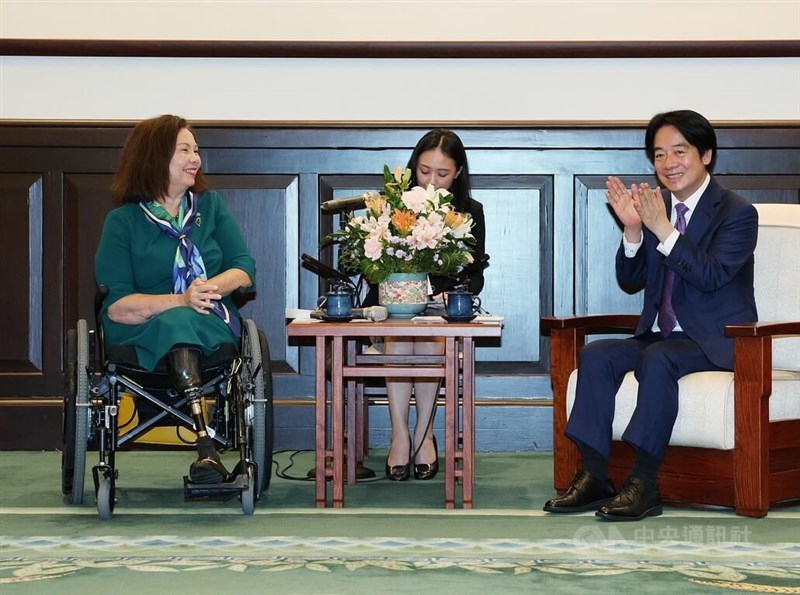
Her remarks came amid concerns among some analysts in Taiwan and abroad that improving U.S.-China relations could come at Taiwan's expense.
Duckworth also told Lai that Taiwan's security is a matter of global concern, warning that a conflict in the Taiwan Strait could cost the world economy as much as US$10 trillion and put more than 7 percent of U.S. GDP at risk -- an impact she said would exceed that of either the global financial crisis or the COVID-19 pandemic.
- Sports
Taiwanese men's, women's doubles pairs lose in BWF Arctic Open finals
10/12/2026 08:48 PM - Business
Nanya Technology expects DRAM prices, margins to rise in Q4
10/12/2026 08:47 PM - Politics
Kaohsiung mayoral candidates outline AI industry development plans
10/12/2026 08:24 PM - Society
Victim's nephew arrested in fatal Xinzhuang stabbing
10/12/2026 08:17 PM - Politics
Taiwan condemns China over sanctions on ministers of diplomatic allies
10/12/2026 07:44 PM