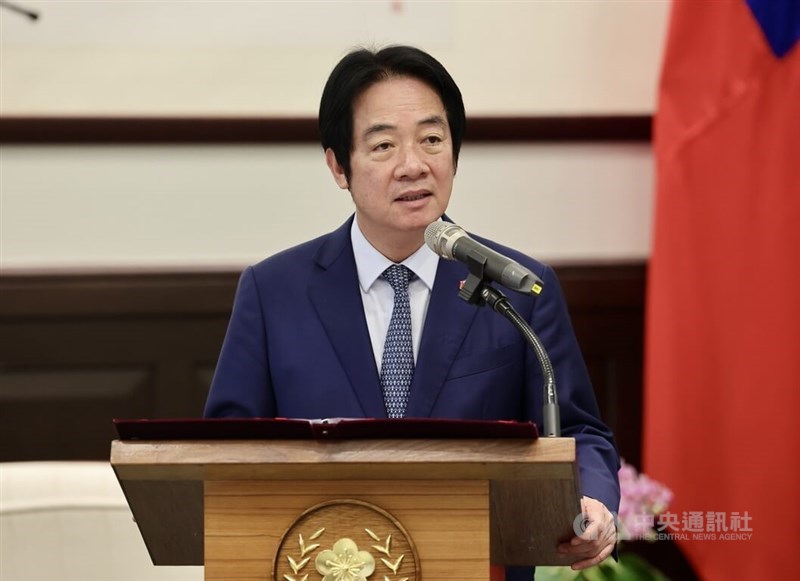
Taipei, June 23 (CNA) President Lai Ching-te (賴清德) on Tuesday called for closer international cooperation to counter transnational repression, describing it as a growing challenge facing democracies around the world.
At the opening ceremony of a Global Cooperation and Training Framework (GCTF) workshop in Taipei, Lai said authoritarian regimes were increasingly using emerging technologies, illicit financial flows, cyberattacks and information manipulation to carry out cross-border surveillance and repression, undermine social trust and erode democratic sovereignty.
"The threats facing democratic countries today have gone beyond traditional military domains and geographic boundaries," Lai said.
He said no country could remain unaffected by such challenges or confront them alone.
"When authoritarianism seeks to export fear, democratic societies must build resilience. When authoritarian forces seek to divide unity, democratic partners must work together," he said.
He noted that the European Parliament passed a resolution this month aimed at countering transnational repression and said Taiwan supports the EU's efforts to strengthen response mechanisms.
Taiwan will continue working with the EU and other like-minded partners to build a secure and trustworthy information environment, establish more timely warning systems, improve accountability mechanisms and strengthen protections for citizens, he said.
The workshop, titled "Building Resilient Democracies: Responding to Transnational Repression," brought together experts and scholars from 29 countries to exchange views and share experiences on safeguarding democracy, freedom, human rights and the rule of law.
Lai said Taiwan had established an interagency mechanism to address transnational repression and was reviewing relevant laws and strengthening response measures from three perspectives: prevention, protection and countermeasures.
He said disinformation and cognitive warfare had increasingly become tools used to silence dissent and divide societies.
To address the issue, Taiwan has strengthened cross-sector cooperation, adopted technological tools and established rapid-response clarification platforms within government agencies to improve the public's ability to identify false information and guard against threats.
Protecting citizens is a fundamental responsibility of the government, Lai said, adding that Taiwan provides emergency assistance and necessary support through its overseas representative offices to citizens facing harassment, intimidation or repression abroad.
For those in Taiwan, the government is working to strengthen legal protections and ensure perpetrators are held accountable, he said.
Established by Taiwan and the United States in 2015, the GCTF has expanded to include Japan, Australia, Canada and the United Kingdom as official partners.
According to Lai, the platform has hosted more than 100 international workshops attended by over 10,000 experts and government officials from 134 countries, covering issues ranging from public health and cybersecurity to semiconductor supply chains.
Lai said Taiwan's experience transitioning from authoritarian rule underscored the value of freedom and human rights, adding that the country will continue sharing its experiences through the GCTF to strengthen democratic resilience and human rights protections worldwide.
- Society
Taiwan headline news
10/02/2026 10:48 AM - Business
U.S. dollar up in Taipei trading
10/02/2026 10:41 AM - Business
Taiwan shares open higher
10/02/2026 09:08 AM - Business
Taiwan's manufacturing activity expands at fastest pace in 5 years
10/01/2026 09:12 PM - Culture
Drama film 'Arrested Memory' leads 11 Golden Horse nominations
10/01/2026 09:09 PM