INTERVIEW/Taiwan needs layered defenses against China's 'robot wolves': Expert
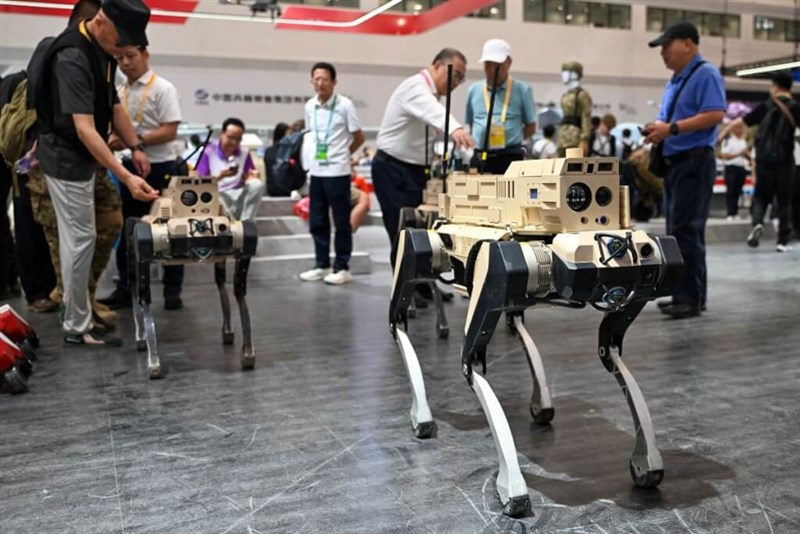
Washington, June 15 (CNA) Taiwan should develop layered defenses against China's emerging "robot wolf" systems that could be part of a future invasion, according to Craig Singleton, senior director of the China Program at the Foundation for Defense of Democracies (FDD).
The four-legged ground robots, roughly the size of large dogs, have appeared in People's Liberation Army (PLA) training footage and can carry cameras, sensors, LiDAR systems, supplies or weapons, Singleton said in an exclusive interview with CNA.
Their appearance in PLA exercises suggests China is testing the systems in realistic operational settings, and they could allow Beijing to deploy machines rather than soldiers during the opening stages of an invasion, helping preserve manpower, Singleton said.
To deter the threat, Singleton said Taiwan does not need an expensive answer to every robotic system, but rather multiple affordable layers of defense.
These should include rapid detection and identification of unmanned ground systems, electronic warfare capabilities, signal jamming, the disruption of navigation and communications links, and urban counter-robot training exercises, he said.
Layered defenses were critical, he said, because alternative measures will remain available if one line of defense fails.
The threat posed by China's robotic systems was detailed in a report by Singleton and Washington-based think tank FDD senior research analyst Jack Burnham titled "China's War Wolves: From Commercial Tech to Combat Power" published in May.
The report highlighted Beijing's efforts to integrate artificial intelligence, robotics and unmanned systems into front-line military operations.
Singleton said that while the systems would not eliminate risk for China, they could redistribute it, potentially lowering the political cost of early casualties and influencing Beijing's strategic calculations.
Aside from setting up layered defenses, Singleton also urged Taiwan to counter the threat by investing in domestic robotics and counter-robotics industries.
Earlier this month, Taiwan's National Chung-Shan Institute of Science and Technology seemed to take a major step in that direction, unveiling three prototypes of robotic dogs for military use.
But while Singleton welcomed the effort, he said Taiwan should also focus on understanding and countering similar technologies.
On the U.S.-Taiwan partnership deterring China, Singleton said the United States could strengthen cooperation with trusted Taiwanese robotics firms, streamline procurement processes and support Taiwan's efforts to counter unmanned systems.
Taiwan's world-leading semiconductor industry could also give it an advantage in developing advanced robotic systems if domestic robotics companies and chipmakers work closely together.
Meanwhile, Washington could slow China's progress through export controls and restrictions on access to key technologies, he said.
![Belize PM Briceño seeks deeper cooperation with Taiwan, invites investment]() Belize PM Briceño seeks deeper cooperation with Taiwan, invites investmentBelize Prime Minister John Briceño has called for deeper cooperation with Taiwan through investment, technology exchanges, and people-to-people ties, saying that he hopes those links will contribute to his country's development.10/15/2026 02:19 PM
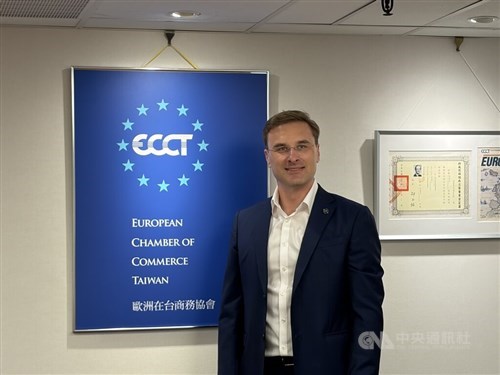
Belize PM Briceño seeks deeper cooperation with Taiwan, invites investmentBelize Prime Minister John Briceño has called for deeper cooperation with Taiwan through investment, technology exchanges, and people-to-people ties, saying that he hopes those links will contribute to his country's development.10/15/2026 02:19 PM![New ECCT chair urges greater agility in Taiwan's software, energy sectors]() New ECCT chair urges greater agility in Taiwan's software, energy sectorsTaiwan is known for its strength in hardware manufacturing, but Frank Grunert, the new chairperson of the European Chamber of Commerce Taiwan (ECCT), sees considerable potential in software as well.10/10/2026 12:36 PM
New ECCT chair urges greater agility in Taiwan's software, energy sectorsTaiwan is known for its strength in hardware manufacturing, but Frank Grunert, the new chairperson of the European Chamber of Commerce Taiwan (ECCT), sees considerable potential in software as well.10/10/2026 12:36 PM![Strategic partnership key to Taiwan-U.K. cooperation: Deputy economics minister]() Strategic partnership key to Taiwan-U.K. cooperation: Deputy economics ministerTaiwan's Deputy Minister of Economic Affairs Cynthia Kiang (江文若), who has just concluded an annual economic and trade dialogue with her U.K. counterpart in London, said Friday that establishing a strategic partnership is key to bilateral cooperation.10/03/2026 01:53 PM
Strategic partnership key to Taiwan-U.K. cooperation: Deputy economics ministerTaiwan's Deputy Minister of Economic Affairs Cynthia Kiang (江文若), who has just concluded an annual economic and trade dialogue with her U.K. counterpart in London, said Friday that establishing a strategic partnership is key to bilateral cooperation.10/03/2026 01:53 PM

- Business
Starlux adds fourth weekly Taipei-Prague flight
10/18/2026 09:08 PM - Society
Taichung Arena on track for completion in 2030: City gov't
10/18/2026 09:02 PM - Society
Typhoon Champi sea warning possible Wednesday night: CWA
10/18/2026 08:42 PM - Politics
Chiang touts first-term results; Shen denies cash gift rumors
10/18/2026 08:38 PM - Sports
Zeng Sheng-an's three-run homer gives Dragons 2-0 lead in Taiwan Series
10/18/2026 08:18 PM