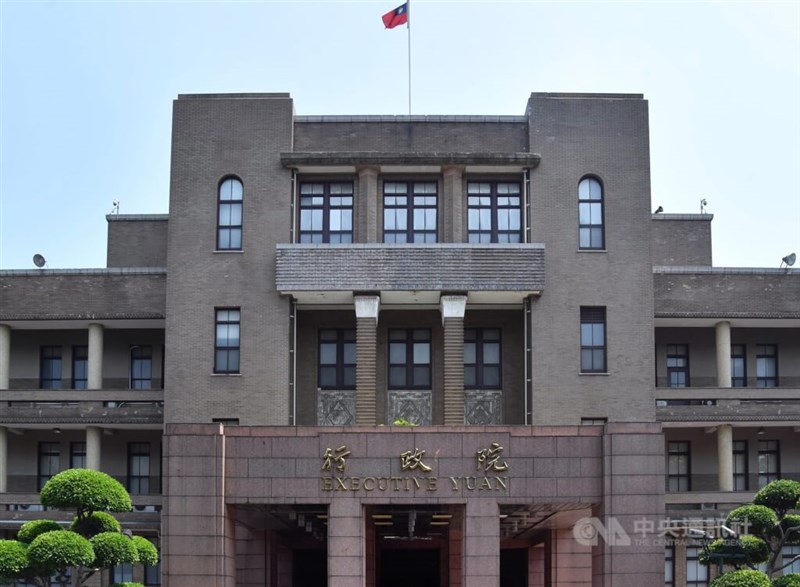
Taipei, Aug. 17 (CNA) Premier Cho Jung-tai (卓榮泰) has declined to countersign the Special Act on Taiwan Future Accounts, which was passed by the opposition-controlled Legislature in July, the Executive Yuan said Monday, citing violations of constitutional principles.
Instead, the government will continue implementing the family support measures it approved in May, Executive Yuan spokesperson Michelle Lee (李慧芝) said in a statement.
The bill passed by the Legislature would require the government to deposit NT$60,000 (US$1,854) annually into a Growth Allowance Account for eligible children under 8.
Children aged 7 to 17 would receive NT$30,000 annually in the Growth Allowance Account and another NT$30,000 in a Future Account.
The accounts would also accept "corporate sponsorship funds," which the Executive Yuan contended could allow wealthier families to accumulate larger amounts and ultimately widen the wealth gap, violating the principle of proportionality.
The legislation's tax exemptions for corporate sponsorship funds also fail to clearly specify the entities and conditions eligible for tax exemptions, violating the constitutional principle that taxation must be based on law, Lee argued.
She said the Executive Yuan is the nation's highest administrative authority and is constitutionally responsible for proposing policies, formulating policy plans and allocating the central government's budget.
In response, Kuomintang (KMT) Culture and Communications Committee Director Chen I-hsin (陳以信) said the decision not to countersign legislation passed by the Legislature was "ironclad evidence" of the contempt the administration of President Lai Ching-te (賴清德) has for the Legislature, according to a report by local news outlet United Daily News.
Chen accused the Cabinet of marginalizing the Legislative Yuan and disregarding the legislative majority.
"This is not the separation of powers, but the Executive Yuan overriding the Legislative Yuan," he said.
He also questioned how the government could pledge to care for children from ages 0 to 18 while refusing to accept the Future Accounts established by the legislation, asking whether the government was simply against policies that it had not proposed itself.
In her statement Monday, Lee said the family support measures approved by the Cabinet in May constitute a comprehensive program that takes into account economic growth and the government's fiscal burden.
The program includes a monthly child allowance of NT$5,000 for children aged 0 to 18, which has been budgeted for 2027, as well as an account for vulnerable and disadvantaged children and youth.
Under the latter program, the government would match savings made by parents or guardians, she said.
The measures also expand existing systems for parental, marriage, maternity and paternity leave, while introducing greater workplace flexibility, Lee said.
Relevant legislation, including amendments to the Gender Equality in Employment Act and Employment Insurance Act, has also been submitted to the Legislature for review, she said.
Cho's decision was the sixth time since December 2025 that he has declined to countersign legislation, a move that was previously unprecedented in the history of the Republic of China, Taiwan's formal name.
The other bills that were not countersigned involved amendments to the Act Governing the Allocation of Government Revenues and Expenditures, the Satellite Broadcasting Act and the Organic Law of the Legislative Yuan, among others.
Under normal circumstances in Taiwan, when the Legislature passes a law or an amendment, it has to be promulgated by the president after being countersigned by the premier.
Those steps have always been routine but are no longer so because of the adversarial relationship between the executive and legislative branches of Taiwan's government, which are controlled by different political parties.
*A correction was made on Aug. 19, 2026: An earlier version of this article incorrectly identified Chen I-hsin as a Kuomintang (KMT) lawmaker. Chen is a former lawmaker and currently serves as director of KMT's Culture and Communications Committee.
- Sports
Men's archery, esports give Taiwan 2 more bronzes at Asian Games
09/30/2026 08:32 PM - Society
Cooler, wetter weather forecast in northern Taiwan next week
09/30/2026 07:25 PM - Politics
Taiwan, Belize sign agreements to enhance collaboration during FM's visit
09/30/2026 07:08 PM - Society
AGC Display Glass employees protest at MOL ahead of 10/5 strike
09/30/2026 06:53 PM - Culture
CNA to relaunch Spanish-language Focus Taiwan with AI assistance
09/30/2026 05:59 PM