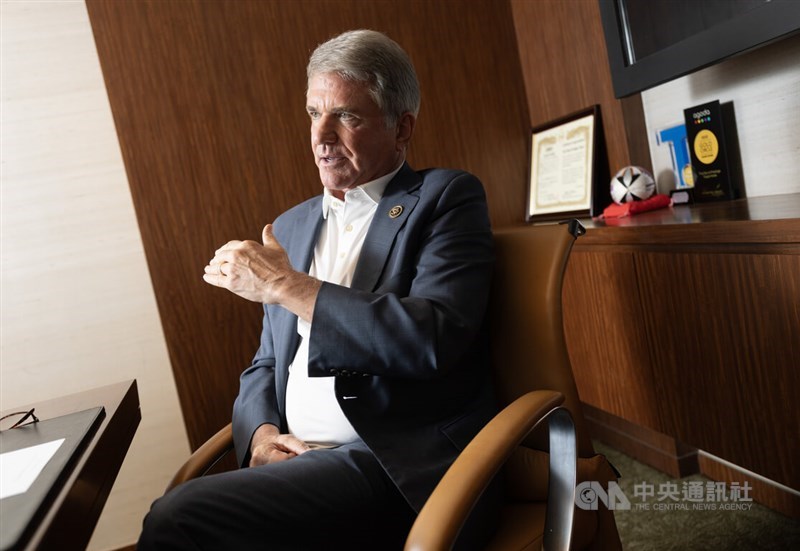
Taipei, Aug. 7 (CNA) U.S. Representative Michael McCaul said Thursday he was "very optimistic" about Taiwan and the United States jointly producing drones, citing growing demand for systems made without Chinese components and the ability of Taiwanese manufacturers to meet U.S. security requirements.
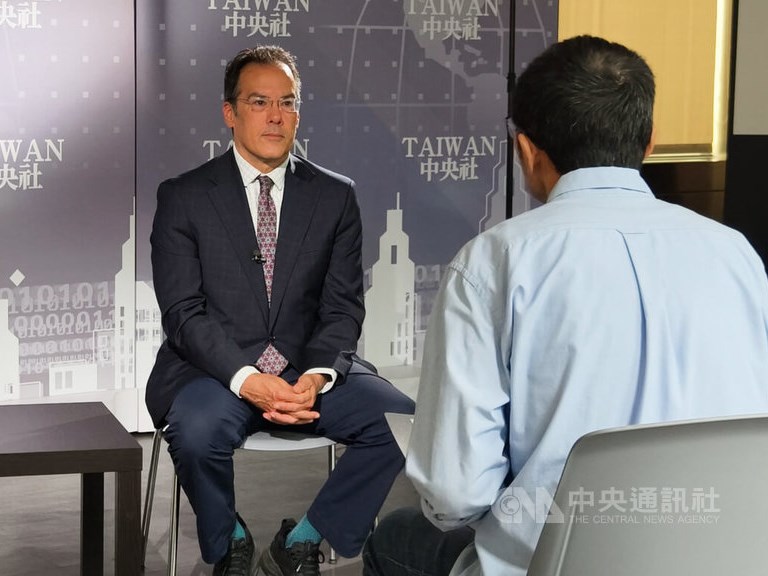
"I'm very bullish. I'm very optimistic," McCaul said in an interview with CNA when asked whether concerns that sourcing key drone components from Taiwan could anger Beijing might hamper Taiwan-U.S. drone cooperation.
"The language that we passed in our National Defense Authorization Act authorizes this type of cooperation between Taiwan and the United States on the co-production of UAV systems," McCaul said.
He was referring to a provision in the 2026 U.S. National Defense Authorization Act directing U.S. authorities to establish a joint program allowing the two sides to co-produce drones and counter-drone systems for their armed forces.
Security as an incentive
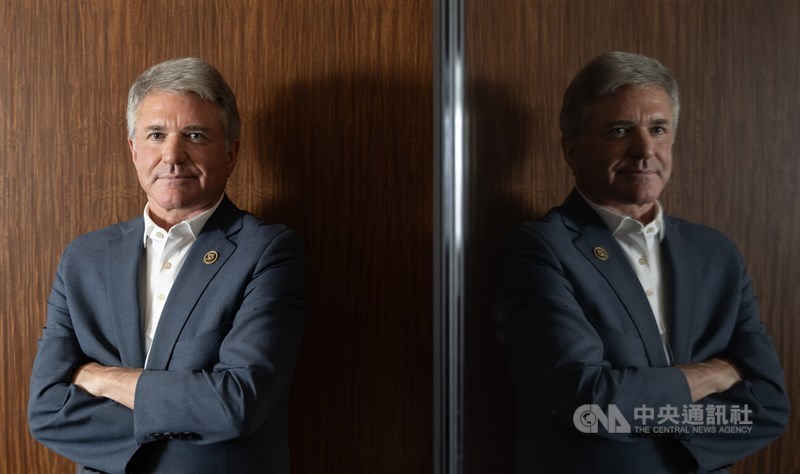
Asked what could encourage U.S. defense companies to choose Taiwan over China for drone manufacturing, given China's dominance of the global drone industry, McCaul highlighted intellectual property protection and cybersecurity.
McCaul, chairman emeritus of the U.S. House Foreign Affairs Committee, said that during a recent visit to Ukraine, he learned that some Ukrainian manufacturers took pride in producing drones without Chinese components.
"You don't want your supply chain compromised by your adversary," McCaul said, noting that China has supplied Russia with significant technology during its war against Ukraine.
Another incentive for U.S. manufacturers to partner with Taiwanese firms, McCaul said, is that many Taiwanese manufacturers have already obtained, or are close to obtaining, U.S. certifications showing that their drones are secure and contain no Chinese components.
"Those certifications are important with the United States government," McCaul said. "And I think it's in both of our interests. We export things that obviously end up in the wrong hands sometimes."
Of the seven drone companies he visited at a test site in Chiayi County on Thursday, two had already partnered with U.S. defense contractors, McCaul said.
The broader defense picture
The Texas Republican said the Taiwan-U.S. drone co-production initiative forms part of broader U.S.-led efforts to counter China in the Indo-Pacific.
He compared it with the AUKUS security partnership among the United States, the United Kingdom and Australia, under which Washington and London are helping Australia acquire nuclear-powered attack submarines and develop advanced defense capabilities.
"It's all interconnected," McCaul said. "What is happening with AUKUS helps defend the Indo-Pacific, just as co-producing drones with Taiwan helps defend the Pacific."
AUKUS, the Taiwan-U.S. drone initiative and support from Japan and the Philippines, which McCaul described as "very concerned," would provide the deterrence needed to stop Chinese President Xi Jinping (習近平) from pursuing what McCaul called "a legacy item: an imperial China."
McCaul arrived in Taiwan on Aug. 2 and is scheduled to depart on Friday.
During his visit, his third to Taiwan as a member of Congress, he attended the Ketagalan Forum and delivered a keynote address.
He also met with President Lai Ching-te (賴清德), who presented him with the Order of Brilliant Star with Grand Cordon in recognition of his contributions to Taiwan-U.S. relations and peace and stability across the Taiwan Strait.
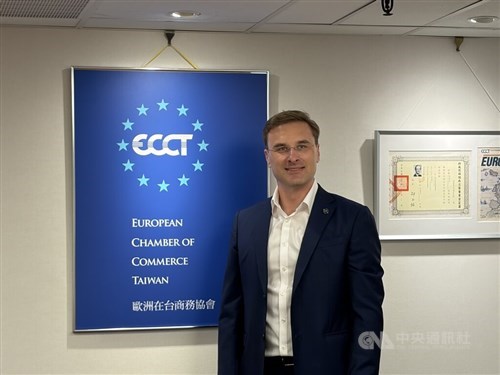
![New ECCT chair urges greater agility in Taiwan's software, energy sectors]() New ECCT chair urges greater agility in Taiwan's software, energy sectorsTaiwan is known for its strength in hardware manufacturing, but Frank Grunert, the new chairperson of the European Chamber of Commerce Taiwan (ECCT), sees considerable potential in software as well.10/10/2026 12:36 PM
New ECCT chair urges greater agility in Taiwan's software, energy sectorsTaiwan is known for its strength in hardware manufacturing, but Frank Grunert, the new chairperson of the European Chamber of Commerce Taiwan (ECCT), sees considerable potential in software as well.10/10/2026 12:36 PM![Strategic partnership key to Taiwan-U.K. cooperation: Deputy economics minister]() Strategic partnership key to Taiwan-U.K. cooperation: Deputy economics ministerTaiwan's Deputy Minister of Economic Affairs Cynthia Kiang (江文若), who has just concluded an annual economic and trade dialogue with her U.K. counterpart in London, said Friday that establishing a strategic partnership is key to bilateral cooperation.10/03/2026 01:53 PM
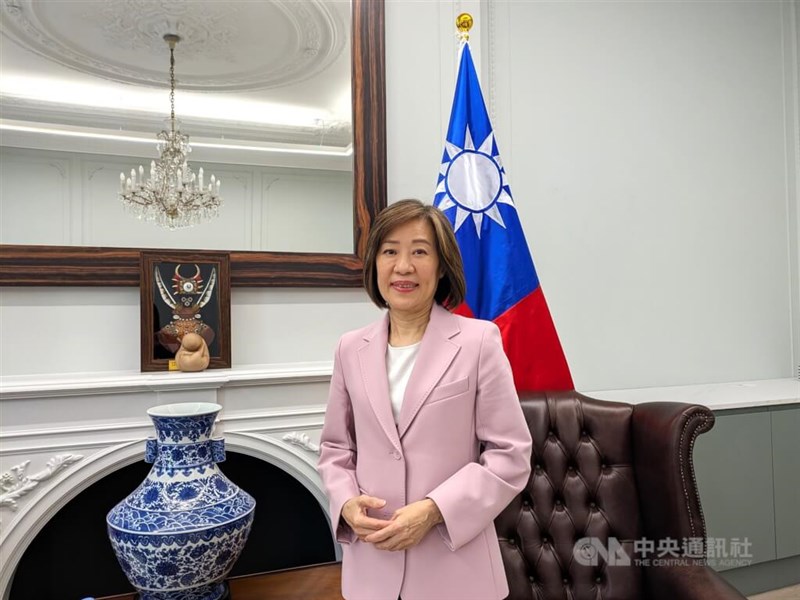
Strategic partnership key to Taiwan-U.K. cooperation: Deputy economics ministerTaiwan's Deputy Minister of Economic Affairs Cynthia Kiang (江文若), who has just concluded an annual economic and trade dialogue with her U.K. counterpart in London, said Friday that establishing a strategic partnership is key to bilateral cooperation.10/03/2026 01:53 PM![Taiwan, democracies must build resilience against China, Russia: Scholar]() Taiwan, democracies must build resilience against China, Russia: ScholarTaiwan and other democracies must strengthen their resilience against the "sharp power" wielded by authoritarian regimes such as China and Russia to defend their shared democratic values, a visiting American scholar said Monday.09/21/2026 04:39 PM
Taiwan, democracies must build resilience against China, Russia: ScholarTaiwan and other democracies must strengthen their resilience against the "sharp power" wielded by authoritarian regimes such as China and Russia to defend their shared democratic values, a visiting American scholar said Monday.09/21/2026 04:39 PM
- Politics
Lai urges respect for WWII history, Taiwan's 'right to exist'
10/10/2026 02:44 PM - Politics
Taiwan needs a 'chain of guardian mountains' across industries: Lai
10/10/2026 01:19 PM - Business
New ECCT chair urges greater agility in Taiwan's software, energy sectors
10/10/2026 12:36 PM - Culture
BigBang throws concert in Taipei; Jay Chou shares photos with group
10/10/2026 11:50 AM - Politics
Full text of President Lai Ching-te's National Day address
10/10/2026 11:10 AM