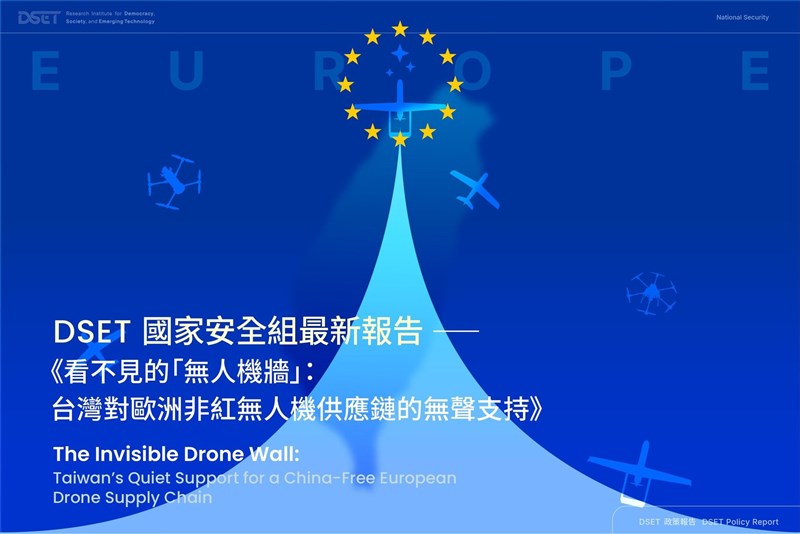
Taipei, April 23 (CNA) There is significant potential for Taiwan and Ukraine to deepen cooperation in drone technology as wartime demand accelerates innovation and exposes supply chain vulnerabilities, analysts at a Taipei-based think tank said Thursday.
Speaking at a report launch hosted by the Research Institute for Democracy, Society and Emerging Technology (DSET), DSET policy analyst Samara Duerr said Ukraine has become "the largest and most advanced testing ground" for unmanned aerial vehicles (UAVs), with drones now accounting for an estimated 95 percent of battlefield casualties.
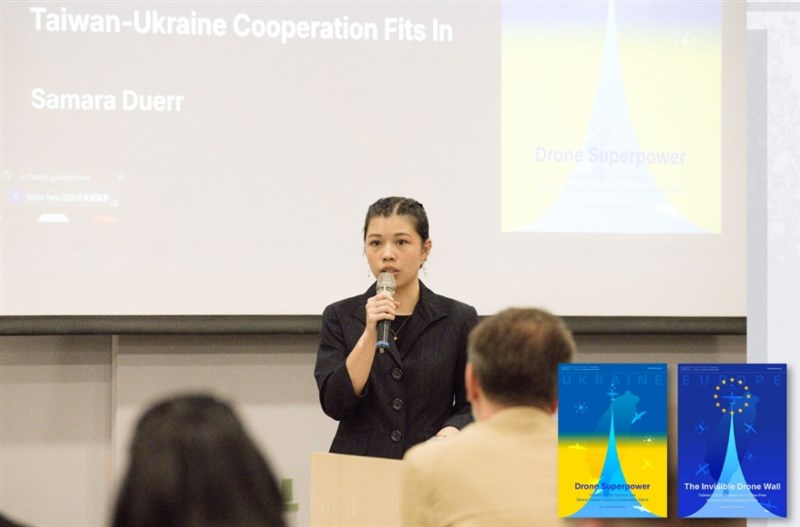
Duerr said Ukraine's rapid innovation cycle -- driven by frontline feedback and decentralized procurement -- has shortened development timelines from months to as little as four to six weeks, as battlefield data is fed directly back into production.
She added that while Ukraine could scale production to up to 20 million drones in 2026 if sufficiently funded, the system remains dependent on imported components, creating opportunities for partners such as Taiwan.
Echoing the findings, Taiwan National Drone Industry Association (TNDIA) President Max Lo (羅正方) said the war in Ukraine has underscored the growing cost imbalance in modern warfare, where relatively inexpensive drones can overwhelm costly air defense systems.
"If you want to fire a US$4 million missile to intercept a US$20,000 Shahed drone, that is not a good way," he said.
Ukraine's drone production still relies heavily on Chinese components, Lo noted, highlighting both the risks of supply disruption and the need for alternative suppliers.
He said Taiwan could help fill that gap by providing key components such as chips, batteries and motors.
On the European front, DSET non-resident fellow Lin Ting-wei (林庭葦) said Taiwan has already entered Europe's drone supply chain in an "invisible way," given that "much of what is happening … is not very widely known and is very low profile."
Lin said Taiwan's exports of complete drones to Europe surged more than 40-fold between 2024 and 2025, with shipments concentrated in Central and Eastern Europe, including Poland and the Czech Republic, and likely transferred onward to Ukraine.
However, Lin warned that this cooperation remains precarious due to a lack of formal recognition in the European Union's strategic framework.
Unlike in the United States, where Taiwan is supported by clear procurement and certification pathways, the EU's defense roadmap prioritizes working with member states and NATO; it mentions potential partners such as Japan and India, but not Taiwan, Lin noted.
"Taiwan is already in the global supply chain, but fragmented cooperation does not survive," Lin said, noting that without a common door to work through, Taiwanese manufacturers must navigate a patchwork of varying procurement rules across different member states.
Providing a broader context, DSET policy advisor Cathy Fang (方怡然) said Taiwan's drone industry has expanded rapidly over the past year, with the number of participating companies rising from 50 to 260.
Taiwan exported 123,000 drones in 2025, while exports in the first quarter of 2026 alone have already surpassed that figure, Fang said, adding that challenges remain, including limited production scale and supply chain bottlenecks.
- Society
DPP township council candidate dies after collapsing on stage
09/23/2026 11:52 AM - Science & Tech
Taiwan part of WorldSkills Competition opening ceremony in China
09/23/2026 10:53 AM - Business
U.S. dollar down in Taipei trading
09/23/2026 10:17 AM - Society
Taiwan headline news
09/23/2026 10:05 AM - Business
Taiwan shares open higher
09/23/2026 09:15 AM