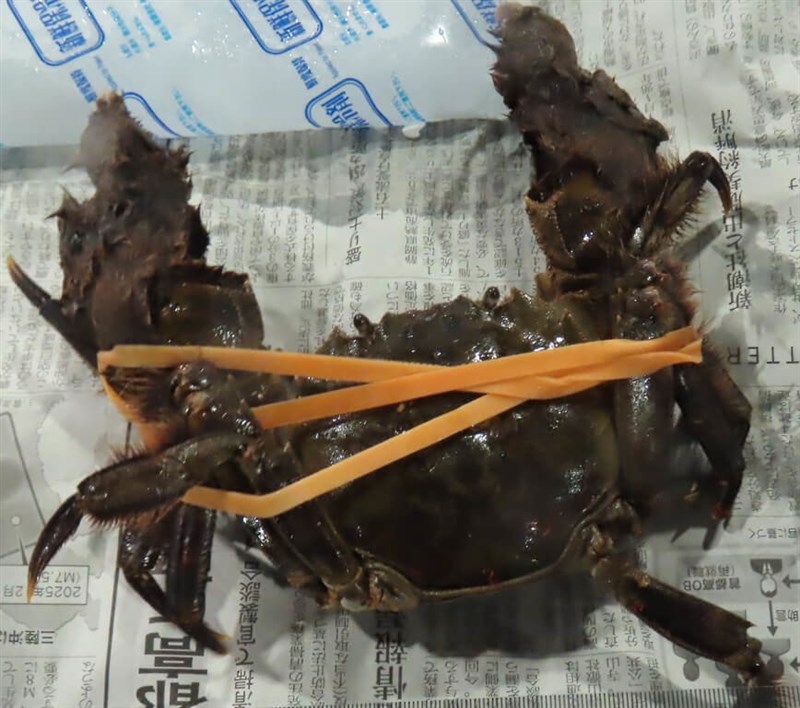
Taipei, June 9 (CNA) Two shipments of Japanese mitten crabs imported into Taiwan were found to contain excessive levels of dioxins, marking the first border inspection violation involving the product in three years, the Taiwan Food and Drug Administration (TFDA) said Tuesday.
The shipments, weighing a combined 10 kilograms, were ordered returned or destroyed, the TFDA said in its weekly border inspection report.
According to the agency, the crabs were found to contain dioxin levels of 4.5 picograms and 8.0 picograms per gram in two shipments, respectively, with the second shipment also recording a combined level of dioxins and dioxin-like polychlorinated biphenyls (PCBs) of 10.1 picograms per gram.
Liu Fang-ming (劉芳銘), director of the TFDA's Northern Taiwan Management Center, said Taiwan's regulatory limit is 3.5 picograms per gram for dioxins and 6.5 picograms per gram for the combined concentration of dioxins and dioxin-like PCBs.
Following the latest findings, all future Japanese mitten crab imports will be subject to batch-by-batch inspections from June 4, 2026, through June 3, 2027, Liu said.
The agency reviewed import records from the past three years and found that 63 shipments of Japanese mitten crabs had been declared for import, with 22 batches sampled and tested. The two shipments announced Tuesday were the only ones found to be non-compliant.
Japanese mitten crabs, which belong to the same genus as Chinese mitten crabs but are a different species, had previously been subject to routine random inspections at a rate of 2-10 percent, Liu said.
The stricter surveillance measure will remain in place throughout the inspection period, regardless of whether future shipments meet inspection standards, he added.
Speaking to local media, Yen Tzung-hai (顏宗海), director of Clinical Poison Center at Chang Gung Memorial Hospital, said dioxins are often referred to as the "poison of the century" and comprise a group of more than 400 chemical compounds.
He said dioxins are typically generated through industrial processes, including the incomplete combustion of waste materials containing certain chemicals.
According to Yen, short-term exposure to high levels of dioxins can cause skin disorders and liver abnormalities, while long-term low-dose exposure may increase cancer risk, impair immune function and contribute to reproductive and developmental problems.
As dioxins tend to accumulate in internal organs and fatty tissue and there is no specific antidote, Yen recommended consuming more fresh fruit and vegetables while limiting the intake of offal and fatty foods.
- Sports
Men's archery, esports give Taiwan 2 more bronzes at Asian Games
09/30/2026 08:32 PM - Society
Cooler, wetter weather forecast in northern Taiwan next week
09/30/2026 07:25 PM - Politics
Taiwan, Belize sign agreements to enhance collaboration during FM's visit
09/30/2026 07:08 PM - Society
AGC Display Glass employees protest at MOL ahead of 10/5 strike
09/30/2026 06:53 PM - Culture
CNA to relaunch Spanish-language Focus Taiwan with AI assistance
09/30/2026 05:59 PM