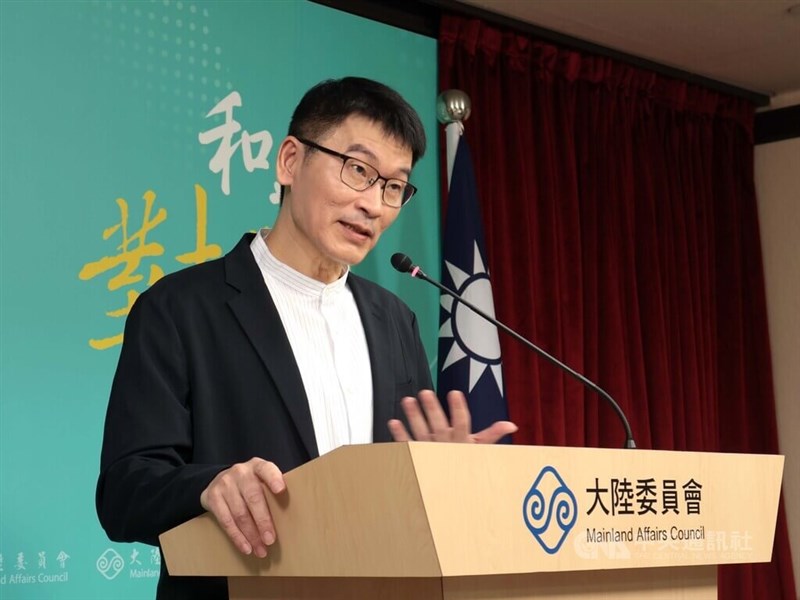
Taipei, July 16 (CNA) A serving Taiwanese police officer and a retired officer were questioned by Chinese state security personnel in Fujian Province in June, while four other Taiwanese reported missing in China this month were said to be detained, the Mainland Affairs Council (MAC) said Thursday.
The Chinese personnel "knew that the two officers had previously worked at a particular government agency" and focused their questioning on the organizational structure and lists of Taiwan's critical infrastructure, MAC deputy head and spokesperson Liang Wen-chieh (梁文傑) told a regular news briefing in Taipei.
Liang did not reveal the agency where the two had worked or specify which critical infrastructure was discussed.
Under Taiwan's classification, critical infrastructure encompasses nine sectors, including energy, water resources, communications, transportation, finance, government agencies and food, hospitals, science and industrial parks.
Chinese officials also examined the officers' mobile phones to determine whether they remained in contact with the agency and questioned them about personal details concerning their families and children, Liang said.
The officers were later released and returned to Taiwan but were told not to report the incident to Taiwanese authorities, according to Liang.
Travel approval rules
Under the Cross-Strait Act, certain categories of people, including county magistrates, city mayors and personnel whose work involves national security, must obtain approval from a central review committee before traveling to China.
The committee comprises representatives from central government agencies, including the Ministry of the Interior and MAC.
However, civil servants at Grade 10 or below and police officers at Grade 4 or below are exempt if their duties do not involve national security, national interests or classified matters.
Such lower-ranking civil servants and police officers are currently required only to obtain approval from their own agencies before traveling to China, according to guidelines published on the MOI's website.
The serving officer's rank was not high enough for the trip to require a review by the central review committee, while the retired officer was not subject to post-retirement travel restrictions, Liang said.
However, their previous work involving critical infrastructure should have been deemed related to national security or classified information and therefore subject to a central committee review, he added.
MAC will ask government agencies to tighten their handling of similar applications, Liang said, adding that travel should not be approved simply because an officer is relatively low ranking and describes the trip as tourism.
Four detained
Meanwhile, Liang noted that four Taiwanese traveling together in China are being detained for unknown reasons, while five others reported missing this month remain unaccounted for.
The four were among 10 Taiwanese whose families reported losing contact with them in China in July. Their relatives learned they were in detention through telephone calls from the travelers themselves, Liang said.
MAC also strongly suspects that another person among the 10 has been detained, while authorities have obtained no information about the remaining five, he said.
Taiwanese police will seek information from their Chinese counterparts, although Beijing has responded inconsistently to such requests, citing political preconditions, Liang said.
When the cross-strait joint crime-fighting mechanism functioned normally, authorities could verify whether Taiwanese reported missing had merely lost contact or had been detained, he said.
Taiwan now often has to seek information through Taiwanese business associations and other informal contacts in China, making such cases more difficult to handle, Liang added.
- Politics
228 foreign guests to attend 2026 ROC National Day celebrations: MOFA
10/08/2026 08:53 PM - Business
September exports hit record monthly high, extend growth to 35 months
10/08/2026 08:52 PM - Politics
MAC slams Beijing over threats tied to Kevin Tsai's campaign appearance
10/08/2026 08:29 PM - Politics
Taipei mayor candidates Chiang, Shen spar over Songshan Airport plan
10/08/2026 08:22 PM - Society
Northeasterly winds to bring rain to parts of Taiwan over holiday weekend
10/08/2026 07:20 PM