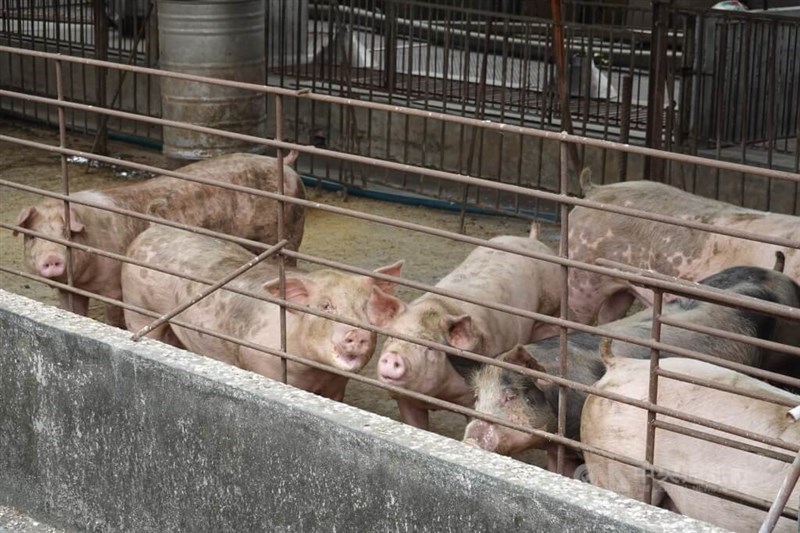
Taipei, Dec. 4 (CNA) Taiwan's Cabinet on Thursday approved a plan at its weekly meeting to phase out the use of food waste in pig farming by Dec. 31, 2026, paving the way for a full ban starting in 2027 as part of efforts to prevent African swine fever.
Under the plan presented by the Ministry of Agriculture (MOA) and the Ministry of Environment (MOENV) during the meeting, 2026 will serve as the transition year.
Food-waste feeding will be permitted only under strict conditions during that period, after which it will be fully prohibited. Farmers will be given a one-year grace period and financial incentives to switch to commercial feed.
During the transition year, farms may use food waste only with local government approval and after they meet several requirements, including installing heat-treatment and video monitoring systems, adding GPS tracking to transport vehicles and passing interagency inspections. Only business-generated food waste, animal by-products and slaughterhouse scraps will be allowed, while household food waste will be banned.
• Unsterilized food waste likely source of swine fever outbreak: Official
During that year, the MOA will provide NT$3,600 (US$115) per head in feed subsidies for farmers who immediately switch to feed-only operations. Additional support includes NT$300,000 to NT$3 million per farm depending on size, as well as access to interest-subsidized agricultural loans.
Farmers who continue using properly processed food waste during the transition year will remain eligible for subsidies, but at half the rate -- NT$1,800 per head -- along with other forms of support.
The MOA said the higher incentive for early adopters is designed to accelerate the shift and ensure fairness.
For producers of traditional black pigs, which are often raised on food waste, the MOA said it would establish a dedicated task force and develop specialized feed formulas.
Cabinet spokesperson Michelle Lee (李慧芝) said Premier Cho Jung-tai (卓榮泰) instructed the MOA and MOENV to assist local governments in enforcing strict controls during the transition and to accelerate the development of food-waste recycling and treatment facilities.
Cho also called for full implementation of the ban by Dec. 31, 2026, to ensure a smooth nationwide shift in 2027, according to Lee.
-
Politics
KMT's Cheng to visit U.S. June 1, with stops in New York, D.C., Boston: Source
05/24/2026 08:10 PM -
Politics
Taiwan, Chinese coast guard vessels in standoff near Dongsha Island
05/24/2026 06:12 PM -
Business
Cosmed, Starbucks target further expansion after reaching 600 stores
05/24/2026 05:31 PM -
Politics
Probe clears ex-Ma Ying-jeou Foundation employees of wrongdoing
05/24/2026 04:41 PM -
Sports
Taiwan's Teng gives season-best start in Astros' 3-0 win over Cubs
05/24/2026 03:10 PM