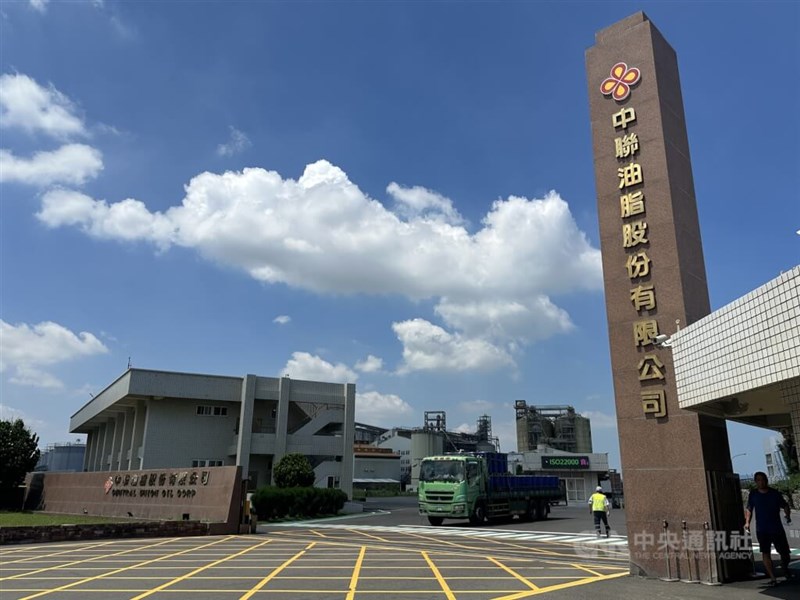
Taipei, July 7 (CNA) Central Union Oil Corp. has been fined NT$165.2 million (US$5.2 million) for not immediately reporting that its soybean oil was found to contain excessive levels of the carcinogen benzo[a]pyrene (BaP).
It was the largest fine ever imposed by a central government agency in a food safety case, the Ministry of Health and Welfare (MOHW) said Tuesday.
Health Minister Shih Chung-liang (石崇良) said an investigation found that Central Union had not immediately notified authorities of the problem and had provided inaccurate information during the probe.
The company was penalized under the Act Governing Food Safety and Sanitation, and the fine, which was calculated based on the severity of the violation and the impact of the tainted product's distribution, represented the maximum fine possible, Shih said.
• Prosecutors probe Central Union liability for tainted cooking oil
The soybean oil produced by Central Union contained 8.1 micrograms per kilogram of BaP, exceeding Taiwan's legal limit of 2 ppb.
About 1,300 metric tons of the tainted soybean oil produced by Central Union entered the supply chain through three downstream companies -- Taisun Enterprise Co., Fwusow Industry Co. and Formosa Oilseed Processing Co.
A recall of Central Union's problem oil and the products made by the three companies using the tainted oil was ordered on July 1, but by July 3, only 17 metric tons had been recovered.
On July 4, the recall was expanded to further downstream products that contained at least 20 percent of the affected oil.
On Tuesday, Shih said the recall order had been expanded again to cover all downstream products made with the tainted oil, regardless of the proportion used, meaning that any product that used soybean oil from the tainted batch will be removed from circulation.
Shih said the investigation found reporting problems throughout the process, including by the Namchow Group, Fwusow and Taisun.
Namchow was the first company to discover excessive BaP levels through its own testing on May 13, Shih said, but it failed to immediately notify health authorities after receiving the test results.
The MOHW said Namchow notified Fwusow of the abnormal test results on June 10, and Fwusow informed Central Union the following day.
Central Union conducted further tests on June 16 and June 25, received confirmation of abnormal results on June 29, and reported the issue to the Taiwan Food and Drug Administration on June 30, Shih said.
Meanwhile, Education Minister Cheng Ying-yao (鄭英耀) said Tuesday that 165 schools had reported using some of the affected oil products. All schools have been instructed to stop using the products and remove them as a precaution.
The Ministry of Education said 18 cities and counties had confirmed that their schools had not used the affected oil, while authorities in Taipei, New Taipei, Taichung and Keelung reported use of the products by some schools in their cities.
- Society
Taiwan headline news
10/18/2026 12:07 PM - Politics
Taiwan security chief urges closer Europe ties against authoritarianism
10/17/2026 09:19 PM - Sports
Gant's eight scoreless innings lift Dragons to win in Taiwan Series opener
10/17/2026 08:26 PM - Society
Fees proposed for new Qilai Mountain Cabin, Paiyun Lodge rate hike
10/17/2026 07:57 PM - Society
Typhoon Champi could approach or cross Taiwan next week: CWA
10/17/2026 06:15 PM