INTERVIEW/Ex-U.S. intelligence chief urges 'haste' in Taiwan's defense budget review
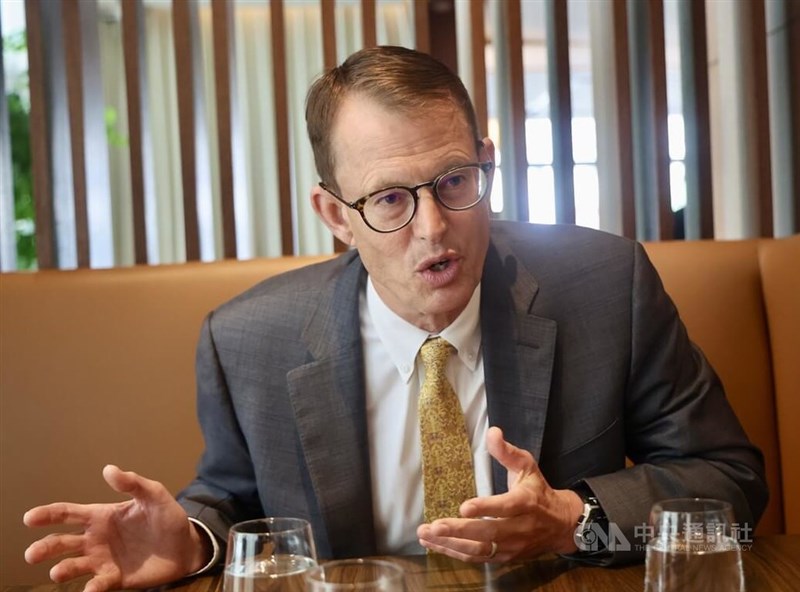
Taipei, April 30 (CNA) A former intelligence chief of the United States Indo-Pacific Command (INDOPACOM) has called on Taiwan's Legislature to pass a NT$1.25 trillion (US$39.56 billion) supplementary defense budget "with all due haste," saying that Taiwan should look beyond 2026 and not allow "temporary" headwinds to derail its critical defense strategy.
Michael Studeman, a recognized expert on Asian affairs and national security, is in Taiwan to meet with government officials to discuss issues relating to Taiwan's security and to promote the Chinese-language edition of his book "Might of the Chain: Forging Leaders of Iron Integrity."
In an interview Wednesday with CNA, Studeman said "the Davidson window" still stands despite a report published last month by the U.S. Intelligence Community assessing that Chinese leaders do not currently plan to invade Taiwan in 2027.
The Davidson window refers to a time frame first brought to the attention of the U.S. Senate in 2021 by former INDOPACOM Commander Philip Davidson, which indicated that the Chinese military was working to develop the capabilities to attempt a takeover of Taiwan between then and 2027, under the direction of Chinese President Xi Jinping (習近平).
Studeman, a retired U.S. Navy rear admiral, said that time frame was meant to highlight China's overarching strategic ambition, not to predict what would happen.
Taiwan, however, needs to "meet that strategic ambition with strategic defense ambition that would truly be up to the task," he said.
Citing the occasional large-scale Chinese military exercises encircling Taiwan in recent years and China's intensifying "gray zone" harassment, Studeman said Taiwan should be "on guard."
"The world is proving to be volatile and unpredictable, and any combination of events can skew things into a different situation altogether," said Studeman, who served as director of the National Maritime Intelligence-Integration Office and commander of the Office of Naval Intelligence from August 2022 to July 2023.
On the issue of Taiwan's proposed NT$1.25 trillion special defense budget that has been stalled in the Legislature for months, Studeman urged foresight in reviewing the budget, which was proposed by the Cabinet and includes funding for future arms purchases from the U.S.
The opposition Kuomintang and Taiwan People's Party, which together hold a legislative majority, have been blocking the 2026-2033 special budget, arguing that among other issues, approval of the eight-year NT$1.25 trillion special defense budget would give the government a blank check to bypass routine annual legislative oversight.
According to political commentators in Taiwan, another factor might be the low chances of the U.S. Congress approving additional arms sales to Taiwan this year, given that U.S. President Donald Trump seems poised to strike a trade deal with Chinese leader Xi when they meet in Beijing May 14-15.
Studeman said in Wednesday's interview, however, that "the importance of getting the US$40 billion through the Legislative Yuan is indisputable in terms of the danger to Taiwan and the need to get real capability real fast."
While there may be some efforts to create a positive atmosphere for a trade deal, they are temporary and only apply in the near term, he said.
"Over the long haul, Taiwan needs to get that money allocated so you can do the multi-year planning and funding for a full variety of weapon systems," said Studeman, who served as Director of Intelligence of INDOPACOM from 2019 to 2022.
While much of the attention on the defense budget is focused on the estimated NT$800 billion in U.S. foreign military sales to Taiwan, there are funds earmarked for direct commercial sales that would give Taiwan more "options," he said.
"The foreign military sales program tends to be very structured, very disciplined, very set-piece, and very slow," Studeman said, adding there are different routes to access the capabilities Taiwan seeks.
"Where one may slow down, the dynamic decisions within the government should be to be able to adjust paths and look at other ways to be able to get the capability in," Studeman said.
The special defense budget, planned by Taiwan's Ministry of National Defense, in consultation with the U.S. government, is "sound and reasonable," and should therefore be pursued "with all due haste," he said.
The fact that there are "obstructionists" in the Legislature "makes little sense," he added.
"We need to make sure that we have a sense of urgency on this," Studeman said. "And those people in the Legislative Yuan who want to slow this down and dilute the budget, to me, are risking Taiwan's freedom by delaying it."
In his book, Studeman writes that he believes China could launch an attack on Taiwan within this decade.
Challenges in intelligence sharing
On the question of Taiwan and the U.S. strengthening intelligence sharing, Studeman said Taiwan first has to step up its counterintelligence work against China.
There has been a "night-and-day" difference between the current level of information sharing and what existed six or seven years ago between the U.S. and Taiwan, driven by deepening trust and more frequent contact, Studeman said.
"At the same time, what limits some of the cooperation is the ability to protect secrets," he said, adding that the counterintelligence challenge in Taiwan is "one of the most significant on Earth."
"We have to be very sensitive about how much detail, how much information we provide, because we can't just give it over knowing that the Chinese are going to get it soon after," Studeman said.
While Taiwan has made progress in bolstering cybersecurity and physical security, and it has stiffened penalties for people found to have leaked secrets to China, its work in these areas "could be much better," he said.
When Taiwan has strengthened its ability to protect intelligence, the U.S. side would likely be willing to share even more, said Studeman, who was also previously the Director of Intelligence of the United States Southern Command.
However, the Taiwanese public "would be pleasantly reassured that there is the right amount of dialogue going on in the right places," he said.
![Belize PM Briceño seeks deeper cooperation with Taiwan, invites investment]() Belize PM Briceño seeks deeper cooperation with Taiwan, invites investmentBelize Prime Minister John Briceño has called for deeper cooperation with Taiwan through investment, technology exchanges, and people-to-people ties, saying that he hopes those links will contribute to his country's development.10/15/2026 02:19 PM
Belize PM Briceño seeks deeper cooperation with Taiwan, invites investmentBelize Prime Minister John Briceño has called for deeper cooperation with Taiwan through investment, technology exchanges, and people-to-people ties, saying that he hopes those links will contribute to his country's development.10/15/2026 02:19 PM![New ECCT chair urges greater agility in Taiwan's software, energy sectors]() New ECCT chair urges greater agility in Taiwan's software, energy sectorsTaiwan is known for its strength in hardware manufacturing, but Frank Grunert, the new chairperson of the European Chamber of Commerce Taiwan (ECCT), sees considerable potential in software as well.10/10/2026 12:36 PM
New ECCT chair urges greater agility in Taiwan's software, energy sectorsTaiwan is known for its strength in hardware manufacturing, but Frank Grunert, the new chairperson of the European Chamber of Commerce Taiwan (ECCT), sees considerable potential in software as well.10/10/2026 12:36 PM![Strategic partnership key to Taiwan-U.K. cooperation: Deputy economics minister]() Strategic partnership key to Taiwan-U.K. cooperation: Deputy economics ministerTaiwan's Deputy Minister of Economic Affairs Cynthia Kiang (江文若), who has just concluded an annual economic and trade dialogue with her U.K. counterpart in London, said Friday that establishing a strategic partnership is key to bilateral cooperation.10/03/2026 01:53 PM
Strategic partnership key to Taiwan-U.K. cooperation: Deputy economics ministerTaiwan's Deputy Minister of Economic Affairs Cynthia Kiang (江文若), who has just concluded an annual economic and trade dialogue with her U.K. counterpart in London, said Friday that establishing a strategic partnership is key to bilateral cooperation.10/03/2026 01:53 PM
- Politics
Taiwan security chief urges closer Europe ties against authoritarianism
10/17/2026 09:19 PM - Sports
Gant's eight scoreless innings lift Dragons to win in Taiwan Series opener
10/17/2026 08:26 PM - Society
Fees proposed for new Qilai Mountain Cabin, Paiyun Lodge rate hike
10/17/2026 07:57 PM - Society
Typhoon Champi could approach or cross Taiwan next week: CWA
10/17/2026 06:15 PM - Business
CPC freezes fuel prices for fifth straight week
10/17/2026 05:46 PM