Researchers identify extinct Ice Age peacock species from rare fossil
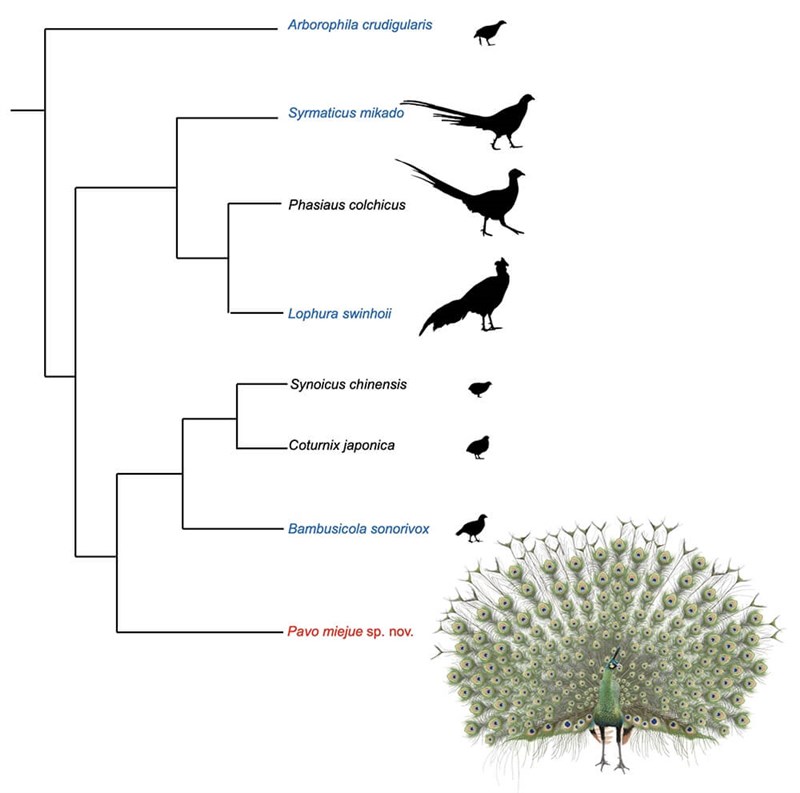
Taipei, June 12 (CNA) National Taiwan University (NTU) researchers have identified an extinct Ice Age peacock species previously endemic to Taiwan, filling a long-standing gap in the island's bird fossil record.
The study, published May 20 in the international journal Royal Society Open Science, was announced Friday on the school's website.
The research's first author, Lan Yung-chieh (藍詠傑), conducted the study under the supervision of Tsai Cheng-hsiu (蔡政修), an associate professor at NTU's Institute of Ecology and Evolutionary Biology, in collaboration with Gerald Mayr of the Senckenberg Research Institute in Germany.
The findings are based on a well-preserved humerus fossil donated by fossil collector Hou Li-jen (侯立仁), NTU said.
Through detailed morphological analysis, the researchers concluded the fossil belonged to a previously unknown Taiwan-endemic bird species during the Pleistocene era (2.58 million-11,700 years ago), which they named "Pavo miejue", NTU said.
The species, Pavo miejue, was larger than the bird featured on the NT$1,000 banknote, the Mikado pheasant, Taiwan's largest extant endemic bird.
The researchers said Pavo miejue, meaning "extinct peacock," is the first extinct Pleistocene bird species identified in Taiwan. They said the name was chosen to draw public attention to past extinction events.
Pleistocene epoch bird fossils are rare in East Asia, limiting understanding of regional avian extinctions, according to the study's abstract.
The researchers said studying past extinction events could help inform understanding of the ongoing Holocene extinction, a term used to describe current species losses linked to human activity.
The discovery extends the known range of the genus Pavo, which includes peafowl, into East Asia, according to the study.
- Sports
Taiwan bags 5 more bronze medals at Asiad
09/25/2026 08:15 PM - Sports
Taiwan swimmer Wang Kuan-hung bags men's 200m butterfly gold (update)
09/25/2026 07:48 PM - Sports
Taiwan swimmer Wang Kuan-hung bags men's 200m butterfly gold
09/25/2026 06:37 PM - Politics
MOFA rejects Xi remarks on Taiwan during U.S. visit
09/25/2026 06:24 PM - Sports
Young skateboarders achieve milestones for Taiwan at Asian Games
09/25/2026 05:35 PM