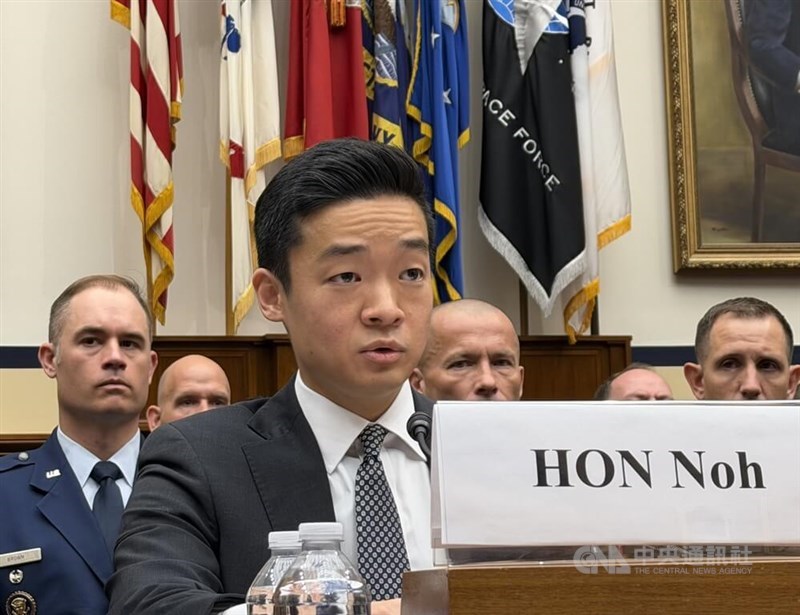
Washington, April 22 (CNA) A senior official at the U.S. Department of Defense on Wednesday urged Taiwan's political parties to work together to approve a special defense budget, saying that the United States has multiple tools to provide security assistance to Taiwan.
Speaking at a House Armed Services Committee hearing, John Noh, assistant secretary for Indo-Pacific security affairs at the Defense Department, cited the United States' Foreign Military Sales (FMS) program, Taiwan Defense Act, and Taiwan Security Cooperation Initiative as the basis for such assistance.
"We're actively working to present options to our leadership, including to (Defense) Secretary Hegseth and the president, on different ways to provide security assistance to Taiwan and will continue to do so," Noh said.
In a written statement on Wednesday, Noh said the U.S. military cannot and should not maintain a favorable balance of power in the Indo-Pacific alone. He called on wealthy and capable allies and partners to increase defense spending and share the burden of sustaining deterrence, saying this is particularly critical for Taiwan.
He noted that Taiwan President Lai Ching-te (賴清德) has committed to raising core defense spending to 5 percent of GDP by 2030, including an unprecedented special defense budget to fund many of Taiwan's most critical defense gaps.
Late last year, Lai proposed an eight-year NT$1.25 trillion (US$39.69 billion) special defense budget, but the plan has been facing resistance from opposition parties, which have proposed lower funding ranging from NT$380 billion to NT$400 billion.
Noh said his department has been working closely with Taiwan's Ministry of National Defense on its historic special defense budget and is encouraging Taiwan's political parties to cooperate in passing the budget to fund its requirements.
"Still, Taiwan must do more, and faster, to build on this positive momentum and ensure it has the self-defense capability to meet the scale of the threat it faces," he added.
Meanwhile, Adm. Samuel Paparo, commander of the U.S. Indo-Pacific Command, was asked at the hearing about delays in the delivery of F-16 fighter jets ordered by Taiwan from the U.S.
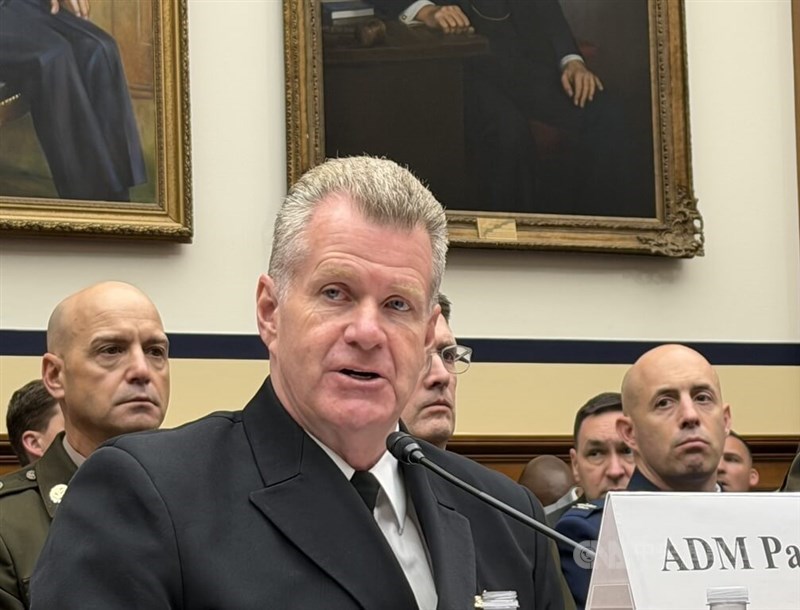
"The State Department is working hard to fix those problems," Paparo said, adding that Taiwan's integrated air and missile defense would be "absolutely critical."
"So, I think it's important that every FMS delivery is delivered, not just on time, but early," he added.
Paparo was also asked about possible non-kinetic measures China could use to gain control over Taiwan, including united front work, information warfare, and lawfare operations, which refer to the use of legal systems and tools to advance political or strategic objectives.
Careful detailed planning is in place for all of those scenarios, Paparo said, adding other possible risks include a near or full blockade of Taiwan and seizure of its outlying islands.
In a written statement on Wednesday, Paparo said Beijing will not rule out the use of force against Taiwan.
China's increasingly aggressive actions near Taiwan serve not just as exercises but as rehearsals for potential forced unification, he said.
- Sports
Taiwan bags silver medals in men's, women's team soft tennis
09/20/2026 07:57 PM - Politics
Labor minister heads to China for APEC meeting
09/20/2026 07:56 PM - Society
Favorable weather to allow Mid-Autumn Festival moon gazing: CWA
09/20/2026 07:40 PM - Culture
Lai outlines 4 priorities for Taiwan's cultural future at congress
09/20/2026 07:20 PM - Society
Over 21,000 swimmers participate in annual Sun Moon Lake swim fest
09/20/2026 04:56 PM