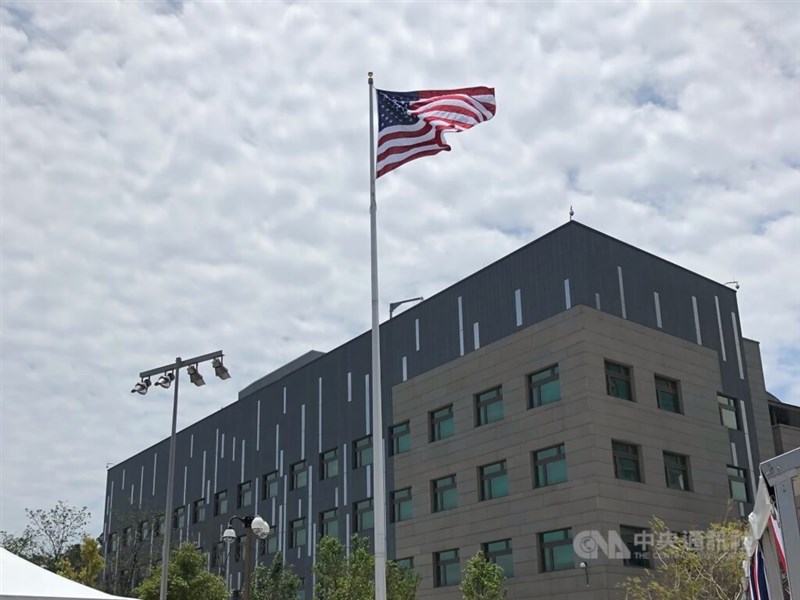
Taipei, April 10 (CNA) Meaningful cross-Taiwan Strait exchange requires unconditional dialogue between Beijing and Taiwan's elected leadership, alongside engagement with all political parties, the American Institute in Taiwan (AIT) said Friday.
In response to an inquiry from CNA about the meeting between Kuomintang (KMT) Chairperson Cheng Li-wun (鄭麗文) and Chinese President Xi Jinping (習近平) that took place in Beijing Friday, the AIT said the United States supports cross-strait dialogue.
"We expect cross-strait differences to be resolved by peaceful means, free from coercion, in a manner acceptable to the people on both sides of the Strait," the AIT said.
Meaningful cross-strait exchange should focus on dialogue between Beijing's leadership and Taiwan's democratically elected authorities without preconditions, while also including engagement with all other political parties in Taiwan, the AIT added.
Beijing has suspended official cross-strait dialogue since the Democratic Progressive Party (DPP) assumed power in 2016, citing the administration's rejection of the "1992 consensus," referencing a tacit understanding between Beijing and Taiwan's then KMT government in 1992 that there is "one China," with each maintaining their own interpretations of what that means.
At their meeting, Cheng and Xi reaffirmed the "1992 consensus," opposition to Taiwan independence and emphasized the shared interests of the Chinese nation.
Speaking to CNA, Wang Hsin-hsien (王信賢), director of the Institute of International Relations at National Chengchi University, noted that Xi struck a more conciliatory tone than in the past, pointing out that the Chinese president reaffirmed the "1992 consensus" without explicitly mentioning "one China."
Wang noted that Xi's omission of "one China" during his meeting with Cheng -- the first encounter between leaders of the KMT and Chinese Communist Party in a decade -- was also seen as a positive development for Taiwan's main opposition party.
Wang attributed Xi's softer tone to Taiwan's shifting political landscape, specifically the DPP's unprecedented third consecutive presidential term.
Beijing is also seeking to project regional stability in the lead up to a meeting between Xi and U.S. President Donald Trump, scheduled for May 14-15, aiming to seize the moral high ground while the U.S. remains preoccupied with the war in Iran, Wang added.
According to Wang, the decision to host Cheng was finalized by Xi to bolster his hand in upcoming negotiations with Trump.
Wang noted that Xi will frame Cheng's visit as a signature achievement of his cross-strait policy -- one destined to be "formally documented in the political report of the 21st National Congress" in 2027, when Xi is expected to seek an unprecedented fourth term.
Commenting on the implications of the Cheng-Xi meeting at home, Wang said the trip will augment Cheng's political capital, strengthening her influence among the KMT's top leadership.
Cheng's framing of the mission within a "cross-Strait peace" narrative will also pose a significant challenge to the ruling DPP's current position, he added.
- Politics
- Society
Scattered showers expected in Greater Taipei, eastern Taiwan Saturday
10/03/2026 10:41 AM - Society
Taiwan headline news
10/03/2026 10:22 AM - Sports
'Hao-yu like that?' A deep dive into Lee's rookie MLB season
10/03/2026 10:00 AM - Sports
Taiwan boosts medal haul in multiple events at Asian Games on Friday
10/02/2026 08:55 PM