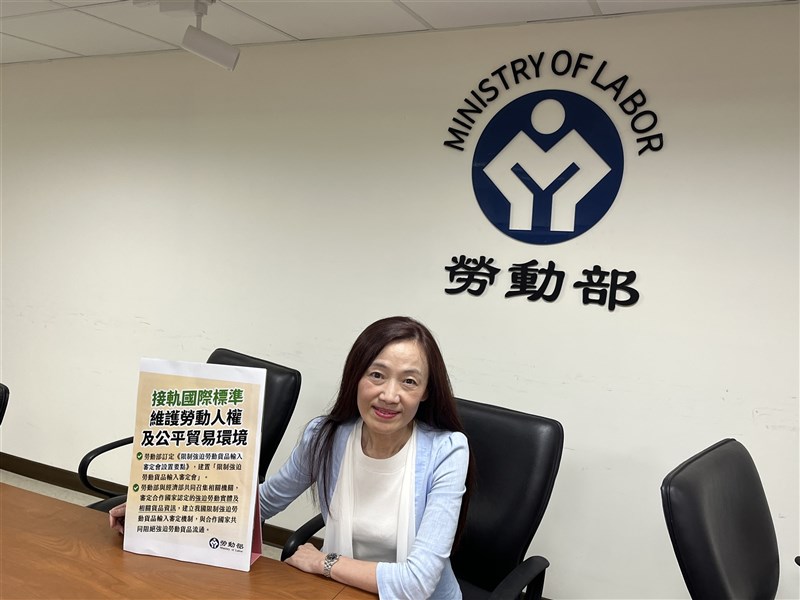
Taipei, July 30 (CNA) Taiwan's economic and labor ministries on Thursday established a cross-agency mechanism to block goods linked to forced labor from entering the country, in part to fulfill Taiwan's trade commitments to the United States.
Under the mechanism, the Ministry of Economic Affairs (MOEA) will forward information on goods identified by partner countries as involving forced labor to the Ministry of Labor (MOL), which will initiate a review, according to news releases issued by the two ministries.
A 12-member committee jointly convened by the two ministries and comprising representatives from government agencies including the Cabinet's Office of Trade Negotiations and the Ministry of Foreign Affairs will determine whether the goods should be barred from entering Taiwan.
According to MOL, the mechanism was established in part to implement Taiwan's commitment under the Taiwan-U.S. Agreement on Reciprocal Trade (ART), signed in February, to enforce a ban on imports produced using forced labor.
At a news briefing, Huang Chi-ya (黃琦雅), head of MOL's Department of Labor Standards and Equal Employment, said the committee would meet as cases arise rather than on a fixed schedule.
"Once a case comes in [from a partner country], we will convene immediately," Huang said, adding that no cases have yet been referred.
Asked how "partner countries" would be defined, Huang said only that Taiwan currently has a related agreement with the United States, while the MOEA would determine the scope of countries covered by the mechanism.
In response to CNA, the MOEA said Taiwan will reference information on cases already determined or subject to enforcement action by partner countries, including "goods identified by U.S. customs authorities as involving forced labor," before conducting its own "independent review."
The ministry did not specify which other countries would be considered partners or identify any goods currently under consideration.
When a case is received, four designated committee members will first consider whether to recommend a temporary import restriction, Huang said.
The full committee must reach a decision within 30 days of receiving complete information, according to Huang.
The committee's review will focus on whether the case involves any of the International Labour Organization's 11 indicators of forced labor and whether the company concerned has taken corrective action, she said.
"We will not rely entirely on the partner country's determination; otherwise, there would be no need to establish a review committee," she said.
If necessary, Taiwan could also use its diplomatic network to gather information about overseas companies, factories and workers, Huang added.
Once a decision is reached, the committee must notify the MOEA or the relevant free trade port authority within five days. The responsible authority will then announce whether the goods are subject to an import restriction, according to the two ministries.
The new mechanism follows a July 23 U.S. decision that grouped 60 trading partners according to their enforcement of forced-labor import policies and granted Taiwan relatively favorable tariff treatment.
MOL said Taiwan's placement in the 10 percent category, with the rate not added on top of most-favored-nation tariffs, reflects the nation's commitment under the ART to ban imports produced using forced labor.
- Sports
Taiwan boosts medal haul in multiple events at Asian Games on Friday
10/02/2026 08:55 PM - Society
Workers at Taiwan snack maker Kuai Kuai extend strike over relocation
10/02/2026 08:45 PM - Business
Chain businesses association seeks more foreign workers
10/02/2026 08:04 PM - Politics
Shen unveils Taipei education platform, Chiang defends free lunches
10/02/2026 06:45 PM - Politics
Taiwan receives first 2 F-16V Block 70s (update)
10/02/2026 06:39 PM