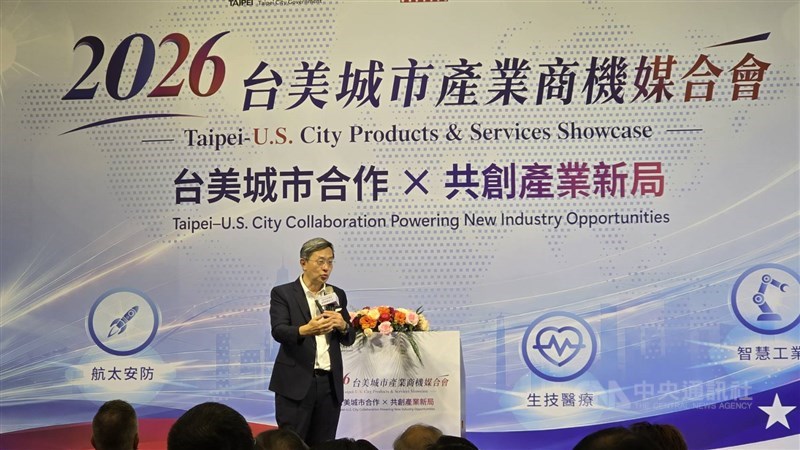
Taipei, July 30 (CNA) Taiwan is moving from a largely invisible supplier to a more influential global player as economic power increasingly shapes international trade, economist Roy Lee (李淳) said Thursday.
Speaking at an event in Taipei, Lee said the shift presents opportunities for Taiwan, whose technological, manufacturing and economic capabilities are gaining greater weight as the rules-based trading order weakens.
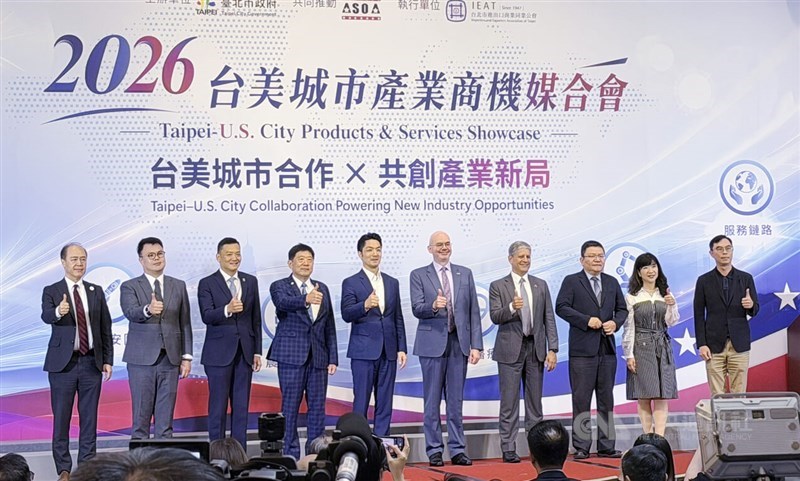
Lee delivered a speech titled "Industrial Opportunities for Taiwan and the U.S. Amid Global Changes" at the 2026 Taipei-U.S. City Products & Services Showcase, held under the theme "Taipei-U.S. City Collaboration: Powering New Industry Opportunities."
Under the previous system, Taiwan was largely excluded from international rule-making and had to follow standards negotiated by others, said Lee, senior deputy executive director of the Chung-Hua Institution for Economic Research's Center for International Trade Policy.
"Taiwan is an economy with real capabilities," he said. "We are being pushed from backstage to the front and are still learning how to act as an economy with a voice and influence."
That transition comes as strategic competition between the United States and China reshapes critical supply chains and technologies, including semiconductors, artificial intelligence, unmanned systems, new energy, advanced materials and biotechnology.
Lee argued that the two economies had passed a "divergence point" in some areas, after which path dependence would make their technologies and supply chains increasingly difficult and costly to reintegrate.
However, he cautioned against viewing the emerging order as two opposing blocs.
The U.S., European Union, Japan and Southeast Asian countries are pursuing varying degrees of de-risking based on their security concerns, industrial structures and dependence on China, he said.
While military and some critical technology supply chains are likely to decouple more extensively, much ordinary trade will remain largely unchanged, Lee said.
"Economic security is not about abandoning efficiency, but about rebalancing security and efficiency," he said, adding that countries would strike that balance differently depending on their circumstances.
Taiwan should therefore tailor its approach to individual partners rather than applying Washington's terminology and priorities universally, Lee said.
"You should not go to ASEAN and talk about decoupling. ASEAN does not want to hear it," he said, referring to the Association of Southeast Asian Nations.
For Taiwan, navigating the fragmented landscape will require more than simply choosing sides, Lee said.
He described competitiveness and "indispensability" as the foundation of Taiwan's economic security, with reduced dependence and resilience against coercion or disruption playing supporting roles.
Greater competitiveness would also strengthen Taiwan's economic autonomy and resilience, he added.
Cooperation with the U.S. could help Taiwan remain close to leading technologies and customers, while successful bilateral projects could bolster its credentials as it seeks closer ties with Japan and the EU, Lee said.
Taiwan should seek to retain its position as a global "kingmaker," he concluded.
"We are not trying to take the throne," he said. "But without Taiwan, it will be difficult for others to compete for it."
- Business
U.S. remains top debtor of Taiwan's banks for 44th straight quarter
10/03/2026 03:14 PM - Sports
Hsieh, Liang claim Asian Games gold in women's doubles tennis
10/03/2026 03:12 PM - Politics
Defense ministry releases images of jets escorting new F-16Vs
10/03/2026 03:05 PM - Culture
Italian translator wins Pisa award for translation of Taiwan novel
10/03/2026 02:43 PM - Business