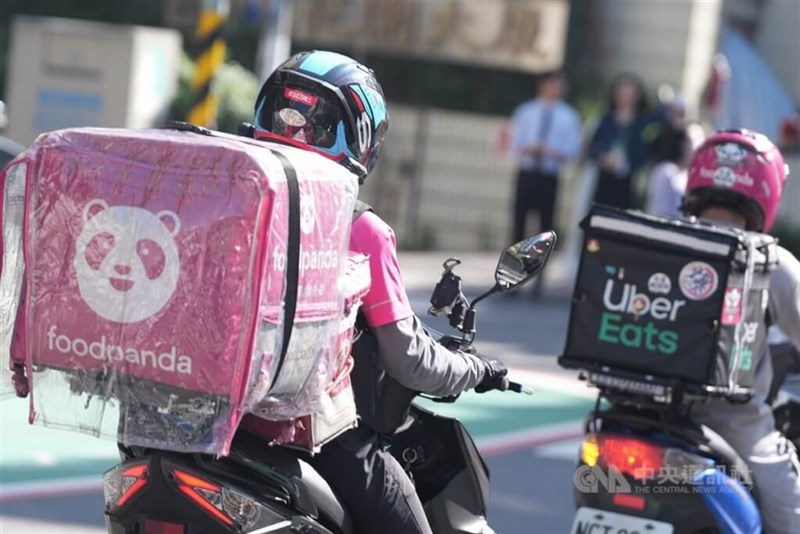
Taipei, March 29 (CNA) Taiwan's food delivery market could undergo a major shift if Singapore-based Grab Holdings Ltd. completes its planned acquisition of Delivery Hero's foodpanda business in Taiwan, industry experts said.
Grab announced on March 23 that it would acquire foodpanda's Taiwan operations for US$600 million. The deal is expected to be finalized in the second half of this year, with user migration to Grab's platform targeted for completion by the first half of 2027.
A duopoly between Uber Eats and foodpanda currently dominates Taiwan's delivery market. The structure has remained intact since the Fair Trade Commission (FTC) blocked Uber Eats' proposed acquisition of foodpanda in December 2024, citing concerns that the combined entity would control about 90 percent of the market.
Experts say Grab's entry would significantly alter competition.
Taiwan Mobile Co. President Jamie Lin (林之晨) said Grab's strength in Southeast Asia lies in its integrated ecosystem, which combines food delivery, ride-hailing and digital payments, along with partnerships in telecommunications and financial services.
If successfully replicated in Taiwan, such a model could shift competition beyond delivery speed and pricing to broader platform ecosystems, including service integration, user engagement and data accumulation, Lin said.
However, analysts cautioned that Taiwan presents structural challenges.
Market analyst Lee Shi-chen (李世珍) said the relatively small market size and dense concentration of food and beverage outlets make delivery services highly substitutable. In addition, a new law passed in January to strengthen protections for delivery workers is expected to increase operating costs.
These factors leave little room for new entrants, Lee said, adding that Grab's decision to enter through acquisition reflects these constraints.
He also noted that building a full-service ecosystem in Taiwan will be difficult, given strong local competition in ride-hailing and other sectors. Grab may need to rely on price incentives to gain market share, while also investing heavily to attract both consumers and merchants.
Lee said delivery platforms must balance three key factors: consumer prices, merchant commission fees and delivery worker pay.
In the short term, increased competition could lead to discounts and promotions that benefit consumers, experts said. However, long-term sustainability will depend on user experience, pricing strategies, and the effectiveness of customer service and dispute-resolution mechanisms.
Analysts highlighted several factors to watch, including the potential for price competition, the pace of Grab's service expansion, and risks related to platform integration. Any disruption during the transition -- such as unstable ordering systems or poor user experience -- could give rivals an opportunity to gain market share.
Meanwhile, Grab on Sunday responded to concerns over its shareholder structure following the acquisition announcement.
Questions have been raised about Uber's "indirect investment" in Taiwan's delivery market through Grab, as the U.S. company is its largest institutional shareholder with a roughly 13.1 percent stake, after its own bid to acquire foodpanda was blocked in 2024.
There were also concerns about potential Chinese capital involvement, as China-based ride-hailing firm Didi Chuxing is among Grab's investors.
Grab said, however, that the voting rights of Uber and Didi Chuxing are limited to less than 4 percent and 1.4 percent, respectively.
It added that Uber does not participate in Grab's operations, and that its nominated board members have recused themselves from decisions related to the Taiwan market.
Fair Trade Commission (FTC) acting chairperson Andy C. M. Chen (陳志民) said Thursday that regulators will assess the deal based on actual control, including the influence associated with a roughly 13 percent equity stake.
The commission will also examine concerns over "indirect investment" and remain alert to potential market concentration or abuse, Chen said.
Founded in 2012, Grab operates as a "super app" across Southeast Asia, offering services including food delivery, ride-hailing and digital payments in more than 900 cities across eight countries, with over 50 million monthly active users.
![Okinawa vote likely to boost Japan's defense buildup, Taiwan security: Scholars]() Okinawa vote likely to boost Japan's defense buildup, Taiwan security: ScholarsThe anti-Henoko "All Okinawa" camp's 12-year hold on the Okinawa governorship ended Sunday when former Naha Deputy Mayor Genta Koja unseated two-term incumbent Denny Tamaki in a six-candidate race.09/15/2026 09:34 PM
Okinawa vote likely to boost Japan's defense buildup, Taiwan security: ScholarsThe anti-Henoko "All Okinawa" camp's 12-year hold on the Okinawa governorship ended Sunday when former Naha Deputy Mayor Genta Koja unseated two-term incumbent Denny Tamaki in a six-candidate race.09/15/2026 09:34 PM![Taiwan, U.S. must counter China gray-zone pressure: Stanford scholar]() Taiwan, U.S. must counter China gray-zone pressure: Stanford scholarTaiwan and the United States need to prepare for a crisis triggered by China's intensifying gray-zone pressure rather than focus only on deterring a full-scale conflict, a Stanford University scholar said Wednesday at a symposium in Taipei.09/09/2026 07:50 PM
Taiwan, U.S. must counter China gray-zone pressure: Stanford scholarTaiwan and the United States need to prepare for a crisis triggered by China's intensifying gray-zone pressure rather than focus only on deterring a full-scale conflict, a Stanford University scholar said Wednesday at a symposium in Taipei.09/09/2026 07:50 PM![China defense mobilization law signals preparations for full-scale conflict: Analysts]() China defense mobilization law signals preparations for full-scale conflict: AnalystsChina's revised National Defense Mobilization Law, which will take effect on Oct. 1, indicates that the Chinese Communist Party (CCP) plans to mobilize the country's full resources in the event of potential conflicts with external adversaries, including Taiwan, according to analysts.09/05/2026 07:24 PM
China defense mobilization law signals preparations for full-scale conflict: AnalystsChina's revised National Defense Mobilization Law, which will take effect on Oct. 1, indicates that the Chinese Communist Party (CCP) plans to mobilize the country's full resources in the event of potential conflicts with external adversaries, including Taiwan, according to analysts.09/05/2026 07:24 PM

- Politics
Taiwan-donated patrol vessel handed to Philippine Coast Guard: Source
09/22/2026 09:13 PM - Business
Taiwan's export orders hit record high in August, surge over 70%
09/22/2026 08:15 PM - Culture
Migrant workers' award-winning photos exhibited at NTCH
09/22/2026 07:46 PM - Politics
Army unveils Stinger simulators, highlights counter-drone role
09/22/2026 07:39 PM - Politics
Labor minister says no 'downgrading' at China APEC meeting
09/22/2026 07:19 PM