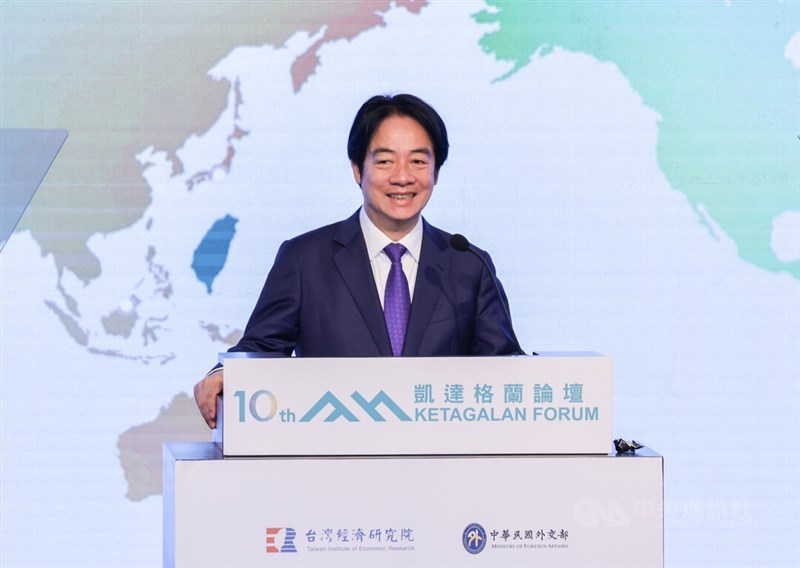
Taipei, Aug. 4 (CNA) President Lai Ching-te (賴清德) on Tuesday called on the international community to take a unified stance against China's Ethnic Unity and Progress Promotion Law, promulgated last month.
"Last month, China implemented the Ethnic Unity and Progress Promotion Law, ignoring international opposition," Lai said at the opening of the 10th Ketagalan Forum. The event, hosted by the Ministry of Foreign Affairs and the Taiwan Institute of Economic Research, focuses on security issues in the Indo-Pacific region.
"I want to emphasize that China's ethnic unity law infringes upon Taiwan's sovereignty, and persecutes religions and minority groups," Lai said.
The law, passed by China's National People's Congress in March, requires all Chinese citizens to uphold national unification and aims to strengthen the identification of Taiwan's people as members of the Chinese nation.
It also states that individuals or organizations, whether inside or outside China, that undermine ethnic unity or promote ethnic division can be held legally liable, without clearly defining what kinds of groups or conduct fall under those categories.
The law uses "transnational repression" to impose political censorship "in all parts of the world," creating a "chilling effect," Lai said, calling for coordinated international resistance to the measure.
"The entire international community should come together and staunchly oppose this malicious law," he said.
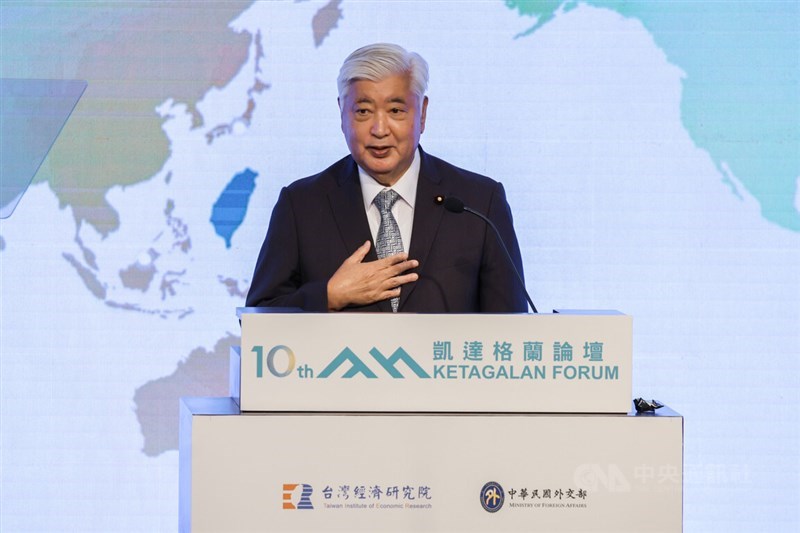
Speaking at the forum, Gen Nakatani, the co-chair of the Inter-Parliamentary Alliance on China (IPAC) for Japan, said transnational repression had grown in recent years despite international efforts to curb it.
Nakatani, a former Japanese defense minister, said IPAC members have worked to devise countermeasures to transnational repression since the forum directed public attention to the issue two years ago.
"And yet the threat has not receded. It has been given the form of law by the Chinese government," Nakatani noted.
The law has raised grave concerns about "forced assimilation" and perceived attempts to conduct "intensified" persecution of ethnic minorities, he said.
"I am deeply troubled, above all, by the violation of sovereignty that its extraterritorial application entails," Nakatani added.
He referenced an assault on Japanese journalist Akio Yaita, a vocal critic of the Chinese Communist Party, who was punched in the face by a Chinese man from Hong Kong on July 6, less than a week after the law took effect.
"I served as Japan's Minister of Defense. When our airspace is violated, radar detects it and our fighters scramble at once," Nakatani said. "But when a citizen standing on our own soil can no longer speak, for fear of a foreign power, no alarm sounds anywhere."
He called on all societies under the threat of transnational repression to treat it not only as a matter of public order, but one of national security, and take concrete action to deter it.
- Society
Seasonal winds to bring cooler weather across parts of Taiwan
10/03/2026 07:26 PM - Politics
Local election campaigns heat up across Taiwan
10/03/2026 06:56 PM - Politics
Taiwan confirms its patrol vessels monitoring Chinese ships near Philippines
10/03/2026 06:46 PM - Business
CPC to leave domestic gasoline, diesel prices unchanged next week
10/03/2026 05:48 PM - Science & Tech
Taiwan, U.K. sign science, technology deal covering 3 areas
10/03/2026 04:26 PM