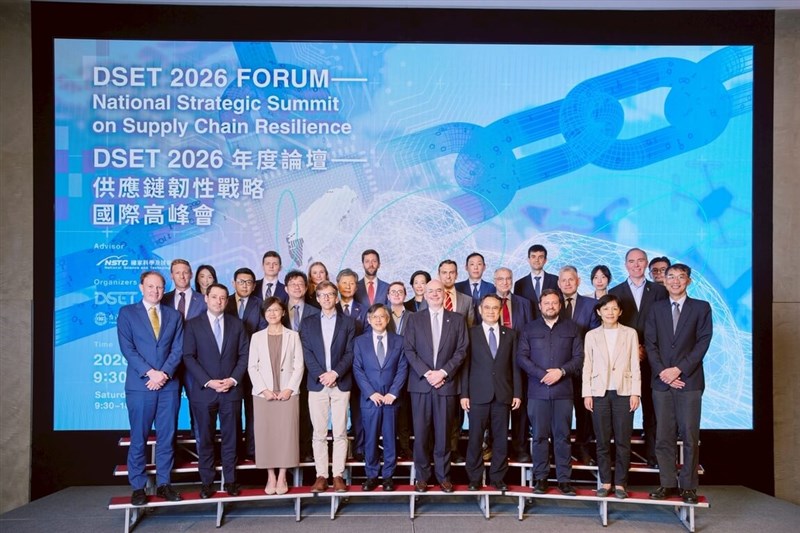
Taipei, June 6 (CNA) Taiwan should make its power system more decentralized and resilient, learning lessons from Russia's attacks on Ukraine's energy infrastructure, experts said Saturday.
At a forum hosted by the Taiwan-based think tank DSET in Taipei, experts from Ukraine, the United States, Japan and Taiwan discussed how Taiwan could strengthen energy security and prepare for potential disruptions caused by conflict or blockades.
Anton Antonenko, vice president and co-founder of Ukrainian think tank DiXi Group, said Russia's attacks on Ukraine have exposed the vulnerabilities of large, centralized energy systems.
"The bigger the dependency, the bigger the sensitivity," Antonenko said, arguing that governments should prioritize distributed power generation, regional self-sufficiency and systems that can be repaired quickly during crises.
He noted that Russian attacks have targeted not only power plants but also substations, transmission networks, water systems and other critical infrastructure, creating what he described as a "multi-crisis" environment.
Rather than relying heavily on a small number of large facilities, countries should develop modular and flexible energy systems, maintain spare parts inventories, and strengthen grid resilience, he said.
Mark Cancian, a senior adviser at the Center for Strategic and International Studies (CSIS), said energy remains one of Taiwan's most vulnerable areas in a conflict scenario because of the island's heavy reliance on imported fuel.
While stockpiles and contingency measures could help mitigate disruptions, strengthening energy resilience should remain a priority, he said.
Tomohisa Takei, a senior fellow at the Sasakawa Peace Foundation, said Taiwan and Japan share similar vulnerabilities because both depend heavily on imported energy and maritime trade routes.
Drawing on a policy simulation conducted by the Japan Forum for Strategic Studies in 2024, Takei said strengthening energy self-sufficiency, protecting sea lines of communication, and deepening cooperation with partners would be critical during a contingency.
He added that a Taiwan crisis would have direct implications for Japan, making close coordination between the two sides essential for maintaining access to energy supplies and commercial shipping routes.
Wu Chin-chung (吳進忠), vice president of Taiwan Power Co. (Taipower), said the state-owned utility has been working to make Taiwan's power grid more decentralized following several major blackouts in recent years.
Taiwan is expanding disaster-prevention microgrids, strengthening backup systems for critical infrastructure, and conducting regular drills to improve recovery capabilities in the event of emergencies, Wu said.
He added that cybersecurity has become an increasingly important part of energy resilience, saying Taipower faces around 30,000 attempted cyberattacks on average each day.
During former U.S. House Speaker Nancy Pelosi's visit to Taiwan in 2022, the company experienced more than 3 million attempted attacks over three days, Wu said.
- Sports
Men's archery, esports give Taiwan 2 more bronzes at Asian Games
09/30/2026 08:32 PM - Society
Cooler, wetter weather forecast in northern Taiwan next week
09/30/2026 07:25 PM - Politics
Taiwan, Belize sign agreements to enhance collaboration during FM's visit
09/30/2026 07:08 PM - Society
AGC Display Glass employees protest at MOL ahead of 10/5 strike
09/30/2026 06:53 PM - Culture
CNA to relaunch Spanish-language Focus Taiwan with AI assistance
09/30/2026 05:59 PM