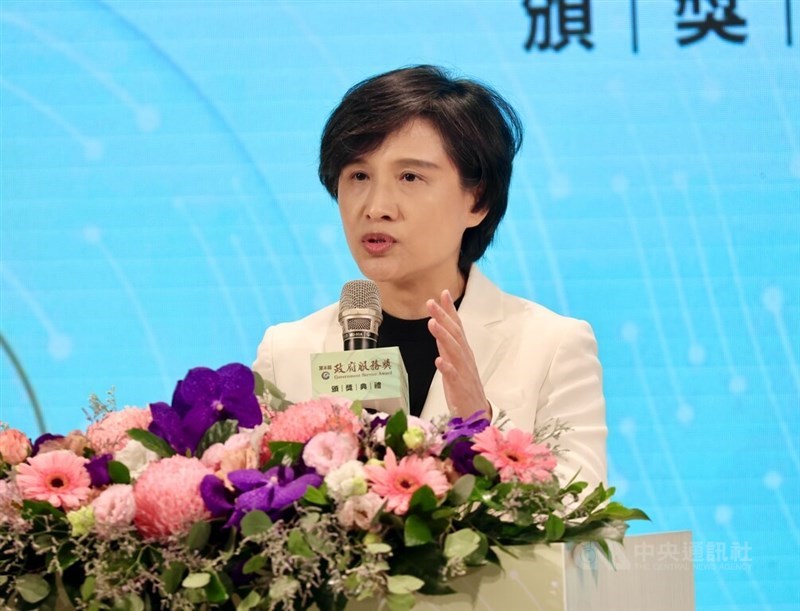
Taipei, Feb. 10 (CNA) Vice Premier Cheng Li-chiun (鄭麗君) is scheduled to lead a delegation to the United States on Tuesday evening where she will sign the Agreement on Reciprocal Trade (ART) later this week, according to the Executive Yuan.
The visit follows a preliminary consensus reached in Washington in mid-January. Under that arrangement, the U.S. agreed to reduce tariffs on Taiwanese goods from 20 percent to 15 percent, matching the rates applied to major competitors like Japan and South Korea.
In exchange, Taiwanese semiconductor and technology firms have committed to investing at least US$250 billion in the U.S.
The preliminary agreement also included US$250 billion in credit guarantees by the Taiwanese government to help domestic companies expand their footprint in the U.S. market.
While full technical details remain undisclosed, the ART is widely expected to include provisions to reduce tariffs on U.S. goods imported into Taiwan, covering U.S.-made vehicles, and to open the local market to specific American agricultural products.
As part of ongoing outreach, Minister of Economic Affairs Kung Ming-hsin (龔明鑫) met with representatives from nine major domestic automakers on Tuesday afternoon, according to sources.
In addition, Minister of Labor Hung Sun-han (洪申翰) is set to meet with automotive industry labor unions on Wednesday to discuss workforce impacts, sources said.
Cabinet spokesperson Michelle Lee (李慧芝) emphasized that the government will continue to adhere to four core principles: upholding national interests, safeguarding industrial growth, protecting public health, and ensuring food security.
Once the ART is finalized, the administration will submit the agreement to the Legislative Yuan for review, accompanied by a legally required impact assessment report, Lee said.
The ART can only come into force if it is passed by the Legislature.
The opposition Kuomintang (KMT) on Tuesday demanded that the government provide a full public report on the scope of the ART to both the Legislature and the public before signing any formal pact.
Those expected to be most affected -- including workers, farmers, and small and medium-sized enterprises -- remain "excluded from key information," KMT caucus secretary-general Lin Pei-hsiang (林沛祥) said, adding that the government has the responsibility to ensure full transparency of the agreement's potential impacts.
- Politics
DPP, KMT take top meetings on road to boost local election campaigns
08/05/2026 08:22 PM - Politics
Reservists conduct rifle and mortar drills in Taipei
08/05/2026 07:32 PM - Politics
Taiwan seeks to block China-run youth platform: MAC
08/05/2026 06:59 PM - Business
Hon Hai posts record July revenue
08/05/2026 06:21 PM - Society
EVA Air to launch Taipei-Delhi flights in December
08/05/2026 05:44 PM