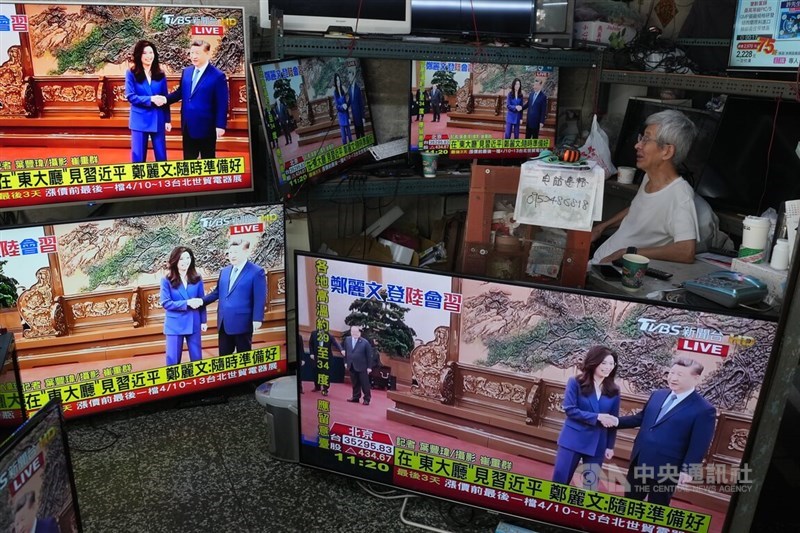
Taipei, April 10 (CNA) Chinese President Xi Jinping (習近平) and the leader of Taiwan's main opposition party met Friday in Beijing, and they vowed to bring people on both sides of the Taiwan Strait closer to facilitate the "great rejuvenation of the Chinese nation."
Xi met with Kuomintang (KMT) Chairperson Cheng Li-wun (鄭麗文) on Friday morning in the East Hall of the Great Hall of the People, a venue typically reserved for meetings between Xi and foreign heads of state.
In public remarks prior to a closed-door meeting, Xi, in his role as head of the Chinese Communist Party (CCP), asserted that Taiwan is historically a part of China and remains an "inalienable" and "inseparable" part of Chinese territory and the Chinese state and nation.
As the world faces great changes, "the broader trend of the great rejuvenation of the Chinese nation will not change, and the great tide of people on both sides of the Strait growing closer and coming together will not change," Xi said.
"This is a historical inevitability, and we are fully confident of this."
The phrase "rejuvenation of the Chinese nation," which Cheng later echoed, refers to the CCP's goal to turn China into a great power by 2049, the 100th anniversary of the People's Republic of China (PRC), but it also connotes making Taiwan officially part of the PRC.
China's "national reunification," which includes annexing Taiwan, is an "essential step toward national rejuvenation," according to a White Paper published by China's Taiwan Affairs Office in 2022 and other official speeches and documents.
Vowing to strengthen exchanges with Taiwan and push for peace across the Taiwan Strait for future generations, Xi said China was willing to engage in dialogue with all Taiwanese political parties and civil society, but that engagement came with a major precondition.
He said it would be based on the "shared political foundation characterized by a firm adherence to the '1992 consensus' and opposition to Taiwan independence."
China sees Taiwan as a part of its territory, to be annexed by force if necessary, while Taiwan considers itself to be a sovereign country, formally named the "Republic of China," and it has never been under the jurisdiction of the PRC.
Echoing Xi's remarks, Cheng claimed that in the more than 100 years of interactions between the KMT and the CCP, "all we ever wanted is to guide the Chinese nation out of decline and toward rejuvenation."
"The great Chinese rejuvenation involves people on both sides of the strait. It is about the reawakening and resurgence of Chinese civilization," Cheng said.
"Although people on both sides of the Strait live under different systems, we will respect one another and move toward each other," she said.
Cheng called on Taiwan and China to put political differences aside and jointly work toward the creation of a "symbiosis of co-prosperity" underpinned by a systemic solution for preventing war.
The two sides of the Taiwan Strait should build sustainable avenues for dialogue and mechanisms for cooperation underpinned by a "shared political foundation characterized by a firm adherence to the '1992 consensus' and opposition to Taiwan independence," Cheng said, matching Xi's wording.
"Hopefully, through the persistent efforts of our two parties, the Taiwan Strait will no longer be a geopolitical flashpoint and will never be a chessboard for interference by external forces," Cheng said.
The "1992 consensus" refers to a tacit understanding reached in 1992 between the then-KMT government of the Republic of China (Taiwan) and the Chinese government.
It has been consistently interpreted by the KMT as an acknowledgment by both sides that there is only "one China," with each side free to interpret what "one China" means.
Taiwan's independence-leaning ruling Democratic Progressive Party has never acknowledged the "1992 consensus," arguing that Beijing allows no room for the interpretation of "China" as the Republic of China, and that acceptance of the consensus would imply agreement with China's claim over Taiwan.
- Politics
Taiwan labor minister's APEC visit to China went smoothly: Labor ministry
09/21/2026 08:39 PM - Sports
Taiwan wins first Asian Games gold in soft tennis mixed doubles (update)
09/21/2026 08:29 PM - Culture
'Black Myth: Wukong' concert wraps up 2-night stint in Taipei
09/21/2026 07:01 PM - Sports
Taiwan's Johnny Sun takes silver in Asian Games wushu
09/21/2026 06:44 PM - Sports
Taiwan wins first Asian Games gold in soft tennis mixed doubles
09/21/2026 05:48 PM