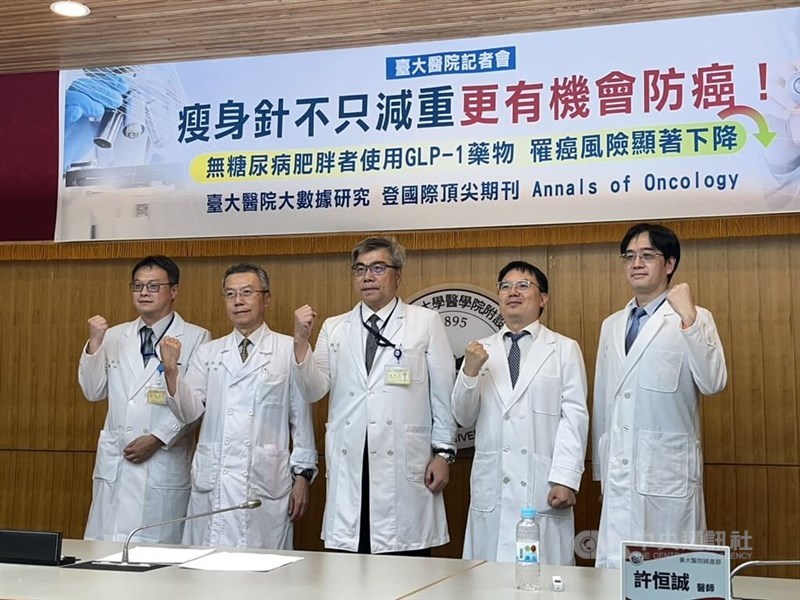
Taipei, Aug. 6 (CNA) Weight-loss injections based on GLP-1 receptor agonists were associated with a 41 percent lower risk of developing 13 obesity-related cancers than weight loss achieved through diet and exercise alone, according to a National Taiwan University Hospital (NTUH) study.
Obesity is an established risk factor for multiple cancers, but evidence has been limited on whether GLP-1 drugs -- popularly known as "skinny jabs" or weight-loss pens -- can reduce cancer risk among obese people without diabetes.
The study was led by Hsu Heng-cheng (許恒誠) and Chiang Ying-cheng (江盈澄) of NTUH's Department of Obstetrics and Gynecology, Chang Yun-hao (張雲澔), a doctoral candidate at National Yang Ming Chiao Tung University's Institute of Statistics, and researchers from Houston Methodist in the United States.
Presenting the findings at a press conference Thursday, Hsu said the team analyzed U.S. TriNetX electronic health records from adults with obesity but no history of diabetes or cancer between 2014 and 2025.
Using propensity score matching and inverse probability of treatment weighting, the researchers compared more than 160,000 matched patients treated with GLP-1 drugs or lifestyle intervention alone over an average follow-up of about two years.
Patients receiving GLP-1 medications had a 41 percent lower overall risk of developing the 13 obesity-related cancers identified by the U.S. National Cancer Institute, the study found.
The findings were published in the August issue of Annals of Oncology, the official journal of the European Society for Medical Oncology (ESMO) and the Japanese Society of Medical Oncology.
According to Hsu, the greatest reductions were seen in endometrial and colorectal cancer risks. No significant reduction was found for breast cancer, while lung cancer was not included because it is not classified as an obesity-related cancer.
NTUH Department of Obstetrics and Gynecology Director Chen Chi-hau (陳啓豪) said the findings suggest GLP-1 drugs have strong potential to help prevent endometrial cancer, for which obesity is a major risk factor.
Hsu stressed that the findings do not constitute a new approved indication for GLP-1 drugs, adding that medication should be combined with healthy lifestyle changes and used only after consulting a physician.
He also cautioned that the retrospective study does not establish a cause-and-effect relationship and that the findings still need to be confirmed in prospective clinical trials.
- Politics
U.S. arms sales to Taiwan a complex issue, still under review: Rubio
09/24/2026 11:15 AM - Business
U.S. dollar up in Taipei trading
09/24/2026 10:40 AM - Society
Taiwan headline news
09/24/2026 10:06 AM - Business
Taiwan shares open lower
09/24/2026 09:07 AM - Sports
Zhang wins second straight Asian Games wushu bronze despite injury
09/23/2026 08:55 PM