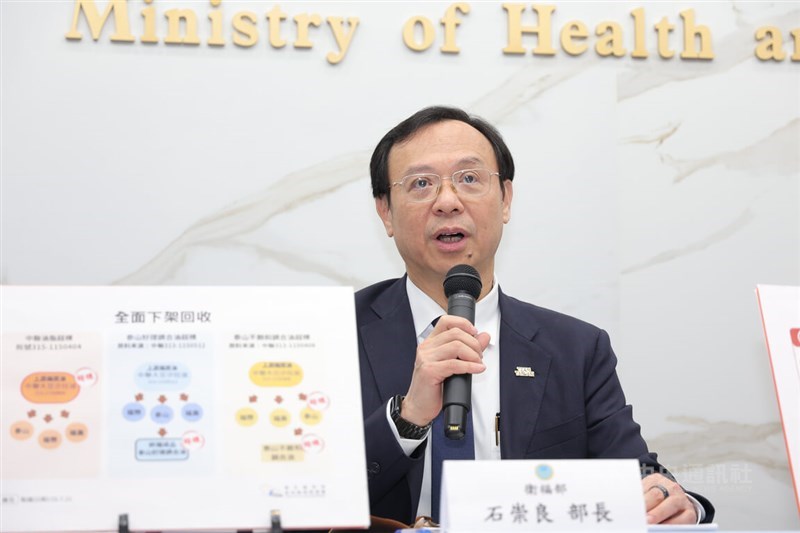
Taipei, July 21 (CNA) Nineteen batches of cooking oil linked to the Central Union Oil Corp. food safety case have been cleared for immediate return to store shelves after passing inspections, while seven batches will be destroyed and one batch remains "banned from sale," Health Minister Shih Chung-liang (石崇良) said Tuesday.
Out of 30 batches tested, 19 had entered the market and, along with products made from them, can resume sales, while another three also met safety standards but remain under government control because they were never shipped and are therefore not covered by Tuesday's relisting announcement.
The remaining eight batches include seven found to contain excessive levels of the carcinogen benzo[a]pyrene (BaP) that will be destroyed and one exported batch that could not be tested because no retained sample was available after it was exported to Japan, Shih said at a news conference.
However, the Ministry of Health and Welfare issued a correction late Tuesday saying the exported batch of oil was sold to South Korea not Japan, adding that Taiwan's Food and Drug Administration has notified the South Korean authorities of potential problems with the oil.
The decision follows the completion of inspections of edible oil produced by Central Union between April and June that were subject to a precautionary recall announced on July 9.
The recall was prompted after one batch of the company's soybean oil was found to contain excessive BaP. About 1,300 metric tons of the contaminated oil had been supplied to major food manufacturers, including Taisun Enterprise Co., Fwusow Industry Co. and Formosa Oilseed Processing Co., affecting more than 1,000 downstream businesses.
Inspection results released Monday showed that no additional contaminated batches have been identified.
Products can be relisted based on three principles: verification by source and product category, batch-by-batch confirmation, and cross-checking between upstream oil supplies and downstream products, Shih said.
The Taiwan Food and Drug Administration said independent experts began inspecting Central Union's production facilities on Tuesday, with the investigation into the source of the contamination expected to be completed within a week.
Shih also outlined proposed amendments to the Act Governing Food Safety and Sanitation, which are expected to be reviewed by the Executive Yuan on Thursday following the Central Union case.
The proposed revisions would authorize the establishment of a central command center for major food safety incidents to coordinate responses between central and local governments. They would also formally incorporate precautionary recalls into law, and raise the maximum fine for delayed or concealed reporting from NT$3 million (US$92,920) to NT$30 million.
Central Union detected abnormal test results in mid-May but did not notify authorities until late June, hampering efforts to contain the contamination at the source and promptly recall affected items, Shih said.
The proposed increase in the maximum fine is intended to deter companies from delaying or concealing reports of food safety incidents, he added.
- Politics
Taipei mayor candidates Chiang, Shen spar over Songshan Airport plan
10/08/2026 08:22 PM - Society
Northeasterly winds to bring rain to parts of Taiwan over holiday weekend
10/08/2026 07:20 PM - Culture
Taiwan, foreign writers to meet at November festival
10/08/2026 04:54 PM - Society
Gangster's 17-year sentence upheld in clerk's death after detention, assault
10/08/2026 04:24 PM - Business
U.S. dollar closes higher on Taipei forex market
10/08/2026 04:08 PM