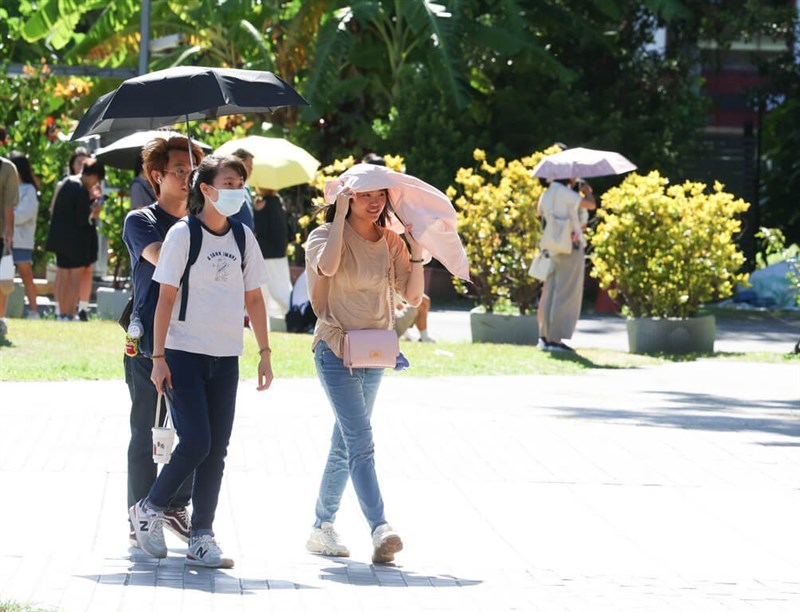
Taipei, June 23 (CNA) Environment Minister Peng Chi-ming (彭啓明) said Tuesday that the ministry plans to conduct an "anti-heat" response drill this year simulating temperatures of 40 degrees Celsius amid increasingly frequent extreme heat events.
After holding its first such drill last July, the Ministry of Environment (MOENV) plans to expand this year's exercise to involve coordination across ministries and strengthen early response efforts for extreme heat, Peng said in a brief Facebook post.
• MOENV to hold three-day 'anti-heat' drill on June 29
The minister did not specify the details or timing of the drill, but said that although it was only late June, extreme heat incidents have occurred earlier than usual, not only in Taiwan but also around the world.
In the post, Peng cited a Reuters report published Monday saying that at least 18 people have died in France due to a heatwave, with temperatures reaching 41.9 degrees in Bordeaux and 41.2 degrees in Poitiers. Some cities in Italy have issued red alerts, while Turin's power grid has deployed additional generators and personnel to cope with increased electricity demand.
The issue goes beyond whether to introduce heat days off and instead spans multiple areas of governance and public policy, including health, education, transport, power supply and urban adaptation, Peng added.
Intensifying global heat stress
Separately on Tuesday, Taiwan's Science Media Center (SMC) cited a Nature Climate Change report saying global heat stress is intensifying and affecting a widening geographic area, with experts warning of rising risks from prolonged extreme heat exposure.
Chen Cheng-ta (陳正達), a professor in National Taiwan Normal University's (NTNU) Department of Earth Sciences, said the real health risks often stem from cumulative heat exposure over a 24-hour period, with high nighttime temperatures giving the body insufficient recovery time.
After enduring high heat loads during the day, continued nighttime conditions of high temperatures, high humidity and low wind speeds can impair the body's ability to dissipate heat and affect sleep, cardiovascular regulation and hydration recovery, he added.
Chen said that in urban environments, nighttime heat and the urban heat island effect are particularly critical. In Taipei and New Taipei, the area's basin topography and dense development have increasingly led to situations where average temperatures in city centers are more than 3 degrees higher than in surrounding areas.
This means urban adaptation should not only focus on daytime shading, but also address heat retention in building materials at night, ventilation corridors, indoor overheating and waste heat from air conditioning systems, he added.
- Society
DPP township council candidate dies after collapsing on stage
09/23/2026 11:52 AM - Science & Tech
Taiwan part of WorldSkills Competition opening ceremony in China
09/23/2026 10:53 AM - Business
U.S. dollar down in Taipei trading
09/23/2026 10:17 AM - Society
Taiwan headline news
09/23/2026 10:05 AM - Business
Taiwan shares open higher
09/23/2026 09:15 AM