ANALYSIS/Taiwan, U.S. must counter China gray-zone pressure: Stanford scholar

Taipei, Sept. 9 (CNA) Taiwan and the United States need to prepare for a crisis triggered by China's intensifying gray-zone pressure rather than focus only on deterring a full-scale conflict, a Stanford University scholar said Wednesday at a symposium in Taipei.
"Taiwan's fate is more likely to be determined by a crisis than by a war," Eyck Freymann, a Hoover Fellow at Stanford's Hoover Institution, said during a panel on democratic resilience and national security.
"We need a collective doctrine or concept of operations for how we deter the crisis, not just deter the war," he added.
'Legal encirclement'
Freymann said China's gray-zone pressure -- coercive actions that stop short of armed conflict -- could gradually alter the status quo around Taiwan while leaving Washington with the burden of deciding whether to escalate.
He pointed in particular to Chinese Coast Guard operations in which vessels radio commercial ships entering or leaving Taiwan and request information on their cargoes.
Such actions could eventually develop into what he described as a "legal encirclement," in which Beijing establishes the principle that goods can enter or leave Taiwan only with its approval.
"If the shipping companies comply with this, if the international insurance system says that we will not insure cargoes that don't comply with PRC [People's Republic of China] directives, China can effectively take control of the maritime space around Taiwan without firing a shot," Freymann said.
His warning comes as China has sharply increased official maritime activity east of Taiwan in recent months.
In June, Beijing began what it called a "special maritime law-enforcement operation" in the area, with Chinese vessels radioing commercial ships and asking about their routes while asserting jurisdiction over the waters.
China has since continued Coast Guard patrols and conducted a seabed survey east of Taiwan from Aug. 10-31 that Beijing said would support territorial planning and resource management. Taiwan has rejected China's jurisdictional claims.
Against that backdrop, Freymann said the question often posed in the U.S. about when Chinese President Xi Jinping (習近平) might move against Taiwan was misguided.
"Xi Jinping is already doing it every day," he said, adding that the real question was "if or when the United States decides to stand up and draw a line, or whether Taiwan's leaders decide to do the same and force that question in the United States."
Chips and financial shock
Freymann also argued that Taiwan has become even more economically and strategically important to the U.S. because of artificial intelligence and global reliance on its advanced semiconductors, with Taiwan producing about 90 percent of the world's most advanced chips.
Even the prospect of financial markets beginning to price in disruptions to Taiwan's chip supplies could cause a sharp fall in major U.S. technology stocks and potentially trigger what Freymann called "a cascade of financial repercussions around the world."
He argued that China itself would have little incentive to directly cut off Taiwan's semiconductor exports because doing so would make Beijing clearly responsible for any resulting global economic shock.
"If China cuts off the supply of chips, they are the bad guy in the narrative that the international community will tell," he said, arguing that such a move would make it easier for policymakers in the U.S. and other countries to rally support for restoring the flow of chips.
The more concerning scenario, Freymann said, would be one in which China gradually tightened control over shipping around Taiwan without formally cutting off semiconductor supplies itself.
That could eventually present a U.S. president with a choice between allowing Taiwan to fall increasingly under Beijing's control or taking action that could disrupt chip supplies and trigger a financial shock, he said.
If Washington then sent forces to the region, imposed sanctions or took other punitive measures, "politically it looks like it's the United States initiating the charge," Freymann said.
'Push the burden back onto China'
Taiwan and the U.S. should therefore develop a doctrine that would force markets to price in the risk of chip disruption and "push the burden back onto China," he said.
One option would be for Taiwan to "calibrate the number of advanced semiconductors that could be exported" according to the nature of China's gray-zone activities, Freymann said.
He also proposed establishing a "common source of truth" about maritime activity around Taiwan by drawing on open-source satellite intelligence and other data and publishing it regularly on a platform trusted by international financial markets.
Taiwan could also require shipping companies to publicly disclose whether they are complying with Chinese directives, Freymann said, arguing that such procedures need to be established before a crisis occurs.
"I believe this has to happen," he said. "And I think we have about 12 months to figure it out."
The urgency, Freymann said, stems from the Chinese Communist Party's national congress expected next autumn, after which he believes Xi could have greater freedom to increase pressure on Taiwan as Taiwan and the U.S. both head into presidential election seasons.
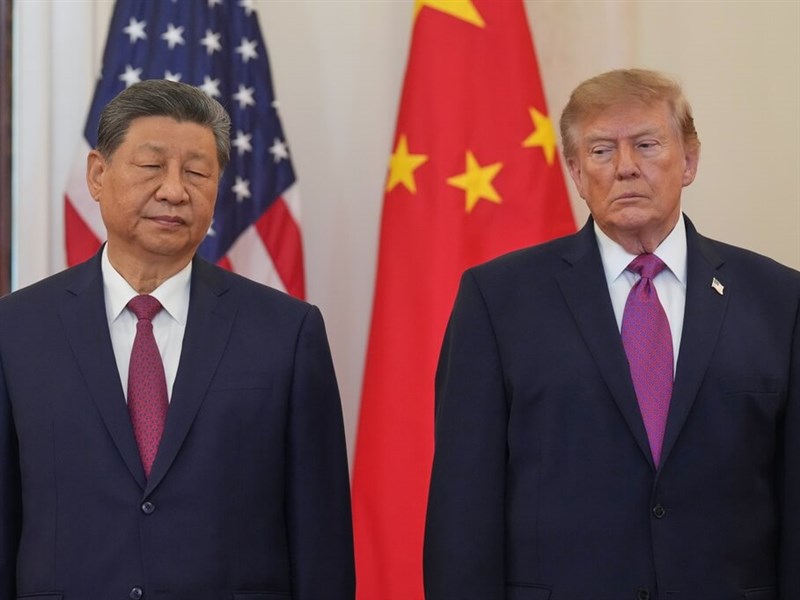
![Xi's WWII account obscures ROC role, evokes Japan tensions: Scholars]() Xi's WWII account obscures ROC role, evokes Japan tensions: ScholarsWhen Chinese President Xi Jinping (習近平) recalled U.S.-China cooperation during World War II at a White House state dinner Thursday, he left out a name central to that history: the Republic of China (ROC).09/29/2026 04:30 PM
Xi's WWII account obscures ROC role, evokes Japan tensions: ScholarsWhen Chinese President Xi Jinping (習近平) recalled U.S.-China cooperation during World War II at a White House state dinner Thursday, he left out a name central to that history: the Republic of China (ROC).09/29/2026 04:30 PM![Okinawa vote likely to boost Japan's defense buildup, Taiwan security: Scholars]() Okinawa vote likely to boost Japan's defense buildup, Taiwan security: ScholarsThe anti-Henoko "All Okinawa" camp's 12-year hold on the Okinawa governorship ended Sunday when former Naha Deputy Mayor Genta Koja unseated two-term incumbent Denny Tamaki in a six-candidate race.09/15/2026 09:34 PM
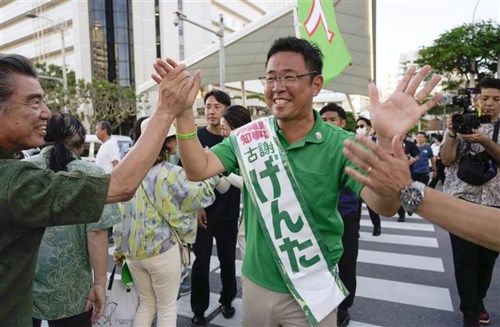
Okinawa vote likely to boost Japan's defense buildup, Taiwan security: ScholarsThe anti-Henoko "All Okinawa" camp's 12-year hold on the Okinawa governorship ended Sunday when former Naha Deputy Mayor Genta Koja unseated two-term incumbent Denny Tamaki in a six-candidate race.09/15/2026 09:34 PM![China defense mobilization law signals preparations for full-scale conflict: Analysts]() China defense mobilization law signals preparations for full-scale conflict: AnalystsChina's revised National Defense Mobilization Law, which will take effect on Oct. 1, indicates that the Chinese Communist Party (CCP) plans to mobilize the country's full resources in the event of potential conflicts with external adversaries, including Taiwan, according to analysts.09/05/2026 07:24 PM
China defense mobilization law signals preparations for full-scale conflict: AnalystsChina's revised National Defense Mobilization Law, which will take effect on Oct. 1, indicates that the Chinese Communist Party (CCP) plans to mobilize the country's full resources in the event of potential conflicts with external adversaries, including Taiwan, according to analysts.09/05/2026 07:24 PM
- Business
Amazon taking part in Taiwan PCB maker's private placement
09/29/2026 09:06 PM - Sports
Taiwan snatches 2 more silvers in shooting, Kurash at Asian Games
09/29/2026 08:42 PM - Business
Taiwan economic indicators stay strong for 9th straight month: NDC
09/29/2026 07:44 PM - Politics
AIDC, Corrections Agency hold counter-drone drill
09/29/2026 07:15 PM - Politics
KMT, TPP legislators reject all 27 of Lai's Control Yuan nominees
09/29/2026 06:55 PM