ANALYSIS/Okinawa vote likely to boost Japan's defense buildup, Taiwan security: Scholars
By Chao Yen-hsiang, CNA staff reporter
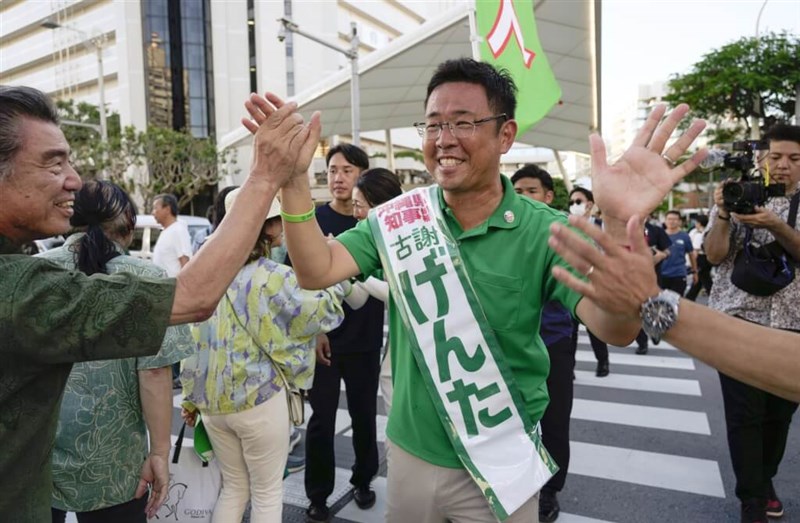
The anti-Henoko "All Okinawa" camp's 12-year hold on the Okinawa governorship ended Sunday when former Naha Deputy Mayor Genta Koja unseated two-term incumbent Denny Tamaki in a six-candidate race.
The conservative-backed 42-year-old won 59.4 percent of valid ballots after campaigning largely on livelihood issues.
But the local election could have consequences far beyond Okinawa.
Two scholars told CNA Monday that Koja's victory could quicken Japan's defense preparations across its southwestern islands -- a development both viewed as favorable to Taiwan.
From local vote to first island chain
Lim Chuan-tiong (林泉忠), a research fellow at the University of Tokyo's Institute for Advanced Studies on Asia, called Koja's victory "a source of reassurance" for Taiwan amid growing Chinese military pressure.
Okinawa Prefecture lies along Japan's southwestern island chain, a key section of the first island chain, while the Miyako Strait is an important route into the Pacific for Chinese warships, he said.
Koja's willingness to work with Tokyo should smooth defense efforts, Lim said.
Kuo Yu-jen (郭育仁), vice president of the Institute for National Policy Research, said Koja could not have won had opposition to relocating Futenma remained decisive, adding that his victory should ease friction between Okinawa and Tokyo over base relocation and other defense projects.
"In Japanese, there is only one government, and that means the central government in Tokyo," Kuo said.
Prefectural authorities can nevertheless delay projects through administrative and environmental procedures, he added.
An echo of 1998
Lim said 12 years of lawsuits over Henoko and confrontation with Tokyo had exhausted voters, who were also concerned about possible cuts to central government subsidies.
"What happened this time was a repeat of 1998," Lim said, comparing Tamaki's loss with anti-base Gov. Masahide Ota's defeat.
The 1995 rape of an Okinawan schoolgirl by U.S. servicemen triggered protests, after which Ota refused to renew leases for U.S. military land and clashed with Tokyo.
In 1996, the U.S. and Japan agreed to return Marine Corps Air Station Futenma once a replacement was ready.
A 2006 bilateral roadmap designated Henoko, a less populated coastal area of Nago, as the replacement site. All Okinawa considers it another permanent base and an environmental threat, while Koja accepts the relocation.
Lim said then-Prime Minister Ryutaro Hashimoto warned that subsidies could be cut if Ota continued refusing lease renewals, prompting voters to waver.
"They felt that nothing could be accomplished if this continued," Lim said.
China: A harder 'Ryukyu card' to play
Koja's victory could also make it harder for China to play what Lim calls the "Ryukyu card" by exploiting local discontent.
Lim coined the term to describe Beijing's use of state-linked media and scholars to question Japan's sovereignty over the Ryukyu Islands.
Lim identified four waves since 2005: during disputes over then-Prime Minister Junichiro Koizumi's Yasukuni Shrine visits and wartime history; amid Senkaku/Diaoyutai tensions around 2013; during Tamaki's 2023 Beijing visit and debate over a Taiwan contingency; and after Prime Minister Sanae Takaichi's Taiwan-related remarks last year.
Tamaki attended a meeting between a Japanese trade delegation and Chinese Premier Li Qiang (李強) in 2023.
"Tamaki was not particularly pro-China," Lim said. "But he actively engaged with China, rarely criticized Beijing, opposed U.S. military bases and had poor relations with the LDP. Taken together, all of that was very much in line with what Beijing wanted."
Koja's victory gives Beijing less room to maneuver, Lim said, adding that Beijing may now emphasize trade, exchanges and Okinawa's ties with China while saying less about political status.
"The Ryukyu card will not disappear," Lim said. "But the strategy and approach will change."
Changes expected by 2027
Kuo traced Japan's current defense direction to its 2013 National Defense Program Guidelines and three key security documents adopted in 2022.
Planned revisions could enable Japan's Self-Defense Forces to respond more proactively to regional contingencies, including scenarios involving Taiwan.
Koja's victory would not alter that strategic direction, but could ease its implementation in Okinawa, Kuo said.
Projects include reorganizing the Ground Self-Defense Force's 15th Brigade into a division, expanding military access to airports and ports, and adding anti-ship and air-defense missile sites across the southwestern islands, Kuo said.
Those measures would help deter China's navy and air force, especially its aircraft carriers, he said.
"If progress is slowed, Taiwan would lose its shield to the east and northeast," Kuo said.
With the Defense Buildup Program running through fiscal 2027 and Takaichi seeking to revise the three security documents by the end of 2026, Kuo expected implementation to accelerate.
"I think we will see fairly immediate and visible results in 2027," Kuo said.
Enditem/sfj
![Laos air base part of China's Indian Ocean ambitions: Expert]() Laos air base part of China's Indian Ocean ambitions: ExpertThe recent opening of a joint air support center in Laos is part of China's decades-long power-projection efforts to extend its influence into the Indian Ocean, a Taiwanese defense expert said Sunday.10/04/2026 04:44 PM
Laos air base part of China's Indian Ocean ambitions: ExpertThe recent opening of a joint air support center in Laos is part of China's decades-long power-projection efforts to extend its influence into the Indian Ocean, a Taiwanese defense expert said Sunday.10/04/2026 04:44 PM!['Hao-yu like that?' A deep dive into Lee's rookie MLB season]() 'Hao-yu like that?' A deep dive into Lee's rookie MLB seasonOne of the biggest stars on the Detroit Tigers' Threads account is infielder Lee Hao-yu (李灝宇), with posts featuring the Taiwanese rookie rarely drawing fewer than 5,000 likes, far more than the 1,000 likes posts featuring other players only occasionally draw.10/03/2026 10:00 AM
'Hao-yu like that?' A deep dive into Lee's rookie MLB seasonOne of the biggest stars on the Detroit Tigers' Threads account is infielder Lee Hao-yu (李灝宇), with posts featuring the Taiwanese rookie rarely drawing fewer than 5,000 likes, far more than the 1,000 likes posts featuring other players only occasionally draw.10/03/2026 10:00 AM![F-16Vs vital for Taiwan despite rise of drones: Experts]() F-16Vs vital for Taiwan despite rise of drones: ExpertsF-16C/D Block 70 fighter jets remain relevant in modern warfare even as drones are playing an increasingly prominent role, an expert told CNA, citing their ability to conduct combat air patrols (CAPs) and threaten conventional surface warships, including Chinese aircraft carriers deployed in waters off Taiwan's east coast.10/02/2026 12:39 PM
F-16Vs vital for Taiwan despite rise of drones: ExpertsF-16C/D Block 70 fighter jets remain relevant in modern warfare even as drones are playing an increasingly prominent role, an expert told CNA, citing their ability to conduct combat air patrols (CAPs) and threaten conventional surface warships, including Chinese aircraft carriers deployed in waters off Taiwan's east coast.10/02/2026 12:39 PM
- Business
NT$10 receipts win NT$10 million prizes
10/05/2026 09:02 PM - Politics
OCAC minister, family accused of misusing public resources overseas
10/05/2026 08:58 PM - Politics
New Eswatini envoy pledges support for Taiwan's int'l participation
10/05/2026 08:17 PM - Politics
Taichung mayoral rivals Ho, Chiang visit transport project sites
10/05/2026 07:41 PM - Society
6 Taipei police officers disciplined over misconduct in gay bar raid
10/05/2026 07:04 PM