Taipei, Aug. 28 (CNA) An opposition-backed drone procurement law passed Thursday could slow Taiwan's acquisition of unmanned systems needed for its defense by subjecting funding to repeated annual budget negotiations, analysts told CNA.
Lawmakers from the main opposition Kuomintang (KMT) and the smaller Taiwan People's Party (TPP) passed the Act on Strengthening Defense Autonomy and Developing the Unmanned Vehicles Industry by majority vote.
The legislation offers an alternative to the Cabinet's proposed NT$210 billion (US$6.6 billion) special budget, which would have run from August 2026 through the end of 2031.
Under the act, annual spending will in principle be capped at NT$40 billion for six consecutive years, although additional funding can be budgeted according to actual needs and remains subject to legislative approval.
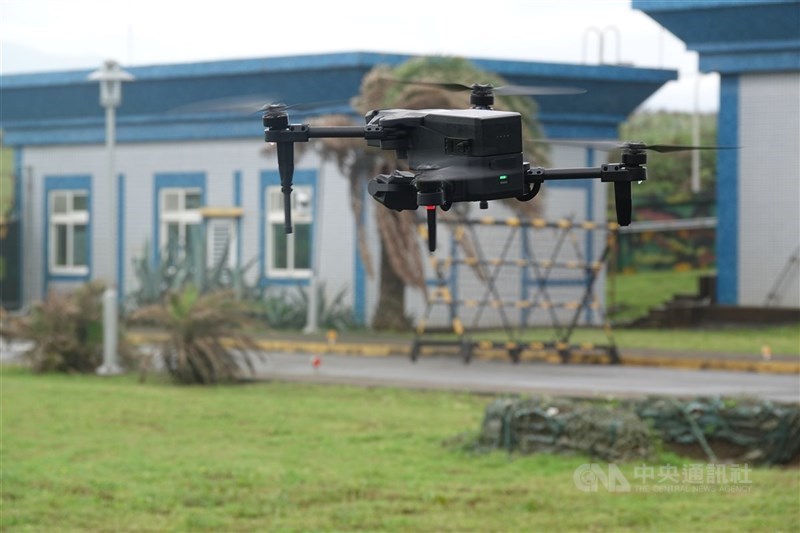
The act covers the three types of domestically produced unmanned systems sought by the Ministry of National Defense (MND): coastal surveillance drones, coastal attack drones and small suicide unmanned surface vessels (USVs).
It also allows funding for a broader range of unmanned systems and does not exclude imported models.
Officials from the ruling Democratic Progressive Party have repeatedly warned, however, that the NT$40 billion annual spending cap would be insufficient to cover all of the drones the MND plans to procure in 2027.
A race against time
Cathy Fang (方怡然), a policy analyst at Taiwan's government-funded Research Institute for Democracy, Society and Emerging Technology (DSET), said the option of providing additional funding gave the act some flexibility but also introduced uncertainty.
"If budget negotiations delay contracting or deliveries, phased procurement risks becoming interrupted procurement," Fang said.
Her comments came in response to the KMT caucus' argument that phased procurement would allow the military to keep pace with rapidly evolving drone technologies.
"For drones, time is especially important," Fang said, noting that in Ukraine and other fast-moving programs, drone technology can evolve every three to six weeks.
"A one-year delay could mean losing roughly eight to 17 potential iteration cycles," she said.
"Under the annual budget framework, the concern is whether Taiwan can still move from authorization to contracting, fielding, operational feedback, and follow-on production quickly enough."
Fang said there was a strong case for phased and iterative procurement, but argued that this should be distinguished from requiring procurement to pass through annual budget cycles.
"Successive procurement batches allow the MND to incorporate operational feedback and technological improvements rather than locking in a fixed configuration through each annual budget cycle," she said.
"That is particularly important for communications, autonomy, navigation, electronic-warfare resilience, sensors, and software."
Funding as political leverage
William Yang (楊晧暐), a senior analyst for Northeast Asia at the International Crisis Group, also raised concerns that funding for urgent asymmetric capabilities could be delayed by political deadlock if each tranche requires legislative approval.
Since the 2024 legislative elections, the KMT and TPP have together held a majority in the Legislature, allowing them to control the legislative agenda.
Yang said the continuing confrontation between the opposition-controlled Legislature and the government could spill over into future drone procurement budgets.
"I don't see the ongoing tit-for-tat between the Legislative Yuan and the government disappearing anytime soon," Yang said.
He added that opposition lawmakers could potentially delay budgets for specific systems requested by the MND and use them as "political leverage."
Broader scope, competing priorities
Fang also said the act's scope was considerably broader than the Cabinet proposal, which focused on funding the three types of unmanned systems requested by the MND.
"The final law combines urgent military procurement with industrial development, R&D, cybersecurity, certification, supply chain policy, and institutional coordination," she said.
"The risk is that broader policy objectives could dilute attention or resources from the military's most immediate requirements."
Yang, meanwhile, said the annual funding structure could also make it harder for Taiwan to compete for foreign-made unmanned systems at a time of strong global demand.
Taiwan could be "left behind," he said, if other countries are able to commit larger sums more quickly and secure production slots ahead of Taiwan.
- Business
Amazon taking part in Taiwan PCB maker's private placement
09/29/2026 09:06 PM - Sports
Taiwan snatches 2 more silvers in shooting, Kurash at Asian Games
09/29/2026 08:42 PM - Business
Taiwan economic indicators stay strong for 9th straight month: NDC
09/29/2026 07:44 PM - Politics
AIDC, Corrections Agency hold counter-drone drill
09/29/2026 07:15 PM - Politics
KMT, TPP legislators reject all 27 of Lai's Control Yuan nominees
09/29/2026 06:55 PM