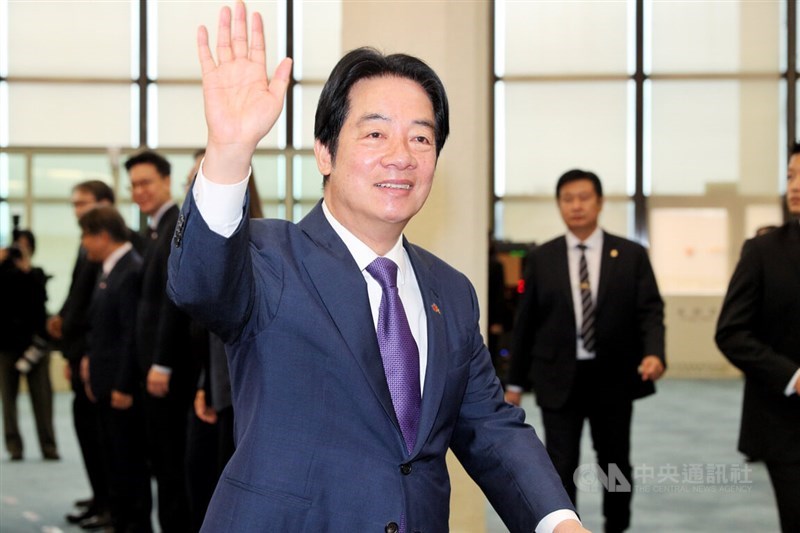
Taipei, May 5 (CNA) Scholars said Tuesday that President Lai Ching-te's (賴清德) return from a state visit to Eswatini on a near-maximum-range flight after alleged airspace disruptions forced a detour along a southern route demonstrated Taiwan's strategic resilience in the face of pressure from Beijing.
Lai returned to Taiwan on Tuesday after completing his visit to the country's sole African ally. His return flight, originally expected to take a more direct route, instead detoured south, covering around 13,000 kilometers without refueling and bringing the total round-trip distance to approximately 25,000 kilometers.
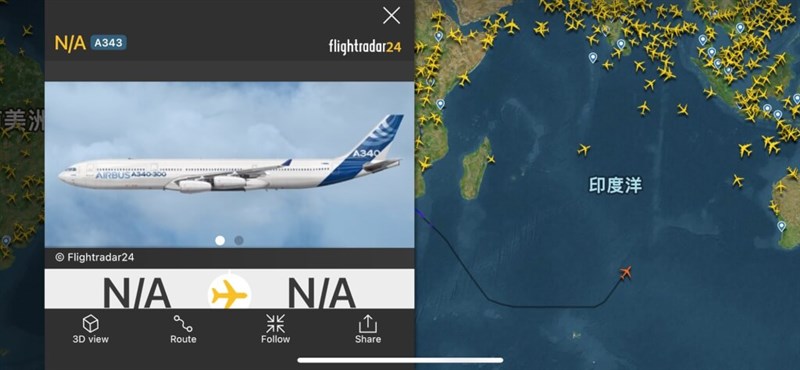
According to flight tracking data from Flightradar24, the Airbus A340-300 used for the trip, the official aircraft of King Mswati III, departed at around 6:40 p.m. on Monday and initially headed southeast, avoiding a shorter northeastern route that would have passed through the flight information regions (FIRs) of Seychelles, Madagascar and Mauritius.
The aircraft instead flew south of 45 degrees latitude in the southern Indian Ocean, before turning north after passing French southern territories and entering the Melbourne FIR. It then continued via Jakarta and over Philippine airspace before returning to Taiwan.
The journey pushed the limits of the A340's operational range, with no stopovers for refueling, and drew significant global attention, with more than 3,000 users tracking the flight online at one point.
Su Tzu-yun (蘇紫雲), a research fellow at the government-funded Institute for National Defense and Security Research, said the mission combined logistical expertise, the use of an allied nation's aircraft and an "arrive then announce" (ATA) approach to complete what he described as a diplomatic breakthrough.
Su noted that the aircraft, previously operated by Taiwan's state-run China Airlines, is familiar to Taiwan's maintenance system, and said qualified Taiwanese pilots may have been on board as backup to ensure flight safety.
He added that the ATA model -- in which visits are only made public after arrival -- has precedent internationally, including trips by former U.S. presidents Joe Biden and Barack Obama, as well as current U.S. President Donald Trump when visiting sensitive or conflict-prone areas.
Using allied aircraft for transport is also not unprecedented, Su said, citing Ukrainian President Volodymyr Zelensky, who has frequently been transported by foreign aircraft since Russia's invasion of Ukraine.
Regarding airspace restrictions, Su said while sovereign nations have full authority over their territorial airspace, aircraft operating in FIRs beyond the contiguous zone that extends 24 miles from a country's coastline generally have greater flexibility under international norms, particularly for military or official flights.
Su said the combination of flexible use of FIR rules, strong logistical support, allied cooperation and the ATA model could serve as a template for Taiwan in ensuring future presidential travel amid mounting pressure from China.
Meanwhile, Wang Hung-jen (王宏仁), CEO of the Institute for National Policy Research, said Beijing's current approach is to make it increasingly difficult for Taiwan's leaders to travel abroad.
"This raises the cost of Taiwan's international engagement and risks normalizing such disruptions," Wang said, adding that such "abnormal" interference should not become the new normal.
Responding to criticism from some opposition figures that the trip was conducted "secretively," Wang said such views failed to reflect the current geopolitical environment.
"The procedures surrounding presidential travel have become more complex due to Beijing's efforts to constrain Taiwan's international space," he said. "Taiwan must explore all possible ways to break through these constraints, rather than framing such efforts as 'secretive.'"
Wang also contrasted the current approach with the "diplomatic truce" policy under former President Ma Ying-jeou (馬英九), which he said relied heavily on Beijing's goodwill and could limit Taiwan's autonomy.
Regardless of whether the president is visiting diplomatic allies or transiting through partner countries, Wang said, Taiwan's head of state should be afforded normal and dignified treatment, and the government must continue to demonstrate resilience in safeguarding that right.
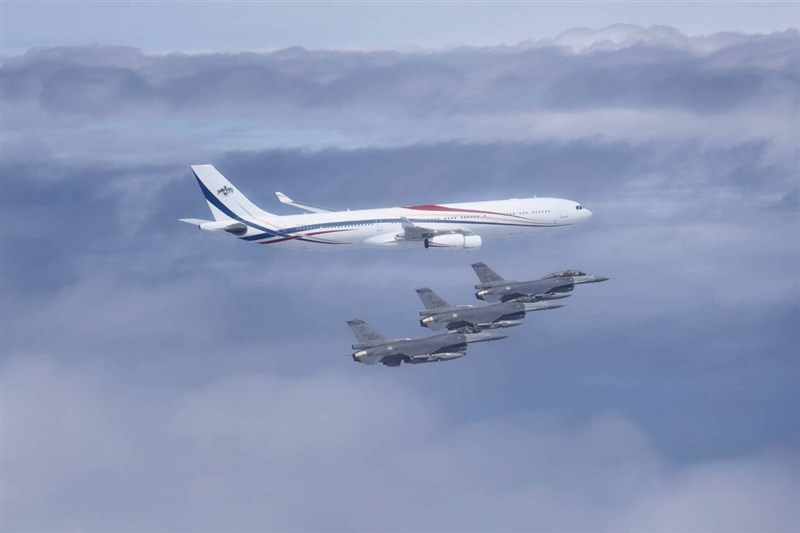
The aircraft used for the trip, an Airbus A340 originally delivered to China Airlines in 2001 and retired in 2015, was sold to Eswatini in 2016 for around US$12 million and now serves as the king's official plane.
- Politics
Lai's WWII remarks warn of China's bid to reshape world order: Analysts
10/10/2026 07:27 PM - Business
Gasoline, diesel prices to remain unchanged next week: CPC
10/10/2026 06:09 PM - Politics
Opposition leaders criticize DPP, Lai in National Day remarks
10/10/2026 04:48 PM - Politics
Ex-President Tsai calls for deeper ties between Taiwan, Silicon Valley
10/10/2026 04:25 PM - Society
Filipino worker hospitalized, over 300 evacuated in Tainan dorm fire
10/10/2026 03:59 PM