Taiwan ranked 28th globally in 2026 Press Freedom Index, down four places
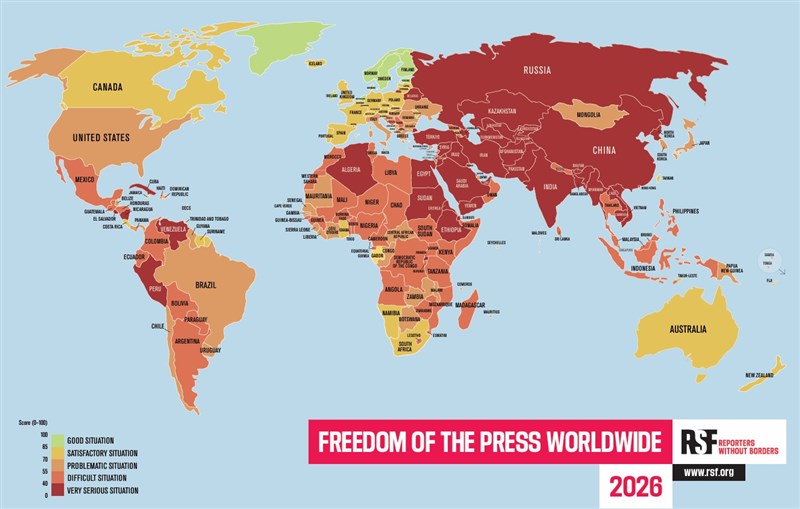
Taipei, April 30 (CNA) Taiwan dropped four places to 28th in the 2026 World Press Freedom Index compared to the previous year, as Reporters Without Borders (RSF) warned that global press freedom conditions were at a record low.
According to the index released on Thursday, Taiwan's ranking out of 180 countries and territories declined from 24th in 2025 to 28th this year, with its global score falling from 77.04 to 75.44.
At a news conference in Taipei, Aleksandra Bielakowska, advocacy manager of RSF's East Asian Bureau, said that while Taiwan saw a decline in the index, the country's media environment remained "one of the safest" for journalists even among democracies.
She added that there were no reports of harassment or detentions of journalists by authorities.
Taiwan placed second in the Asia-Pacific region, according to the index, trailing New Zealand (22nd) but ahead of neighboring countries such as Australia (33rd), South Korea (47th) and Japan (62nd).
However, RSF Asia-Pacific Bureau head Cédric Alviani said the lack of effective government action over the past decade to strengthen the quality of news coverage and ensure the public's right to reliable information had become "a major problem" detrimental to Taiwan's democratic system.
Bielakowska also noted that Taiwan's media outlets continued to face economic challenges, such as a slump in advertising revenue and government funding cuts for public media.
Gap between Hong Kong, China narrowing
Across the Taiwan Strait, Hong Kong was ranked 140th and China 178th, with both positions unchanged from last year.
Nevertheless, Bielakowska told CNA that the gap between Hong Kong and China was "closing quickly" because the National Security Law -- imposed in 2020 by Beijing following mass anti-government protests -- continued to erode the city's press freedom.
In February, Apple Daily founder Jimmy Lai (黎智英) was sentenced to 20 years in prison -- the harshest punishment to date under the law -- after being found guilty of conspiring to collude with foreign forces and of publishing seditious articles.
At the same time, RSF also reported that at least 13 foreign journalists had been denied visas or barred from entering Hong Kong after the promulgation of the law.
Bielakowska said while there were no new arrests of journalists or raids on newsrooms last year, RSF had learned of several cases of journalists being followed and harassed during their work.
National security policies weaponized
Countries worldwide, including democracies, have increasingly used national security policies as "weapons" to target journalists and their reporting, Bielakowska said.
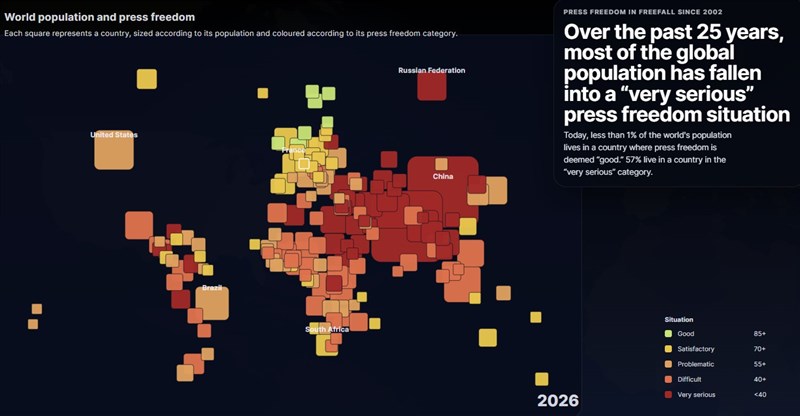
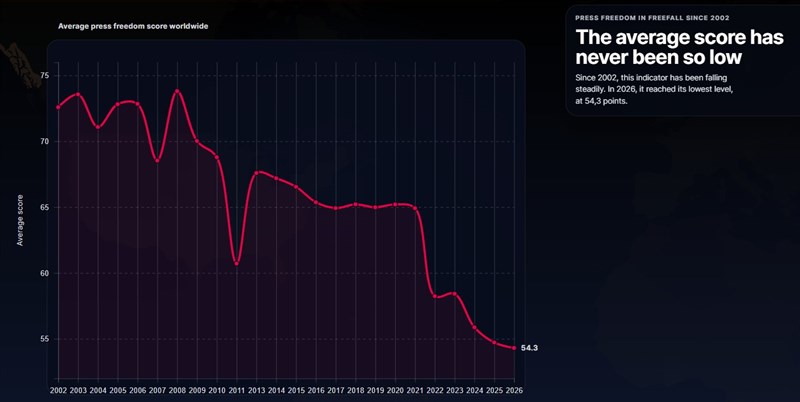
Over half of the world's countries now fall into "difficult" or "very serious" categories -- the bottom two in the five-tier index, RSF said, adding that the press freedom situation was "at a 25-year low."
When the group first launched the index in 2002, 20 percent of the global population lived in countries where press freedom conditions were categorized as "good," but now less than 1 percent do, according to RSF.
Norway was ranked first in the 2026 index based on surveys with journalists worldwide, for the 10th consecutive year, followed by the Netherlands and Estonia.
- Sports
Taiwan's Chen Yi-fan wins artistic skating gold at World Skate Games
10/09/2026 07:21 PM - Politics
Lai's National Day address to focus on Taiwan's economy, global role
10/09/2026 07:07 PM - Politics
Japanese lawmakers visit Taiwan for National Day celebrations
10/09/2026 07:02 PM - Culture
Czech, Taiwanese writers explore democracy, history at Frankfurt Book Fair
10/09/2026 07:00 PM - Society
China Youth Corps' designation as KMT-affiliated organization upheld
10/09/2026 06:09 PM