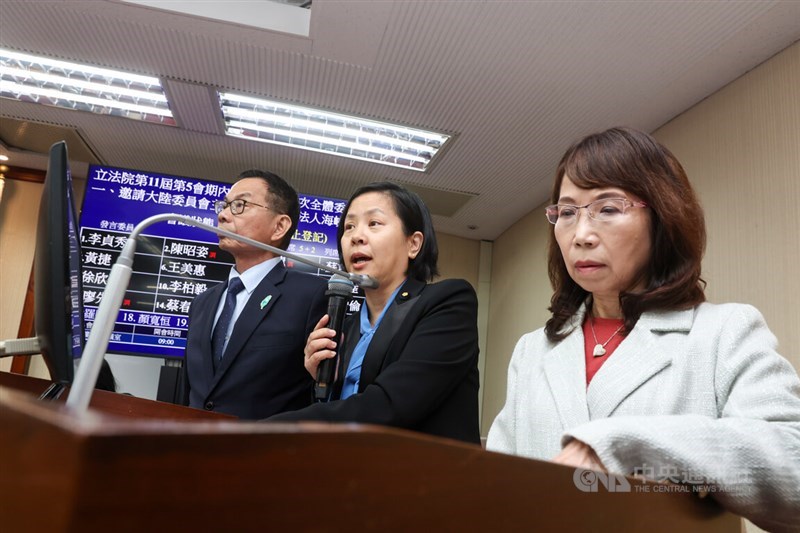
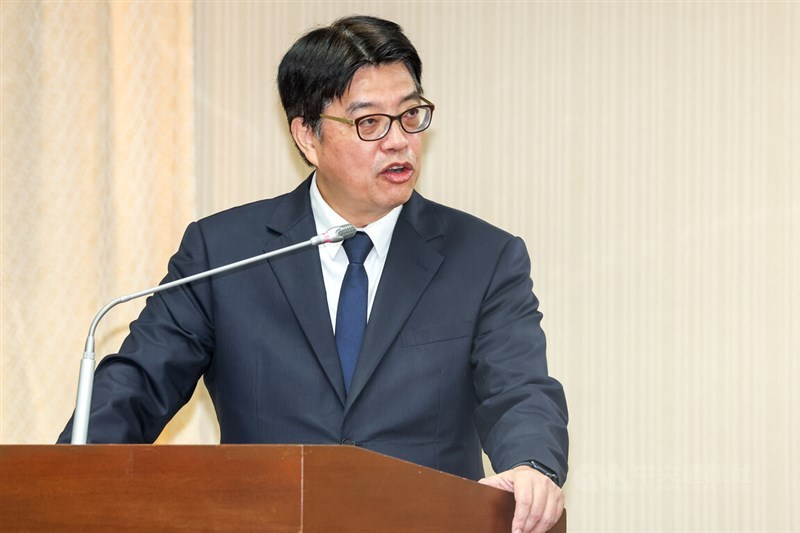
Taipei, March 23 (CNA) Taiwan's top China affairs official on Monday refused to answer questions from China-born Taiwan People's Party (TPP) Legislator Li Chen-hsiu (李貞秀) during a legislative committee session, saying it would be "illegal" to answer someone not legally qualified to hold office.
"If an administrative official responds to questions from someone who is not qualified to serve as a legislator, that would be unconstitutional and illegal," Chiu Chui-cheng (邱垂正), head of Mainland Affairs Council (MAC), said at a meeting of the Legislature's Internal Administration Committee.
Under the Nationality Act, the power to remove a legislator from office rests with the Legislative Yuan. However, Legislative Speaker Han Kuo-yu (韓國瑜) of the KMT has said that Li's legislative status and powers should be respected until the "relevant facts are established" and a "final judicial ruling is made," with no indication that the Legislature plans to remove her from office.
Li is currently not facing legal action for what the government described as illegally sitting in the Legislature and has already taken the oath of office.
Chiu was responding to a joint interpellation by TPP lawmakers Chen Ching-lung (陳清龍), Chen Gau-tzu (陳昭姿) and Li.
Li did not renounce her Chinese household registration "in a timely manner as required by law," and therefore does not meet the eligibility requirements to run for office under the Cross-Strait Act, Chiu said.
He added that Li also failed to fulfill her obligation under the Nationality Act to demonstrate "sole allegiance to the Republic of China (ROC, Taiwan's official name)," referring to Article 20 of the act, which stipulates that ROC nationals with nationalities of another country "shall have no right to hold government offices of the ROC."
Chiu's response came after Li's opening remarks during the joint interpellation -- a relatively rare format in Taiwan's Legislature -- in which she said that neither MAC, the Ministry of the Interior (MOI), nor the Executive Yuan had the authority to determine the status of a legislator.
"If the executive branch overrides the legislative branch, the democratic system will cease to exist," she said.
Li also criticized the Executive Yuan for deciding whether the Legislature could exercise oversight, describing the move as "unprecedented" and a "trampling" of the powers granted to the Legislature by the Constitution.
Following her opening remarks, Li asked Chiu to answer a series of questions, including a request that he read aloud specific articles from the Constitution and its Additional Articles.
Chiu, however, did not respond to Li directly, speaking only after committee convener Liao Hsien-hsiang (廖先翔) of the Kuomintang (KMT) asked him to do so.
Chiu then said he would respond to Liao -- rather than Li -- on questions surrounding her legitimacy as a lawmaker.
A similar pattern continued for the remainder of the joint interpellation; whenever Li asked a question, Liao would repeat it and ask Chiu to respond, and the MAC head would say he was answering Liao.
Monday's exchange was not the first time government officials had refused to answer questions from Li.
At a meeting of the same committee last Monday, Interior Minister Liu Shyh-fang (劉世芳) and other MOI officials did not take the podium despite Li asking Liu at least three times to do so for questioning.
Taiwan's Constitution gives legislators the power to question top government officials. A separate law governing the Legislative Yuan's power also states that officials who are being questioned cannot refuse to answer, withhold information, give false answers, or show contempt toward the Legislature.
- Society
Former, current Taisun executives detained in tainted oil probe
07/25/2026 09:17 PM - Politics
Opposition rallies in Taipei over tainted cooking oil scandal
07/25/2026 08:48 PM - Culture
Foreign applicants for Taiwanese language test hit 5-year high
07/25/2026 06:57 PM - Business
CPC to raise domestic gasoline, diesel prices next week
07/25/2026 05:55 PM - Politics
KMT rallies candidates ahead of 2026 local elections
07/25/2026 04:45 PM