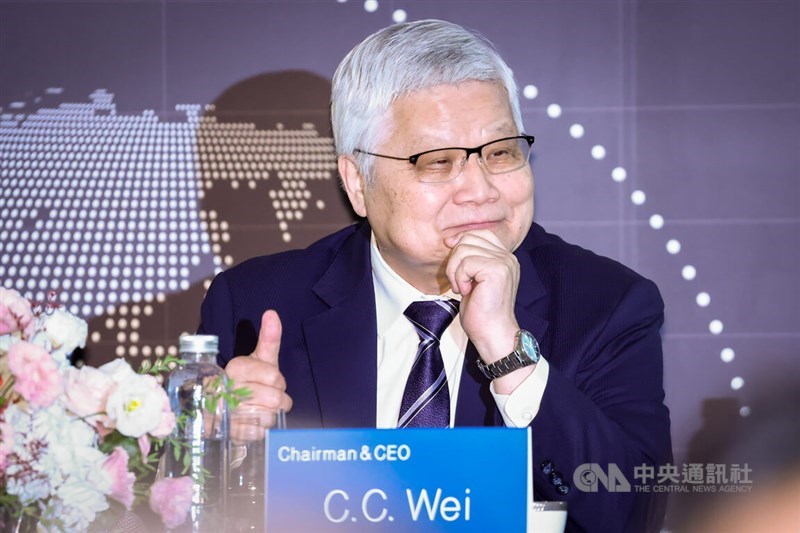
Taipei, Oct. 15 (CNA) Taiwan Semiconductor Manufacturing Co. (TSMC) said Thursday that it has raised its 2026 sales growth forecast to 44 percent in U.S. dollar terms, while leaving its capital expenditure (capex) budget unchanged.
Speaking at an investor conference, TSMC CEO C.C. Wei (魏哲家) said demand for the company's advanced processes is expected to stay strong, driving shipments of chips made using its 2-nanometer process, the most recent technology the chipmaker has put into commercial production.
Wei said TSMC's lead over its peers in leading-edge technology development and strong support from its customers are expected to ensure its performance in 2026.
The 44 percent estimate is an upgrade from the forecast made in July, when Wei predicted sales growth in U.S. dollar terms would be slightly more than 40 percent in 2026.
Before the conference, TSMC released its third-quarter results, reporting record earnings per share of NT$29.43, compared with NT$17.44 a year earlier and NT$27.25 a quarter earlier.
In the third quarter, chips made using the 2nm process accounted for 8 percent of total sales, up from 3 percent in the second quarter.
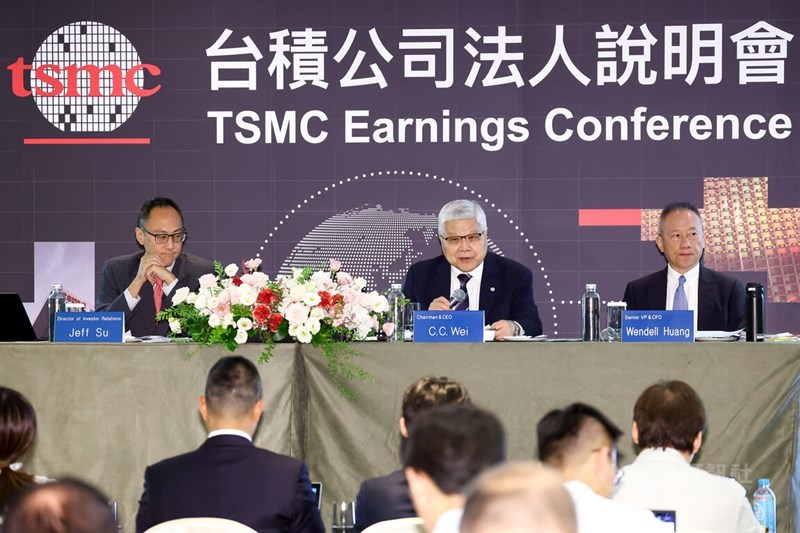
Expressing optimism about the fourth quarter, TSMC Chief Financial Officer Wendell Huang (黃仁昭) said the company expects fourth-quarter revenue of between US$52.3 billion and US$54.3 billion, with the midpoint representing a 58 percent increase from a year earlier and a 14 percent rise from the previous quarter.
Huang said TSMC's gross margin -- the difference between revenue and the cost of goods sold -- is forecast at 65-67 percent in the fourth quarter, compared with 66.4 percent in the third quarter.
Its operating margin -- which also deducts operating expenses -- is estimated at 56.5-58.5 percent in the fourth quarter, compared with 58.7 percent in the third quarter, he said.
Huang said TSMC has kept its 2026 capex budget unchanged at US$60 billion to US$64.0 billion.
The high capex reflects the company's expectations of strong demand from its customers over the next few years, including from emerging agentic artificial intelligence (AI) applications, he said.
TSMC will spend more on capex from 2026 to 2028 than in the previous three years, and spending is expected to keep rising in line with customer demand, Huang said.
● TSMC's Q3 net profit hits new quarterly high
While TSMC will continue to invest, the company will work hard to deliver higher returns to shareholders and pay attractive cash dividends, he added.
Huang said demand for TSMC's Chip-on-Wafer-on-Substrate (CoWoS) packaging technology, which is widely used in AI applications, remained strong.
TSMC will continue to work closely with customers and ensure sufficient CoWoS capacity to meet their demand, Huang said.
Echoing Huang, Wei said CoWoS remained customers' top choice for integrated circuit assembly and that TSMC had a record of satisfactory yield rates for the technology.
- Society
Underground railway set to reshape old Tainan, revive historic station
10/15/2026 05:54 PM - Business
TSMC raises 2026 sales growth forecast to 44%, leaves capex unchanged
10/15/2026 05:17 PM - Society
Taipei hospital highlights long-term medical work in Eswatini
10/15/2026 05:10 PM - Business
U.S. dollar closes sharply higher on Taipei forex market
10/15/2026 04:34 PM - Society
Thai influencer's videos of illegal work lead to 25 arrests
10/15/2026 04:31 PM