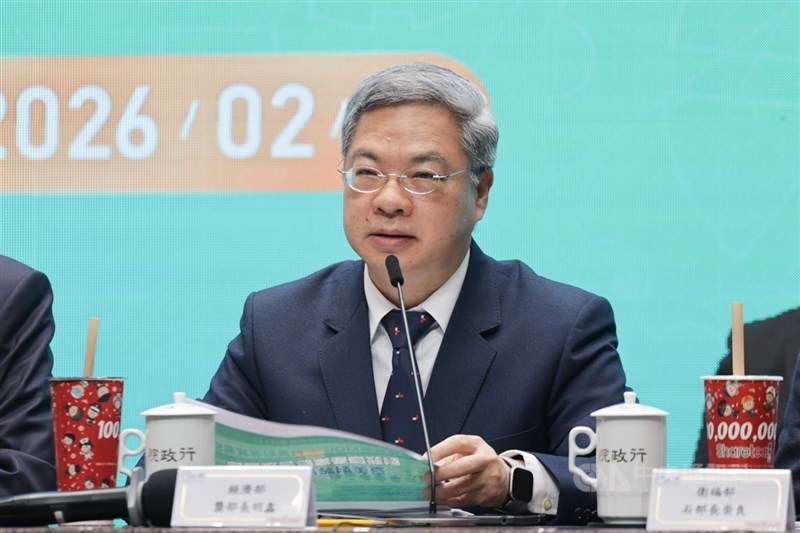
Taipei, Feb. 13 (CNA) Minister of Economic Affairs Kung Ming-hsin (龔明鑫) said Friday that 1,811 Taiwanese industrial products will be exempt from U.S. tariffs under the newly signed Taiwan-U.S. Agreement on Reciprocal Trade (ART), while downplaying concerns that zero tariffs on U.S.-made cars will undermine domestic automakers.
Speaking at a Cabinet press briefing, Kung said the tariff exemptions cover heavy electrical equipment, aircraft components, pharmaceuticals, chemicals and printed materials -- sectors in which Taiwan is highly competitive.
The exempted items account for 36 percent of Taiwan's exports to the United States previously subject to "reciprocal" tariffs, or about US$9.56 billion, and will lower the average tariff rate on affected industrial exports to 12.32 percent, Kung said.
In 2024, Taiwan's industrial exports to the U.S. totaled US$112.87 billion, with 76.3 percent already covered under Section 232 of the Trade Expansion Act of 1962, including semiconductors and their derivatives, auto parts, and steel and aluminum components used in the aerospace industry, he said.
Of the remaining items subject to tariffs, 1,811 products will now be exempt, while 15.2 percent of overall industrial exports will face a flat 15 percent tariff without stacking, Kung said.
On the import side, Taiwan will waive tariffs on 18.3 percent of U.S. industrial products that were not previously duty-free, covering passenger cars and parts, chemicals, machinery, biotech and pharmaceutical products, electronics, metals and minerals -- amounting to about US$6.44 billion in trade value.
The zero-tariff treatment for U.S.-made passenger vehicles has raised concerns that Japanese automakers could shift production to the U.S. and export finished cars to Taiwan, putting pressure on local manufacturers.
Kung said that production costs for entry-level models in Taiwan remain about 10 percent lower than in the U.S.
Even after tariff reductions, the price gap between imported and domestically produced vehicles will likely persist, as most imported cars are positioned in higher-priced segments.
A more plausible scenario, he said, would see automakers import U.S.-made auto parts -- which will also enjoy zero tariffs -- for assembly in Taiwan, rather than moving entire vehicle production abroad.
Some components not currently produced in Taiwan, such as engines previously sourced from Japan, could be imported from the U.S. instead, he said.
Taiwan's complete vehicle industry generates around US$6.36 billion in annual output, while auto parts generate nearly US$9.54 billion, the minister said.
He cited think tanks' assessment that the tariff adjustments could reduce vehicle output value by about US$127 million, saying the government plans to fund industrial upgrading and roll out other measures to mitigate the negative impact on local industries.
- Society
More camellia oil batches fail carcinogen test; sales suspended
07/27/2026 08:57 PM - Politics
Concerns over Chinese sea operations raised with Beijing, Taiwan says
07/27/2026 08:46 PM - Culture
Yu Kan-ping to receive Golden Horse lifetime achievement award
07/27/2026 08:38 PM - Business
Economic monitoring indicators stay red for 7th straight month
07/27/2026 08:18 PM - Society
TFDA releases findings on Central Union cooking oil contamination
07/27/2026 05:59 PM