
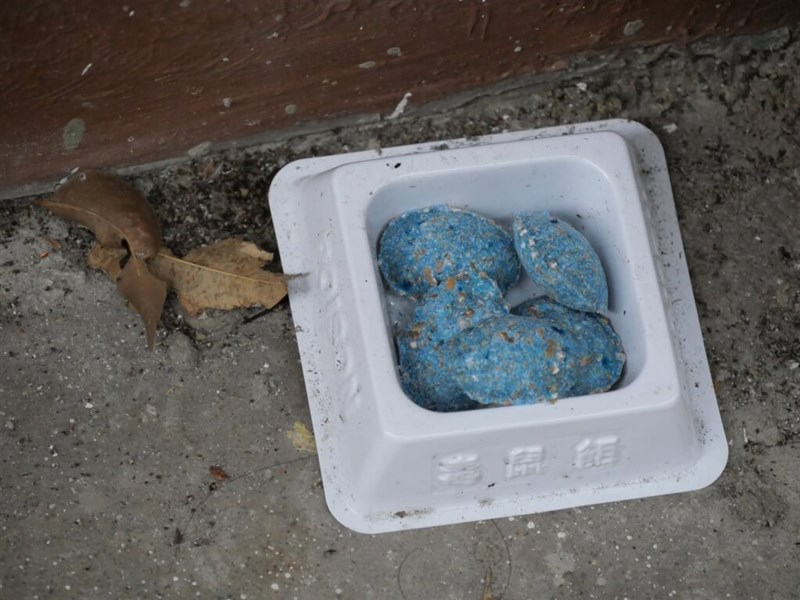
Taipei, May 5 (CNA) Activist groups on Tuesday urged a multipronged approach to curb Taipei's rat population, warning that rodenticide overuse could lead to poison-resistant rats while killing natural predators such as birds of prey.
At a news conference at the Legislature, representatives from Taiwan Walk for Wildlife, the Reptile Conservation Association of Taiwan and the Raptor Research Group called on the Taipei City government to disrupt environments that sustain rodents, rather than relying solely on rodenticide.
The rat issue has become a public concern following social media posts over the past few weeks showing rats running around the streets, prompting the city government to step up its rodent control campaign.
According to the groups, rodenticide use could contaminate the food chain, killing raptors and snakes. The resulting decline in these natural predators, combined with rodents' rapid reproduction, can lead to a surge in the rat population.
Citing data from 2021 to 2024, Raptor Research Group of Taiwan's Tsai Dei-hua (蔡岱樺) said that over 61 percent of examined raptor carcasses showed traces of rodenticides.
Tsai added that in the Taipei and Keelung areas, 92 percent of sampled crested goshawk carcasses tested positive for the chemicals.
Moreover, long-term and widespread use of rodenticides without targeted application may lead rodent populations to develop resistance, Tsai said.
According to Democratic Progressive Party Taipei City Councilor Ho Meng-hua (何孟樺), Taipei still uses the rodenticide bromadiolone, which saw resistance reported within a few years of its 1976 introduction.
"Indiscriminate and widespread use of rodenticides not only risks toxin accumulation in predators, but may also contribute to the emergence of rodent populations with increased resistance -- potentially leading to so-called 'super rats,'" Ho said.
Liu Jhen (劉鎮), a PhD candidate at Academia Sinica's Biodiversity Research Center, said global rodent control trends emphasize source prevention, or improving environmental conditions, over chemical methods.
City government responds
On Monday, Taipei's Environmental Protection Bureau Director Shyu Shyh-shiun (徐世勳) said the city uses rodenticides approved by the central government and follows the Ministry of Environment's guidelines for deployment.
He said that rodenticide is placed in areas where rats are active or may enter buildings, such as warehouse corners, cluttered storage areas, wall crevices, and around burrows.
"The city does not engage in indiscriminate application of rodenticide," Hsu said.
Public health warning
Separately, public health experts also advised against using rodenticide in the home.
In a statement, the Taipei Public Health Specialists Association said that resorting to trapping or poisoning without environmental cleanup will not break the survival chain for rats and may instead increase disease risks, as rats carry zoonotic pathogens.
Rodenticide bait is unsuitable for households because rats may die in hidden places, causing foul odors and allowing fleas and other parasites to spread disease. Residents may not be able to locate the carcasses, National Taiwan University Department of Entomology professor emeritus Hsu Err-lieh (徐爾烈) said.
- Politics
- Society
Scattered showers expected in Greater Taipei, eastern Taiwan Saturday
10/03/2026 10:41 AM - Society
Taiwan headline news
10/03/2026 10:22 AM - Sports
'Hao-yu like that?' A deep dive into Lee's rookie MLB season
10/03/2026 10:00 AM - Sports
Taiwan boosts medal haul in multiple events at Asian Games on Friday
10/02/2026 08:55 PM