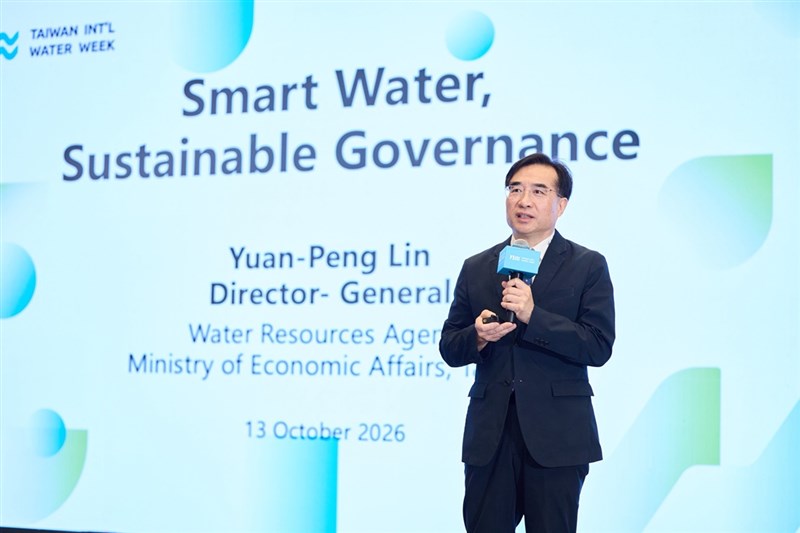
Taipei, Oct. 13 (CNA) Taiwan hopes to complete a network of water supply pipelines within two to three years so water can be shifted between regions during shortages, a senior Water Resources Agency (WRA) official said Tuesday.
Eleven of the 16 pipelines under the Ministry of Economic Affairs' "String of Pearls" initiative have been completed, WRA Director-General Lin Yuan-peng (林元鵬) said at the Taiwan International Water Forum, held as part of the 2026 Taiwan International Water Week.
Completing the remaining five pipes would improve water transfers between northern, central and southern Taiwan. The goal is to give major industrial parks and cities access to two water sources, reducing disruption to households and businesses when one source is constrained, he said.
To reduce reliance on reservoirs, Taiwan has been developing alternative water sources, including artificial lakes, subsurface river water, reclaimed water and desalinated seawater, Lin said.
Authorities will continue tackling leakage, which currently averages about 10 percent nationwide, while requiring businesses to improve water management and conservation, he said.
Dredging, measures to reduce sediment buildup and watershed conservation would help preserve reservoir storage capacity, he added.
Beyond securing supplies, Taiwan faces increasingly extreme weather that is testing its flood preparedness despite years of investment in climate adaptation, Lin said.
He cited the nearly 2,000 millimeters of rain that southwesterly winds brought to Kaohsiung and Pingtung over three days in August, equivalent to about 70 percent of Taiwan's average annual rainfall.
Flood-control measures will include detention basins and flow-control facilities to slow runoff into rivers, along with embankments and improved drainage and pumping capacity, he said.
Artificial intelligence (AI) could help authorities prepare more quickly, Lin said. Rainfall and flood simulations previously could take more than an hour, but faster calculations could identify rivers and drainage areas at risk.
That would help authorities deploy pumps and reallocate emergency resources, with the aim of gaining a critical 30 minutes for preparations, he said.
AI analysis of flooded areas could also aid post-disaster assessments, and cooperation with Google or other app providers could eventually give motorists road flooding information to help them avoid affected routes, Lin said.
Drones, remote monitoring and AI could support reservoir management and post-earthquake inspections, speeding up assessments of facility conditions, he said.
Water management requires coordination across agencies overseeing forests, soil conservation, urban drainage, sewage and river water quality, Lin said.
The government's integrated river basin approach will overlay mapping data to identify problem areas and guide measures incorporated into 10- and 20-year action plans, he said.
Traditional engineering alone is insufficient, Lin said, advocating nature-based solutions and carbon-reduction measures to strengthen flood protection while improving environmental quality.
- Politics
Labor groups urge gov't to raise employer pension contributions
10/13/2026 02:51 PM - Business
Taiwan aims to finish water pipeline network in 2-3 years
10/13/2026 02:02 PM - Business
Starlux Airlines posts almost 70% year-on-year sales growth in September
10/13/2026 01:58 PM - Business
Taiwan shares close down 1.95%
10/13/2026 01:49 PM - Society
Taipei man's life sentence for stabbing ex-girlfriend to death upheld
10/13/2026 01:35 PM