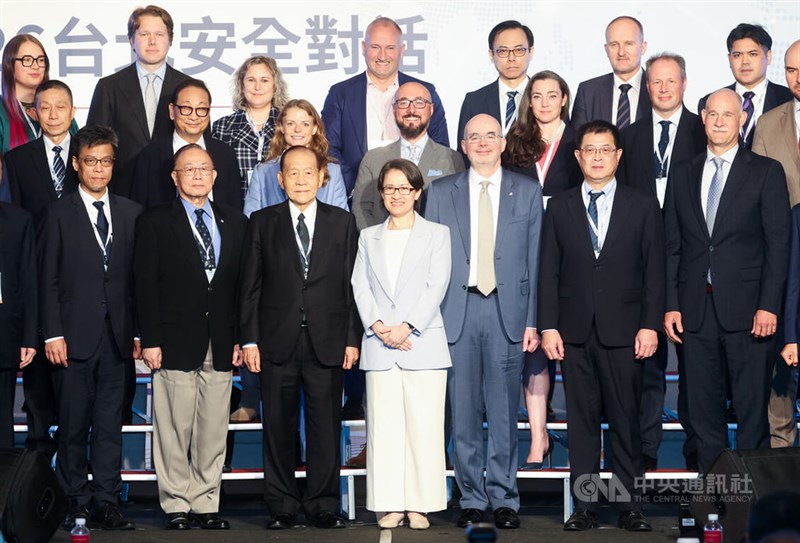
Taipei, Sept. 9 (CNA) Taiwan's growing defense preparations may be sending a stronger signal to the United States than to Beijing, highlighting Taipei's need to tailor its deterrence efforts to different audiences, an American security scholar said Wednesday.
Oriana Skylar Mastro, a center fellow at Stanford University's Freeman Spogli Institute for International Studies, made the assessment during a Taipei Security Dialogue panel examining lessons Taiwan could draw from the wars in Ukraine and the Middle East.
● Economic impact of Taiwan Strait conflict could exceed WWII's: AIT chief
Mastro said she was impressed during a recent visit by Taiwan's increased defense spending, emphasis on asymmetric capabilities, and efforts to prepare society for conflict, but she questioned whom those initiatives were influencing.
When she asked senior Chinese figures and analysts whether Taiwan's improving capabilities were making Beijing more cautious, Mastro said their responses generally amounted to: "We don't really know. We're not paying attention to that. That's not the point."
That led her to conclude that although Taiwan's efforts contributed to deterrence, "the audience is the United States."
Taiwan's message that it is doing more for its defense, particularly its ability to defend itself without outside intervention, is largely directed at Washington, Mastro said.
She called that an appropriate strategy because it reassured Washington of Taiwan's determination to defend itself, but said Taipei needed a separate approach to ensure that its capabilities also affected Beijing's calculations.
"There's no situation under which Taiwan can defend itself without direct U.S. military intervention," Mastro asserted, noting that the views were her own and did not represent the U.S. government's stance.
Given this situation, Taiwan should communicate its newly acquired capabilities more effectively to Beijing so that its defense investments can both strengthen relations with Washington and deter China, she contended.
Chen Ping-Kuei (陳秉逵), a professor in National Chengchi University's Department of Diplomacy, seemed to agree with Mastro, saying Taiwan's public appeared to believe the country's defense efforts had sent a clearer signal to Washington than to Beijing.
"I think the public believes that we have sent an effective signal to the U.S. However, we haven't sent a very effective deterrent signal to Beijing," Chen said.
He also described U.S. arms sales to Taiwan as an important signal of Washington's commitment, arguing that their political significance could be more important than the size of individual packages.
If Washington were to begin discussing proposed arms sales packages for Taiwan with Beijing, it would send "a very, very bad signal" to Taipei, Chen said.
He was referring to concerns raised after Trump confirmed speaking about arms sales to Taiwan with Chinese President Xi Jinping when they met in Beijing in mid-May.
That violated a key tenet of the "Six Assurances" made to Taiwan by the Ronald Reagan administration in 1982 -- that the U.S. would not consult China on arms sales to Taiwan.
Trump seemed to brush aside such a pledge. "What am I going to say? I don't want to talk to you about it because I have an agreement that was signed in 1982?" he said after the meeting.
Beyond military capabilities and signaling, Taiwan must prepare to remain functional if China seeks to isolate it, according to Wolfgang Müller, a senior research fellow at the German Institute for Defence and Strategic Studies.
Isolation would not necessarily require a formal blockade, Müller said, because heightened risk alone could alter the behavior of shipping companies, insurers, suppliers and maintenance providers.
"Do not ask only how China would invade Taiwan. Ask also how China could make an invasion unnecessary," he said.
Rather than pursuing complete self-sufficiency, Taiwan should measure how long essential services could continue operating if normal external supplies were interrupted, Müller said.
He also urged Taiwan to identify bottlenecks linking infrastructure systems and pre-position critical items that could be difficult to obtain during a crisis, including transformers, medicine, chemicals, communications equipment and machine parts.
"Taiwan cannot make its critical infrastructure invulnerable, but it can make failure more temporary," Müller said. "Recovery capacity is combat power."
- Society
Taiwan headline news
09/30/2026 10:14 AM - Business
U.S. dollar up in Taipei trading
09/30/2026 10:12 AM - Business
Taiwan shares open higher
09/30/2026 09:09 AM - Business
Amazon taking part in Taiwan PCB maker's private placement
09/29/2026 09:06 PM - Sports
Taiwan snatches 2 more silvers in shooting, Kurash at Asian Games
09/29/2026 08:42 PM