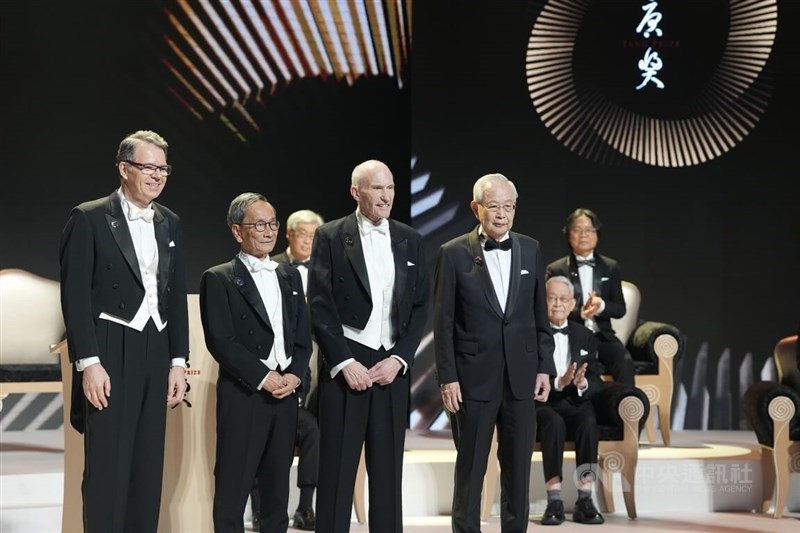
Taipei, Sept. 18 (CNA) The six recipients of the seventh Tang Prize were honored at a ceremony in Taipei on Friday, ahead of a full day of lectures on Saturday featuring their award-winning work.
Five of the six laureates attended the ceremony at the Taipei Performing Arts Center to receive their awards in person. Steven A. Rosenberg, one of three recipients in the biopharmaceutical science category, was unable to travel to Taiwan, according to the Tang Prize Foundation.
During the ceremony, Tang Prize Selection Committee convener Wong Chi-huey (翁啟惠), a former president of Academia Sinica, and the chairs of the four category selection panels introduced the laureates and outlined their major contributions.
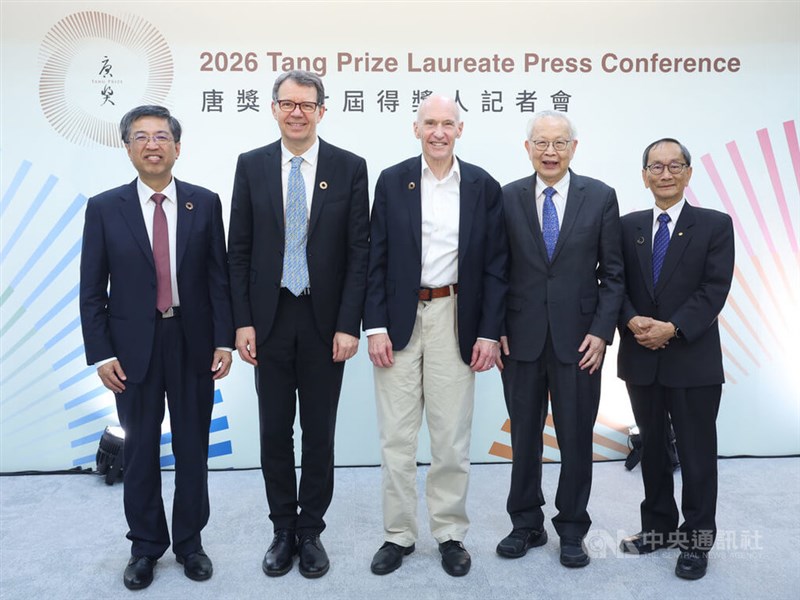
The six recipients were announced by the prize's selection committees in mid-June.
They are scheduled to deliver lectures at the Taipei Bioinnovation Park throughout Saturday, discussing the research and ideas they have developed over their careers.
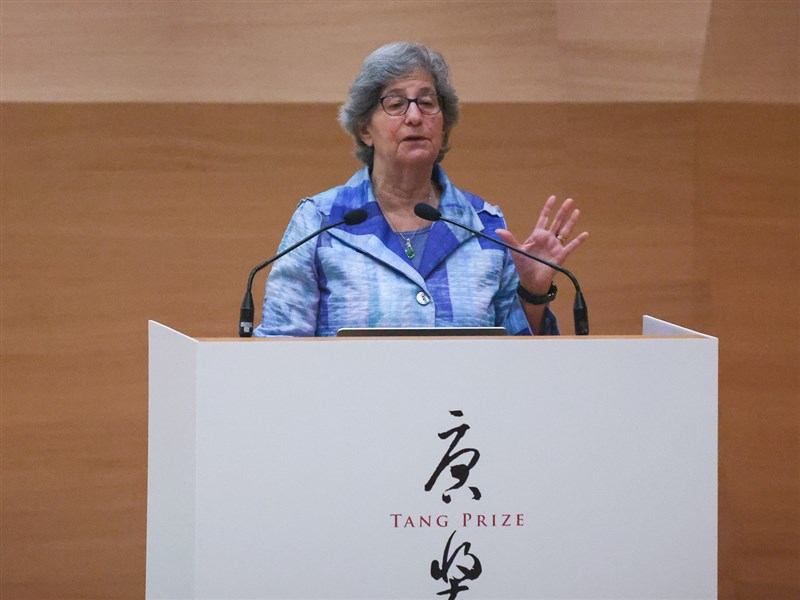
American atmospheric chemist Susan Solomon received the Tang Prize in Sustainable Development for research that helped establish chlorofluorocarbons, or CFCs, as the primary cause of the expanding hole in the ozone layer over Antarctica.
Her work explained the chemical reactions behind ozone depletion and provided a scientific basis for global efforts to phase out CFCs under the Montreal Protocol.
At Friday’s ceremony, Solomon compared the scale of today’s global environmental challenges to that of reaching the moon and urged humanity to protect rather than damage the planet. Despite resistance to environmental progress, she remained confident that opportunities for improvement would return.
The Tang Prize in Biopharmaceutical Science was jointly awarded to Rosenberg, Michel Sadelain and Carl H. June for developing cancer treatments that harness patients’ own immune cells.
Their work on tumor-infiltrating lymphocyte and chimeric antigen receptor T-cell therapies helped pioneer “living drugs,” in which immune cells are collected, enhanced or genetically modified, and returned to patients to attack cancer.
The three laureates also credited the colleagues, patients and families who helped turn an initially speculative idea into viable treatments. Sadelain thanked colleagues who risked their careers when the work still resembled science fiction, while June emphasized that therapies must reach patients if they are to change lives.
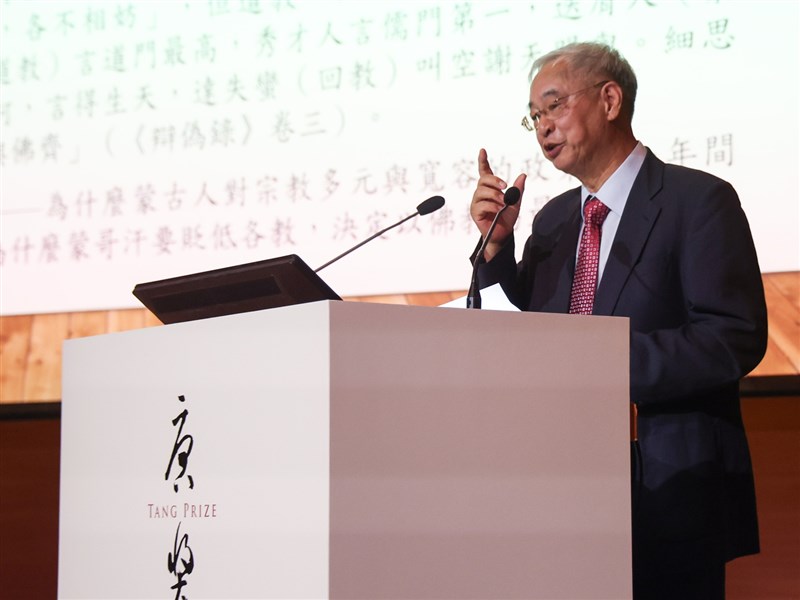
Chinese historian Ge Zhaoguang (葛兆光) received the Tang Prize in Sinology for his research on Chinese intellectual, cultural and religious history.
His influential studies exploring the question “What is China?” have challenged conventional historical perspectives and introduced new approaches to the study of China.
Looking to the future of sinology, Ge called for a more open and diverse field that situates China within broader Asian and global contexts and engages more deeply with Indian, Japanese, Persian and Egyptian studies.
Yale University constitutional scholar Bruce Ackerman received the Tang Prize in Rule of Law for his work on constitutional government, judicial review and democratic institutions.
His ideas include “dualist democracy,” which distinguishes routine government decision-making from rare periods of broad public mobilization that bring about fundamental constitutional change.
Ackerman argued that democratic renewal should begin by giving young children room to explore possibilities and develop independent judgment, rather than simply training them to obey and perform well on examinations.
The Tang Prize is a biennial award established in 2012 by Taiwanese entrepreneur Samuel Yin (尹衍樑) to recognize significant contributions in four fields: sustainable development, biopharmaceutical science, sinology and rule of law.
![U.S. research funding cuts hurt scientific progress: Tang Prize laureates]() U.S. research funding cuts hurt scientific progress: Tang Prize laureatesThe 2026 Tang Prize laureates in Biopharmaceutical Science warned Saturday that cuts to U.S. government research funding could slow scientific progress and reduce opportunities for young researchers, with potentially long-term consequences for the scientific workforce.09/19/2026 07:39 PM
U.S. research funding cuts hurt scientific progress: Tang Prize laureatesThe 2026 Tang Prize laureates in Biopharmaceutical Science warned Saturday that cuts to U.S. government research funding could slow scientific progress and reduce opportunities for young researchers, with potentially long-term consequences for the scientific workforce.09/19/2026 07:39 PM![Find pivotal moments that shape history: Tang Prize Sinology laureate]() Find pivotal moments that shape history: Tang Prize Sinology laureateGe Zhaoguang (葛兆光) used his platform as the 2026 Tang Prize laureate in Sinology on Saturday to encourage historians to broaden their perspective and focus on identifying pivotal moments that shape history's course.09/19/2026 07:02 PM
Find pivotal moments that shape history: Tang Prize Sinology laureateGe Zhaoguang (葛兆光) used his platform as the 2026 Tang Prize laureate in Sinology on Saturday to encourage historians to broaden their perspective and focus on identifying pivotal moments that shape history's course.09/19/2026 07:02 PM![Ozone recovery a rare success story: Tang Prize laureate Susan Solomon]() Ozone recovery a rare success story: Tang Prize laureate Susan SolomonThe recovery of the Antarctic ozone layer represents a rare example of science and international policy successfully addressing a global environmental threat, said Susan Solomon, whose research on chlorofluorocarbons (CFCs) earned her the 2026 Tang Prize in Sustainable Development.09/19/2026 05:25 PM
Ozone recovery a rare success story: Tang Prize laureate Susan SolomonThe recovery of the Antarctic ozone layer represents a rare example of science and international policy successfully addressing a global environmental threat, said Susan Solomon, whose research on chlorofluorocarbons (CFCs) earned her the 2026 Tang Prize in Sustainable Development.09/19/2026 05:25 PM
- Politics
Taiwan needs a 'chain of guardian mountains' across industries: Lai
10/10/2026 01:19 PM - Business
New ECCT chair urges greater agility in Taiwan's software, energy sectors
10/10/2026 12:36 PM - Culture
BigBang throws concert in Taipei; Jay Chou shares photos with group
10/10/2026 11:50 AM - Politics
Full text of President Lai Ching-te's National Day address
10/10/2026 11:10 AM - Society
Taiwan headline news
10/10/2026 10:08 AM