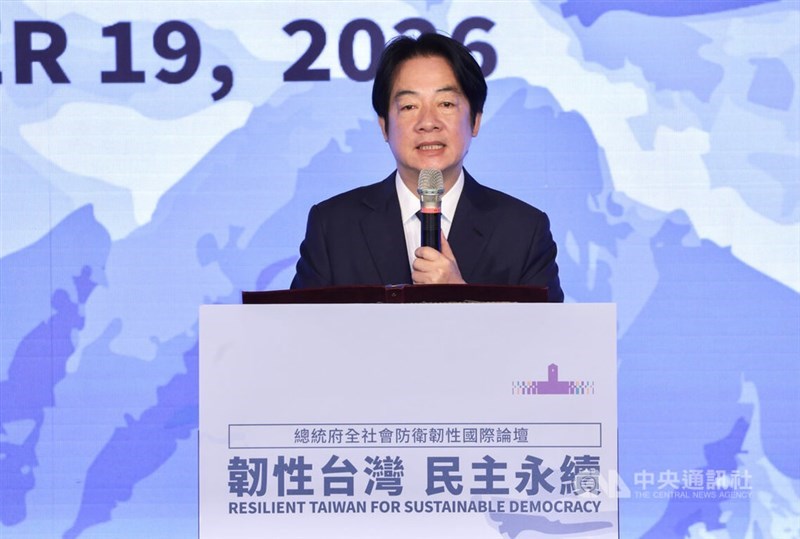
Taipei, Sept. 19 (CNA) President Lai Ching-te (賴清德) on Saturday announced the establishment of the World Alliance for Disaster Management (WADM) at a forum in Taipei, saying it would strengthen disaster preparedness and response through international cooperation.
The alliance's founding members are Taiwan, 11 of its diplomatic allies and Somaliland. Another 21 countries, including the United States, Japan, the United Kingdom, Germany, the Netherlands, Poland, Türkiye and the Philippines, are participating as observers or partners.
According to the Presidential Office, the WADM will promote joint training and exercises, mutual assistance and information sharing, with the aim of making Taiwan a cross-border hub for disaster prevention and response coordination.
Addressing the opening of the 2026 Resilient Taiwan for Sustainable Democracy International Forum, Lai said the alliance's establishment marked "a major breakthrough for Taiwan in over half a century of efforts to take part in international organizations."
Lai said Taiwan would work with international partners to coordinate early warning, disaster response and post-disaster recovery through joint training and shared standards.
He pointed to the fire and rescue training center in Zhushan Township, Nantou County, which he described as the largest in Asia and the third largest in the world.
Taiwan hoped such cooperation would establish a common professional language and strengthen the participating countries' ability to respond to disasters together, Lai said.
Lai noted he established the Office of the President Whole-of-Society Defense Resilience Committee two years ago to strengthen societal resilience through public-private cooperation and joint efforts involving industry, government, academia, research institutions and civil society.
"From the beginning, we have sought to gain international insights on everything from major global events to advanced models for societal resilience in other countries," Lai said.
"After two years of preparations, we are confident that the current Taiwan model has something to offer the international community, and can serve as a basis for other nations working to boost their own preparedness," he added.
Turning to security, Lai said that amid a rapidly changing international political landscape and growing threats from China, his responsibility as president was to ensure Taiwan was better prepared to maintain the status quo and prevent peace from being undermined by unilateral provocations.
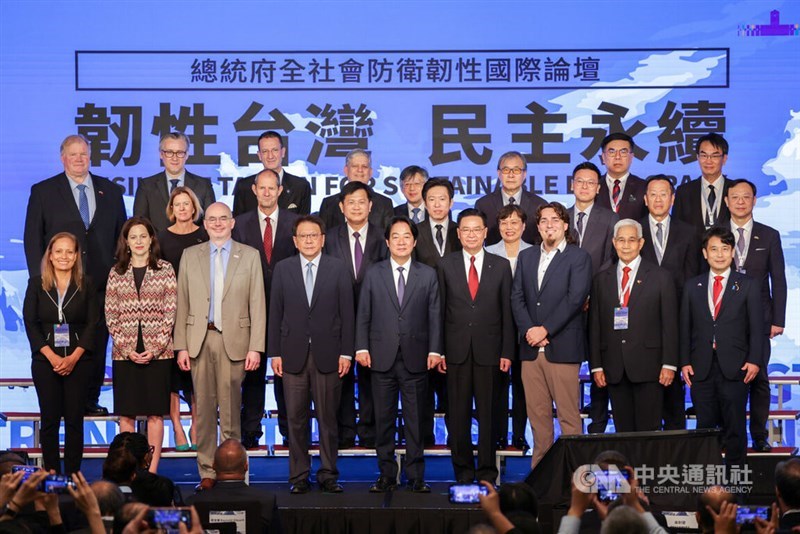
"When authoritarian actors seek to spread fear, democratic societies must spread confidence through resilience," Lai said. "And when authoritarian forces try to create disunity, that is all the more reason for democratic partners to join hands and cooperate."
Lai also thanked foreign guests attending the forum, including Anduril Industries founder Palmer Luckey, Japanese Sen. Takinami Hirofumi, former Philippine National Security Adviser Hermogenes Esperon, and former U.S. deputy national security advisers Matt Pottinger and Anne Neuberger.
In his keynote speech, Luckey said he believed freedom was Taiwan's most powerful weapon.
Luckey said China could steal technologies from the United States, but "what they can't copy is a country where people are free to improvise, experiment, to act without permission, and come up with a lot of this technology in the first place."
"I think that I've been able to do very well because in America, I had those freedoms, because I had those advantages. I think that Taiwan already has a system that supports those same advantages," Luckey said.
- Culture
Czech, Taiwanese writers explore democracy, history at Frankfurt Book Fair
10/09/2026 07:00 PM - Society
China Youth Corps' designation as KMT-affiliated organization upheld
10/09/2026 06:09 PM - Politics
Ex-President Tsai says threats won't shake Taiwan's resolve
10/09/2026 03:57 PM - Politics
Lai seeks deeper cooperation with Eswatini as king visits Taiwan
10/09/2026 02:49 PM - Culture
Taiwanese show wins best series at Seoul Int'l Drama Awards
10/09/2026 02:24 PM