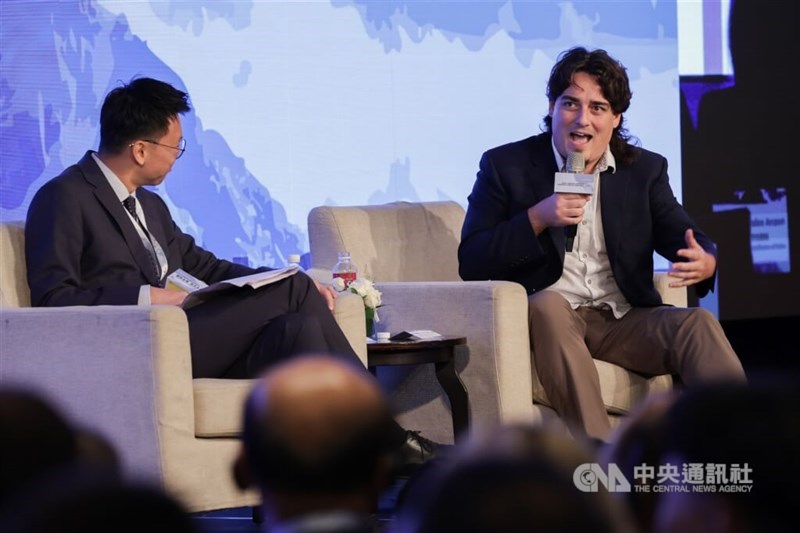
Taipei, Sept. 19 (CNA) Anduril Industries founder Palmer Luckey urged Taiwan on Saturday to expand weapons production for export and ease regulatory barriers, saying overseas demand could help sustain the local defense industry needed for long-term deterrence.
If Taiwan eased restrictions, it could become "the largest firearms accessories manufacturing base in the whole world," Luckey said in a joint interview with three media outlets including CNA, following his keynote speech at an international forum.
Citing Taiwan's globally dominant airsoft sector, Luckey said he had encouraged local firms to adapt their accessories for use with real firearms.
However, many manufacturers told him that regulatory hurdles made the transition slow and expensive, underscoring the need for better export rules to capitalize on Taiwan's industrial edge, he said.
■ Anduril founder says he discussed Taiwan arms sale with Trump
Luckey was responding to a question about prospects for U.S. companies to co‑produce defense products with Taiwanese partners, given Anduril's experience working with Taiwan's defense industry and government.
Although Anduril does not operate a factory in Taiwan, it works with numerous Taiwanese vendors that mass‑produce components for its products, including composite and metal parts and sensor gimbals, Luckey said. Many of those products are not intended for use in Taiwan.
Luckey said Taiwan needs to design and manufacture its own weapon systems at scale, even though arrangements such as "designed in the U.S., made in Taiwan" or "designed collaboratively and made in Taiwan" would better align with his business interests.
He made similar arguments in his keynote speech, urging Taiwan to use its existing industrial strengths to design and mass‑produce weapon systems and turn its manufacturing expertise into defense capabilities that could sustain long-term deterrence.
"Don't just sell airsoft guns. Make real guns," Luckey told the second Resilient Taiwan for Sustainable Democracy International Forum, hosted by the Presidential Office, drawing applause from the audience.
He cited Taiwan Semiconductor Manufacturing Co. (TSMC), the world's largest contract chipmaker, as an example of the role Taiwan could play in defense exports.
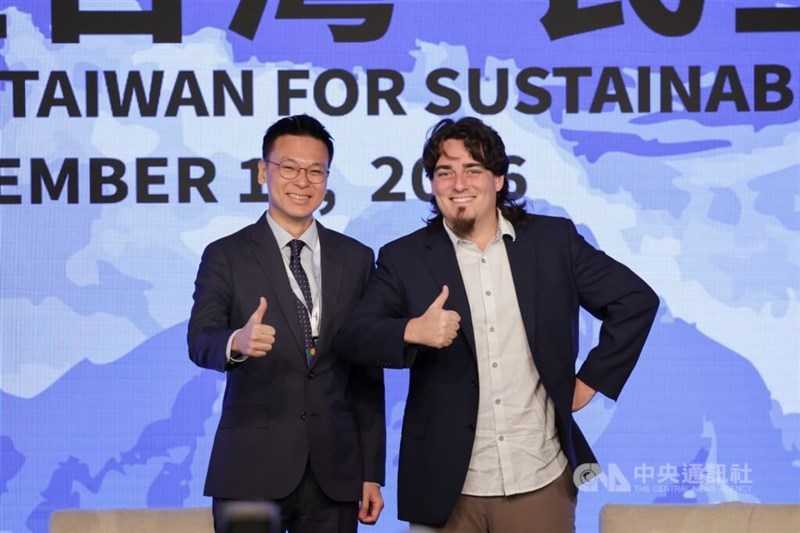
"Sell them to the countries that share Taiwan's commitment to freedom and make those countries depend on you for advanced capabilities the way the world already depends on TSMC for commercial capabilities," Luckey continued.
He said Taiwan already had many of the technologies it needed to withstand adversaries, drawing on its strengths in the consumer, industrial and enterprise sectors.
"It just needs to apply them to the defense space," said Luckey.
Luckey warned that democracies often wait until threats become undeniable, only to discover that factories and skilled workers cannot be created on demand.
He urged Taiwan to make production lines increasingly adaptable to weapons manufacturing at volumes in the millions rather than thousands to build lasting industrial resilience and credible deterrence.
During a subsequent talk with National Security Council Deputy Secretary‑General Lin Fei‑fan (林飛帆), Lin asked how Taiwan could establish itself as a credible defense supplier, citing doubts about its reliability under threat from China.
Luckey expressed confidence that Taiwan could be a trusted defense partner, pointing to its capabilities in semiconductors, machine tools, precision components and advanced composites, as well as its broader industrial base.
He warned, however, that Taiwan's domestic demand alone would not be enough to sustain the industrial base needed to achieve what he described as an unstoppable level of deterrence.
Taiwan should build for export from the outset, serving global partners as well as meeting its national defense needs, he said.
"The goal should be for everyone in the world, whether they're buying from you or just afraid of you, to see a label that says 'designed in Taiwan, made in Taiwan' on a weapons system, and immediately understand what it means," he said.
- Sports
Taiwan's Chen Yi-fan wins artistic skating gold at World Skate Games
10/09/2026 07:21 PM - Politics
Lai's National Day address to focus on Taiwan's economy, global role
10/09/2026 07:07 PM - Politics
Japanese lawmakers visit Taiwan for National Day celebrations
10/09/2026 07:02 PM - Culture
Czech, Taiwanese writers explore democracy, history at Frankfurt Book Fair
10/09/2026 07:00 PM - Society
China Youth Corps' designation as KMT-affiliated organization upheld
10/09/2026 06:09 PM