Taipei, June 14 (CNA) Taiwan's Ministry of Agriculture (MOA) warned Sunday that China is not a stable or reliable export market, after Beijing announced plans to purchase Taiwanese agricultural and fishery products during a cross-Taiwan Strait forum in Xiamen a day earlier.
As part of measures Beijing unveiled in April, mainland enterprises signed procurement agreements with Taiwanese businesses and trade associations on the sidelines of the annual Straits Forum in Xiamen on Saturday.
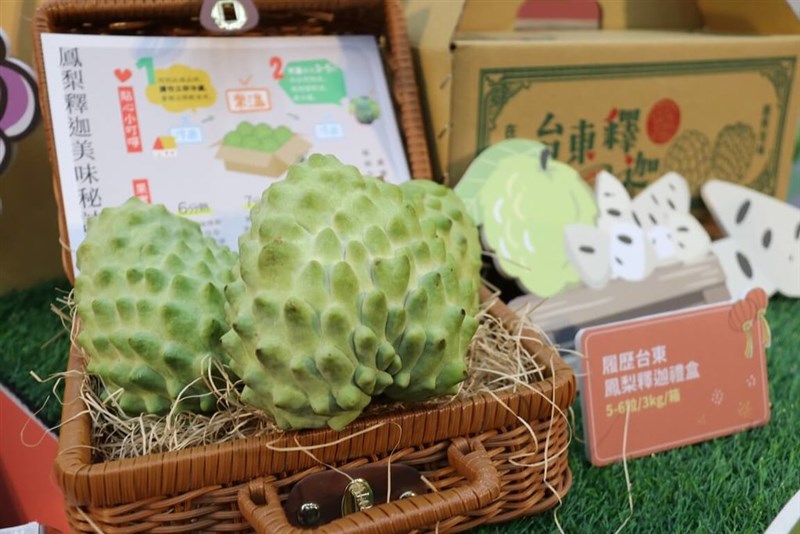
The agreements cover purchases of Taiwanese agricultural and fishery products, including atemoyas (similar to sugar apples), pomelos, tea and grouper, but no figures were given on the values of the deals.
Though the MOA did not say in its statement it would block the deals, it frowned on the pledges, saying that Taiwan's agricultural exports require diversified markets with stable demand that respect international trade rules and scientific standards.
It said Taiwan has previously relied heavily on the Chinese market, but Beijing has repeatedly suspended imports of Taiwanese agricultural products in recent years without justification.
Beijing has also refused to hold scientific consultations with Taiwan and attached political conditions to the resumption of imports, it said.
At the same time, the ministry accused China of using an approval system as a de facto form of restricting imports, referring to a 2022 Chinese regulation requiring overseas food producers to obtain prior approval before their products can enter the Chinese market.
According to the MOA statement, Taiwan has submitted a list of qualified exporters through the formal mechanism established under a cross-Taiwan Strait agricultural quarantine cooperation agreement, but Beijing has yet to provide a formal response.
Instead, it has selectively approved some Taiwanese companies without explanation, which was a type of arbitrary import barrier, the MOA said.
Given such uncertainty, China cannot be regarded as a stable overseas market on which Taiwan can rely over the long term, the ministry said.
The MOA urged Beijing to resume quarantine consultations and restore imports of Taiwanese agricultural products based on scientific principles, and it also pledged to continue farmers strengthen supply chains and expand into premium overseas markets.
It said Taiwan has made progress in diversifying export destinations in recent years, citing new market access for pineapples to Australia and New Zealand, and red-fleshed dragon fruit and hybrid grouper to Japan.
It also cited pomelos to Malaysia, pork products to the Philippines and Singapore, and guavas, mangoes, dragon fruit and lychees to the European Union.
The MOA's concerns over China's unreliability as a market are founded on experience, as seen through the example of fruit exports.
According to foreign trade statistics, Taiwan's exports of various types of fresh fruit to China and Hong Kong totaled about US$30.49 million in 2024 then plummeted to US$14.62 million in 2025.
That number has rebounded to US$13.15 million in the first five months of 2026, up 33 percent year-over-year, International Trade Administration statistics showed.
In contrast, fresh fruit exports to Japan have remained steady at US$29.7 million in 2023, US$33.3 million in 2024 and US$29.74 million in 2025, and exports in the first five months of 2026 of US$20.08 million were about the same as for the same period a year earlier.
For Taiwanese farmers, however, China's market remains tempting. In those same fresh fruit categories, Taiwan exported around US$370 million in fresh fruit to Hong Kong and China from 2020 to May 2026, about 56 percent of the total during that period.
Exports to Japan totaled US$199.4 million during that time, government statistics showed.
Though the government has talked about diversifying markets, whether to Southeast Asia or North America, getting those markets to fully fill gaps created by problems in the China market will be difficult.
- Sports
Taiwanese men's, women's doubles pairs lose in BWF Arctic Open finals
10/12/2026 08:48 PM - Business
Nanya Technology expects DRAM prices, margins to rise in Q4
10/12/2026 08:47 PM - Politics
Kaohsiung mayoral candidates outline AI industry development plans
10/12/2026 08:24 PM - Society
Victim's nephew arrested in fatal Xinzhuang stabbing
10/12/2026 08:17 PM - Politics
Taiwan condemns China over sanctions on ministers of diplomatic allies
10/12/2026 07:44 PM