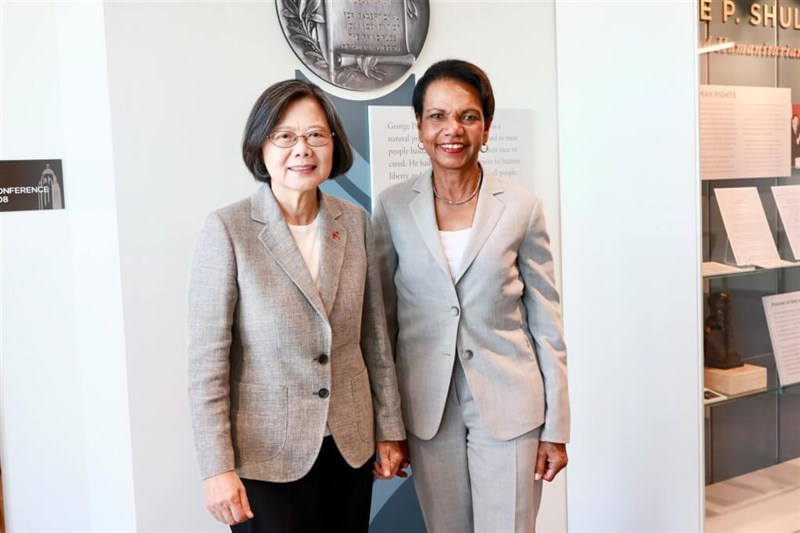
San Francisco, Oct. 9 (CNA) Former President Tsai Ing-wen (蔡英文) said Thursday that no threats or coercion would shake Taiwan's determination to engage with and contribute to the world, at a forum hosted by Stanford University's Hoover Institution.
In her remarks, Tsai spoke about how Taiwan has managed differences, responded to crises and built societal resilience.
Discussions about Taiwan often focus on semiconductors, artificial intelligence (AI), cross-strait relations and the risk of conflict, and occasionally touch on its popular food and drinks, she said.
But those topics are only part of the story, Tsai said, pointing to Taiwan's 23 million people and their experience of building a democracy under challenging circumstances.
"That experience has shaped who we are and continues to shape how we approach the future," she said.
AI-driven disinformation, threats to democracy
Tsai said democracies face growing challenges from both outside and within, as increasingly sophisticated authoritarian influence campaigns coincide with domestic populism and political polarization.
Those domestic divisions make it harder to reach a consensus on how to respond to outside threats, she said.
Tsai also warned that advances in AI have lowered language barriers, making it easier to spread disinformation across borders.
"Ill-intentioned actors, especially from outside, use social media platforms to spread false and misleading information to drive a wedge between fellow citizens, between societies and their governments, and even between countries," she said.
However, decades of external pressure and intense domestic political competition have taught Taiwan how to safeguard democracy while keeping its institutions open and its society resilient, Tsai said.
Tsai said Taiwan moved from authoritarian rule to its first direct presidential election in 1996 and eventually became the vibrant democracy it is today.
"That transition taught us how to confront deep political differences without allowing those differences to make democratic progress impossible," she said.
Maintaining the status quo
Tsai said managing relations with China has required both preparedness and restraint, adding that decades of pressure from Beijing have made Taiwan more resilient and pragmatic.
Although people in Taiwan hold differing views on what form future relations with China should take, there is a consensus on maintaining the cross-strait status quo, avoiding unnecessary provocation and protecting Taiwan's democracy and security, she said.
"Democracy, resilience and partnership are the foundation of our collective future," Tsai said, adding that no amount of threat or coercion would shake Taiwan's determination to engage with and contribute to the world.
Tsai served as Taiwan's first female president between 2016 and 2024.
She arrived in the United States Monday, local time, and is scheduled to return to Taiwan Sunday, Taiwan time.
- Politics
Ex-President Tsai says threats won't shake Taiwan's resolve
10/09/2026 03:57 PM - Politics
Lai seeks deeper cooperation with Eswatini as king visits Taiwan
10/09/2026 02:49 PM - Culture
Taiwanese show wins best series at Seoul Int'l Drama Awards
10/09/2026 02:24 PM - Society
Hualien man sentenced to death over murder, sexual assault of teacher
10/09/2026 02:15 PM - Politics
U.S. urges China to stop pressure on Taiwan after militia vessel spotted
10/09/2026 12:03 PM